May 24, 2013, 05:18:51 PM

Show Posts

This section allows you to view all posts made by this member. Note that you can only see posts made in areas you currently have access to.


Messages - tpatana

Pages: [1] 2 3 ... 6
1
Best would be if they had couple custom metering settings, where (advanced) user could input they own formula how to calculate the exposure based on the information coming from the metering system.

2
Does spot metering only use the center circle area?

3
Hello everyone, fisrt time poster here.
The phenomenon described by the OP is related to the strong metering bias that the 5DmkIII has on the selected AF point in evaluative metering.
This is the first thing I noticed coming from a 40D, and is my main complain about 5DmkIII metering algorithm.
When I shoot at night in urban environment, I always switch from evaluative to mean to avoid any strange behaviour of the camera.
In AF mode the level of brightness of the portion of the scene that is caught in the selected AF point area determines the bias in the exposure value.
When "all points" is selected, or when MF selected, this doesn't happen because the camera has no clue about what AF point will be actually used to focus.
This happens on every lens, and is not a flaw in the body, but a choice of the designers of the evaluative metering algorithm that I personally don't like at all.
I'll provide evidence later.
Bye for now.

Update: see the 4 pics attached, made with 135 f/2 L
the AF point is on the light on ceiling, iso is 320 fixed, aperture f/2.0 fixed
pic 1 has AF + eval metering, resulting in 1/4000 sec (strong bias on the AF point, it results effectively in a spot metering on the AF point)
pic 2 has MF + eval metering, resulting in 1/160 sec (the camera has no clue about the AF point in use, and provides a "true" unbiased evaluative metering)
pic 3 has AF + mean metering, resulting in 1/160 sec (no bias on mean metering)
pic 4 has MF + mean metering, resulting in 1/160 sec
As you see, in the case AF + evaluative metering the camera attemped not to clip the area of the picture on the selected AF point, thus rendering every other area of the image absolutely meaningless.
The amount of shift in this case is almost 5 stops!
If I were the designer of this feature, I would let the user to activare or deactivate it, or at least provide a "cap" on the maximum amount of correction allowable, say max 2 stops of bias.
Having it permanently operating as it is, without reasonable cap, means that you have a spot metering on whatever AF point is selected, and this is pretty disturbing to me in certain circumstances.
What do you think about it?

Knowing that, you can also use it to your advantage. E.g. if you know you want bright sign to be exposured correctly, use focus points on that one, and also if you want ambient proper but focus, you can e.g. exposure lock somewhere else and re-compose.

So I don't see that as a disadvantage, after knowing how it works. Not sure if that was mentioned in the manual though.

Also for the OP, I wish I had that much confidence on my skills and gear that I don't chimp the histogram every few picture. If it took you after the shooting to notice over-exposure, maybe next time you should chimp some too?

4
Ok, confirmed.

You get the problem if you don't have all AF points selected, and if you select all AF, then the problem goes away.

So depending on AF/MF and AF method/selection, the evaluation formula based on the measurement data is changed. MF will make it back to same formula as with all AF points.

5
Also, I can confirm it happens also with my 70-200. I'm guessing the OP just happened to use 24L so that the AFS and MFS were hitting suitable spots to see the problem.

So it's camera body problem, not lens problem. Something changes on the evaluation based on AF/MF. That is strange indeed. I wonder if Canon knows about that.

Maybe I should conduct more tests...

6
Ok, I did plenty more testing, and now I have theory!

It seems I can find "spots" where it doesn't happen, and then other spots it does (see my post below telling it changed when I moved the camera).

I was able to find spot where the difference was full 1/1 stop. And I was able to find spot where it's exactly same. The "same" happened when the lighting of the area was quite uniform, and the 1/1 stop happened when there were big light differences (shade and sunny spot) in the frame.

Also, I was able to find spots where AF SS was slower, and where MF SS was slower.

So my theory: some reason it uses different spot/area for the evaluation when AF/MF is selected. Let's call them AFS and MFS to help explain. So if AFS hits bright area while MFS hits shaded, it will give MF longer shutter speed. If AFS is on the shade, it'll give longer shutter for AF.

If AFS and MFS areas are similarly illuminated, you don't get difference.

7
More testing, this is getting strange.

I took a lens-cap to cover VF, and it didn't change between AF/MF. Then I removed the lens cap, and still no change. And I'm sure it happened before.

So I turned my camera slightly to take different picture (with different exposure), and the problem came back. I put the lens cap back on VF, and still the problem stayed.

I changed different apertures (1.4....4.5), and the problem stayed. I turned the camera around for different directions, the problem stayed.

I took pictures with AF and MF (1/125 and 1/100), and the histograms for each were as expected, so MF 1/100 had more on the right.

The shutter speed indicator will jump the instant you flick the switch, you don't need to half-press the shutter. So take exposure with AF for 1/125, switch to MF and it changes immediately to 1/100, back to AF and it's 1/125, MF and it's 1/100.

And now no matter what I did, I cannot get it back to "no problem", which I got briefly few minutes ago.

Really strange.

Also no (bright) light shining at the top screen, and my model is anyway newer with the fix.

8
Just to confirm - everything else is the same with the physical setup?  Remember that it's not just what's in front of the camera that matters - light entering through the VF also affects metering so if you're in a different position behind the camera, that can make a difference.  Try covering the VF during testing (a lens cap hung over the eyecup does the trick).

I was really careful with this, holding it absolutely one place, keeping my head/eye/hands/everything exactly same position, and AF on I got 1/50-1/60, and 1/40 with MF. Everytime, and switching back and forth it was always 1/50 or 1/60 for AF, and 1/40 for MF. I didn't cover VF though.

And live-view it used 1/60 every time regardless of AF/MF.

9
Wow, happens!!!

And live-view it doesn't.

Mark II lens here, it it matters.

10
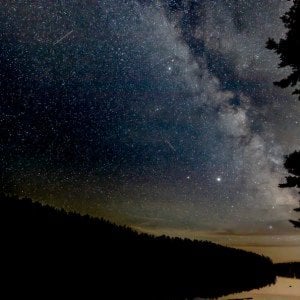
I've only attempted this a few times, once during a meteor shower (used high ISO at 2.8, 16-35mm lens) I was running at closer to 8 second exposures (meteors are bright but too fast for a 30 sec exposure)


What you mean with too fast?

I though moving lights are pretty much dictated by your aperture and ISO, but shutter speed doesn't matter. Same as with fireworks and light painting, no?

at 30 seconds exposures it's just not enough light at enough of a duration...airplanes get caught because they are slower moving, but fast moving ones blaze in and out in 1-5 seconds (at least that was the case the night I was shooting) I watched as the camera was exposing... over the course of 10 shots I saw at least 6 meteors, but when I paused to check, no evidence of meteor was present.  So I backed things up to 25, then 20, then 15...found that 8 was the sweet spot

I'm confused.  i don't understand why you would lose the meteor trails in a longer exposure. since the meteor is a transient light source, leaving the shutter open before or after its occurrence should only allow you to capture other transients, but have no impact on those previously detected. I would think the only issues should be the ability of the sensor to detect the transient and blowing out the area of the transient with background light.  Increasing the shutter duration shouldn't decrease the sensor's sensitivity.

I think he's also adjusting aperture/ISO to match exposure for the stars for that shutter speed, but he misses the point that meteors don't care about shutter speed, only aperture and ISO.

So using those aperture/ISO settings for stars at 8 seconds, but shutter speed at 30 seconds, you'd get overly bright stars (if possible), but also capture longer time and usually easier to catch meteors then too.

11
I've only attempted this a few times, once during a meteor shower (used high ISO at 2.8, 16-35mm lens) I was running at closer to 8 second exposures (meteors are bright but too fast for a 30 sec exposure)


What you mean with too fast?

I though moving lights are pretty much dictated by your aperture and ISO, but shutter speed doesn't matter. Same as with fireworks and light painting, no?

12
I'm planning to go someday soon too, my friend borrowed me his 24/1.4 for that, on 5D3 that should give nice images. I also have Sigma 14/2.8 I'm planning to try. Just waiting for cloudless night.

13
EOS Bodies - For Stills / Re: my new 5D3 battery life
« on: May 17, 2013, 03:03:02 PM »
Especially that "20 shots / 94%" is not good information. Battery capacity cannot be estimated that good, especially at the full end. So keep shooting until you get battery warning, and then if you don't get enough shots, you can start worrying.

I have grip with double batteries, and 2000+ is normal. Some amount of power save (1min setting), but total ~7-8h of shooting with small amount of chimping.

So one battery should give half of that.

14
EOS Bodies / Re: AF "Cases" for use with Dance Photography
« on: May 04, 2013, 01:32:54 AM »
Like he said, need to know the camera body.

I shoot indoor martial arts fights, the movement might be somewhat similar to your dancing (or not).

For one, AI-servo does the best job as for AF-modes.

On 5D3, I can tune the settings further. Some other cameras too. Last competition day I was trying different ones, and I found out settings #5 and #6 seemed best for people moving random speeds at random directions. In camera those are named "For erratic subjects moving quickly in any direction" and "For subjects that change speed and more erratically".

But start with AI servo, if that was your question.

15
I can't see anything in the upgrade that is enticing for me to do so, in fact because of the battery issue, quite the opposite.

I don't need uncompressed HDMI output and I haven't encountered any of the 'phenomenons'.  I always update to the latest firmware or software for that matter but because of the 'battery phenomenon', (I only have two third party batteries), I'm holding off.

Anyone else in the same boat?

For me the IR-assisted AF is big thing, so I downloaded the FW floating around even before official Canon release.

Pages: [1] 2 3 ... 6