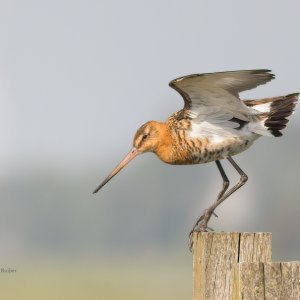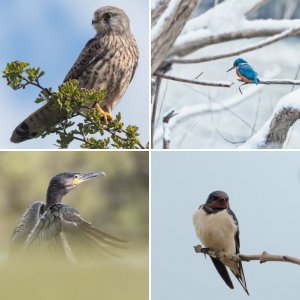
Taken at the San Diego zoo (1D Mark IV, EF 100-400, ISO 160, 365 mm, f/5.6, 1/800 sec)
I like a nice headshot Harris HawkCygnetSnoozing Swan
Male KingyMale Kingfisher by Rich Tinsley, on FlickrGreen WoodyGreen Woodpecker by Rich Tinsley, on FlickrFemale KingyFemale Kingfisher by Rich Tinsley, on Flickr
White-breasted Waterhen (Amaurornis phoenicurus) by alabang, on FlickrAdult White-breasted Waterhens have mainly dark grey upperparts and flanks, and a white face, neck and breast. The lower belly and undertail are cinnamon coloured. The body is flattened laterally to allow easier passage through the reeds or undergrowth. They have long toes, a short tail and a yellow bill and legs. Sexes are similar but females measure slightly smaller. Immature birds are much duller versions of the adults. The downy chicks are black, as with all rails.Several subspecies are named for the populations that are widely distributed. The nominate subspecies is described from Sri Lanka but is often widened to include chinensis of mainland India and adjoining regions in Asia, west to Arabia and east nearly to Japan. The remaining subspecies are those from islands and include insularis of the Andaman and Nicobar Islands, midnicobaricus of the central Nicobars, leucocephala of Car Nicobar, maldivus of the Maldives, javanicus of Java and leucomelanus of Sulawesi and the Lesser SundasSource: http://en.wikipedia.org/wiki/White-breasted_WaterhenCamera Maker: CanonCamera Model: Canon EOS-1D Mark IVLens: Canon EF 800mm f/5.6L IS USMImage Date: 2010-02-20 08:48:39 (no TZ)Focal Length: 800mmAperture: f/5.6Exposure Time: 0.0006 s (1/1600)ISO equiv: 640Exposure Bias: noneMetering Mode: MatrixExposure: ManualExposure Mode: ManualWhite Balance: AutoFlash Fired: NoOrientation: NormalColor Space: sRGBGPS Coordinate: undefined, undefinedSoftware: Aperture 3.2.2Black-crowned Night Heron (Nycticorax nycticorax) by alabang, on FlickrThis species has an extremely large range, and hence does not approach the thresholds for Vulnerable under the range size criterion (Extent of Occurrence 30% decline over ten years or three generations). The population size is very large, and hence does not approach the thresholds for Vulnerable under the population size criterion (10% in ten years or three generations, or with a specified population structure). For these reasons the species is evaluated as Least Concern. Source: http://www.iucnredlist.org/apps/redlist/details/106003742/0Camera Maker: CanonCamera Model: Canon EOS-1D Mark IVLens: Canon EF 500mm f/4L IS USMImage Date: 2010-08-14 07:52:37 (no TZ)Focal Length: 500mmAperture: f/4.0Exposure Time: 0.0006 s (1/1600)ISO equiv: 320Exposure Bias: noneMetering Mode: PartialExposure: ManualExposure Mode: ManualWhite Balance: AutoFlash Fired: NoOrientation: NormalColor Space: sRGBGPS Coordinate: 14° 42′ 46.20″ N, 120° 57′ 15.60″ ESoftware: Aperture 3.0.3Blue-tailed Bee-eater (Merops philippinu) by alabang, on FlickrThis species has an extremely large range, and hence does not approach the thresholds for Vulnerable under the range size criterion (Extent of Occurrence 30% decline over ten years or three generations). The population size has not been quantified, but it is not believed to approach the thresholds for Vulnerable under the population size criterion (10% in ten years or three generations, or with a specified population structure). For these reasons the species is evaluated as Least Concern.Source: http://www.birdlife.org/datazone/speciesfactsheet.php?id=1179Camera Maker: CanonCamera Model: Canon EOS-1D Mark IVLens: Canon EF400mm f/2.8L IS II USM +2.0xImage Date: 2011-12-31 09:33:30 (no TZ)Focal Length: 800mmAperture: f/8.0Exposure Time: 0.0013 s (1/800)ISO equiv: 800Exposure Bias: noneMetering Mode: MatrixExposure: ManualExposure Mode: ManualWhite Balance: AutoFlash Fired: No (enforced)Orientation: NormalColor Space: sRGBGPS Coordinate: 15° 4′ 30.00″ N, 120° 52′ 37.20″ EPhotographer: Paolo DolinaCopyright: Paolo DolinaCaption: This species has an extremely large range, and hence does not approach the thresholds for Vulnerable under the range size criterion (Extent of Occurrence <20,000 km2 combined with a declining or fluctuating range size, habitat extent/quality, or population size and a small number of locations or severe fragmentation). The population trend appears to be stable, and hence the species does not approach the thresholds for Vulnerable under the population trend criterion (>30% decline over ten years or three generations). The population size has not been quantified, but it is not believed to approach the thresholds for Vulnerable under the population size criterion (<10,000 mature individuals with a continuing decline estimated to be >10% in ten years or three generations, or with a specified population structure). For these reasons the species is evaluated as Least Concern.Source: http://www.birdlife.org/datazone/speciesfactsheet.php?id=1179Software: Aperture 3.2.2Purple Swamphen (Porphyrio porphyrio pulverulentis) by alabang, on FlickrThe Purple Swamphen (Porphyrio porphyrio), also known as the African Purple Swamphen, Purple Moorhen, Purple Gallinule or Purple Coot, is a large bird in the family Rallidae (rails). From its name in French, talève sultane, it is also known as the Sultana Bird. It should not be confused with the American Purple Gallinule, Porphyrio martinica. The common name in New Zealand, used for the subspecies P. p. melanotus, is Pūkeko, which is the Māori name. The variant found in Samoa, P. p. samoensis, is called "manuali'i," meaning "chiefly bird" in the Samoan language.Source: http://en.wikipedia.org/wiki/Purple_SwamphenCamera Maker: CanonCamera Model: Canon EOS 40DLens: Canon EF 300mm f/2.8L IS USM +1.4xImage Date: 2010-02-27 09:05:39 (no TZ)Focal Length: 420mmAperture: f/4.5Exposure Time: 0.0006 s (1/1600)ISO equiv: 640Exposure Bias: +1.00 EVMetering Mode: MatrixExposure: shutter priority (semi-auto)White Balance: AutoFlash Fired: No (enforced)Orientation: NormalColor Space: sRGBGPS Coordinate: 14° 42′ 46.20″ N, 120° 57′ 15.60″ ESoftware: Aperture 3.0.3Philippine Duck (Anas luzonica) by alabang, on FlickrAnas luzonica is endemic to the Philippines, being recorded from all the major islands and eight smaller islands. Records since 1980 derive from c.30 localities, most on Luzon and Mindanao. Records from Siquijor and the Sulus remain unsubstantiated. A steep population decline was evident by the mid-1970s, with high numbers recorded at only a few sites in the following decade, e.g. Candaba Marsh (Luzon) which probably supported many thousands in the early 1980s. Subsequent local extinctions and near-disappearances have occurred in several significant sites, including Candaba Marsh and Buguey wetlands (where several thousand were recorded in 1983). Important current areas include Polillo Island (240 seen and an estimated 3,000 present in 1996), Subic Bay (600 seen in 1997), Magat dam (2,000 were seen in 2001) and Malasi lakes (1,320 were recorded in 2002), Luzon. Other recent records come from Mangatarem, Pangasinan (east of Zambales Mountains IBA) where 70 individuals were counted on the Barabac River inside the Manleluag Spring National Park, Cantilan mangroves in Surigao del Sur and from a mangrove fishpond in Bicol Region, Southern Luzon1. In 1993, its population was estimated at 10,000-100,000, but by 2002 fewer than 10,000 birds were thought to remain.Source: http://83.138.144.95/datazone/speciesfactsheet.php?id=439Camera Maker: CanonCamera Model: Canon EOS-1D Mark IVLens: Canon EF 300mm f/2.8L IS II USM +2.0xImage Date: 2011-12-31 09:02:52 (no TZ)Focal Length: 600mmAperture: f/8.0Exposure Time: 0.0008 s (1/1250)ISO equiv: 800Exposure Bias: noneMetering Mode: MatrixExposure: ManualExposure Mode: ManualWhite Balance: AutoFlash Fired: No (enforced)Orientation: NormalColor Space: sRGBGPS Coordinate: 15° 4′ 30.00″ N, 120° 52′ 37.20″ EStriated Grassbird (Megalurus palustris) by alabang, on FlickrThe Striated Grassbird (Megalurus palustris) is an "Old World warbler" species in the family Megaluridae. It was formerly placed in the Sylviidae.It is found in Bangladesh, Cambodia, China, India, Indonesia, Laos, Malaysia, Myanmar, Nepal, Pakistan, the Philippines, Russia, Thailand, and Vietnam.Source: http://en.wikipedia.org/wiki/Striated_GrassbirdCamera Maker: CanonCamera Model: Canon EOS 5D Mark IILens: Canon EF 200mm f/2L IS USMImage Date: 2010-01-26 22:44:31 (no TZ)Focal Length: 200mmAperture: f/2.0Exposure Time: 0.0050 s (1/200)ISO equiv: 640Exposure Bias: noneMetering Mode: MatrixExposure: aperture priority (semi-auto)White Balance: AutoFlash Fired: No (enforced)Orientation: NormalColor Space: sRGBGPS Coordinate: undefined, undefinedSoftware: Aperture 3.0.3Muscovy Duck (Cairina moschata) by alabang, on FlickrThe Muscovy Duck (Cairina moschata) is a large duck which is native to Mexico and Central and South America. A small wild population reaches into the United States in the lower Rio Grande Valley of Texas. There also are feral breeding populations in North America in and around public parks in nearly every state of the USA and in the Canadian provinces; feral populations also exist in Europe. Although the Muscovy Duck is a tropical bird, it adapts to icy and snowy conditions down to –12°C (10°F) and below without ill effectshttp://en.wikipedia.org/wiki/Muscovy_DuckCamera Maker: CanonCamera Model: Canon EOS 5DLens: Canon EF 70-200mm f/2.8L IS USMImage Date: 2009-02-05 18:24:52 (no TZ)Focal Length: 150.0mmAperture: f/2.8Exposure Time: 0.0004 s (1/2500)ISO equiv: 400Exposure Bias: noneMetering Mode: MatrixExposure: ManualExposure Mode: ManualWhite Balance: AutoFlash Fired: No (enforced)Orientation: NormalColor Space: sRGBGPS Coordinate: undefined, undefined
None of the woodpeckers are particularly accomodating when it comes to photographing or getting close to them, but the green woodpecker is probably the most elusive of the UK species. My dream is to photograph one raiding an ant's nest, but I could be waiting some time .
Quote from: Kernuak on June 25, 2012, 04:32:56 PMNone of the woodpeckers are particularly accomodating when it comes to photographing or getting close to them, but the green woodpecker is probably the most elusive of the UK species. My dream is to photograph one raiding an ant's nest, but I could be waiting some time .I am fortunate to have both woodpeckers come to my feeders - both are very beautiful