

|
When you purchase through links on our site, we may earn an affiliate commission. Here's how it works. |
Just Posted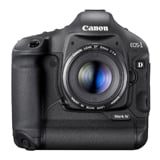
DPR has just posted their review of the 1D Mark IV.
The Final Word (From DPR)
A lot has already been said about the 1D Mark IV, both by people who have tested it and those who have tried to weigh it up against the D3S and that kind of nit-picking makes it easy to overlook what an astonishing camera it is. And looked at from a neutral perspective, both it and the Nikon are unmistakably the best sports cameras that modern technology allows.
Its talents are slightly different to those of D3S but its strengths will be a great asset to many people – the smaller sensor that prevents it competing at the very highest ISOs delivers the kind of extra reach that many touchline shooters will appreciate. Frankly there's more to both cameras than just their high ISO performance and, while the Mark IV isn't the best high ISO camera on the market, it's still an exceptionally good one. From the point-of-view of the tasks it was built to tackle, there is nothing that can touch the detailed, high resolution images that it can deliver ten times a second.
Read More: http://www.dpreview.com/reviews/canoneos1dmarkIV/
cr





where is ‘TONS’ of rumors for this weekend?
All is quiet.
Canon scored the same as Nikon – on a smaller sensor with more pixels. ISO is mitigated by a 1 stop difference – that also makes sense when comparing the the different sensor sizes. It would be interesting to see how a same-sized sensor comparison would fare between the two.
I can’t wait for the new lenses
1 more day, come on Canon!!
is this normal right before what is said to be a release date 23rd?
Or are you getting rumors from dodgy sources that you might be over filtering.
Very, very positive review.
http://www.dxomark.com/index.php/eng/DxOMark-Sensor/DxOMark-reviews/Canon-EOS-1D-Mark-IV-vs-Nikon-D3s
you’ll find out in two days one way or the other… just breathe dude
guess we won’t find out for another couple of years … if Canon finally decides to kill APS-H. somebody made an interesting statement about why Canon is using APS-H still, having to do with dissipating the electronic charge across the sensor area between frames in order to prevent ghosting. apparently you can do it on APS-H 10 times a second, but only 8 times a second on FF. don’t know if that’s a physics-based maximum or something that technology can rectify in the future, but I bet there’s a truckload of Canon engineers chomping at the bit to make a FF 1D Mark V
I thought so dpreview would rate it same as d3s. There is simply too much at stake there…
I’m doing heavy filtering.
Can you do the same comparison for 50D vs 7D? Look at SNR18 and DR tabs under both screen (pixel) and print (image) levels? Now, can you explain the discrepancy between the low light ISO scores based on their data?
If not, DXOMark has lost ALL its credibility, and there is no need to look at any other data from them.
Why not make a top 10 list of the filtered rumours. We can play “pick the winner”
we couls use something to kill the day
Making the 1D Mark V full frame would make a lot of sense and with higher res sensors cropping isn’t an unreasonable solution for sports and press to get the extra reach. It would also make it easier to share components with the 1Ds.
8 times a second on FF – in case of same high number of MPs.
That would be a cool idea!!
Many sports photographer like the 1.3x crop factor, when using long telephoto lenses, the difference is BIG (price and weight too).
There are so many people complaining how D3s has better ISO performance. How many of you would go over ISO 25600 on these two cameras? For newspaper photos, quality and noise is good from both. And if you think that a few years ago, ISO 3200 was noisy a lot, and now people complain about high ISO numbers while they don’t even use them.
1D Mark IV is a great camera, the crop factor, the amount of noise for an APS-H sensor with 16MP is excellent. The only people complaining about auto focus are those who don’t know how to use it. All cameras have focusing problems.
The dpreview was bought!
right. I don’t find most of their test credible
+1 … it’d be amusing to see some of the whack stuff out there too
I think its somewhat bizarre that dpreview is starting to give their review ratings a more and more complex rating system. I suppose it’s supposed to look refined, or technical, but what it ends up looking like is arbitrary and subjective. why does something rate 90 instead of 91? 89 instead of 90?
when they began they were clear that they were serious but amateur reviewers and their rating system was subjective but easy to understand, and their biases were easy to see and account for.
they have since convinced themselves that they are professional reviewers and that their rating system is a scientific sort of tool, but beneath all the gradients and bars, it’s wholly as subjective and arbitrary as it used to be — except it tries to look like something else.
to see someone who presents a completely opposite and yet more useful approach, go take a look at the digital picture. very few charts, very few diagrams, yet so much useable information, especially in terms of the lens reviews. I think within a year or two dpreview is going to have to overhaul their ratings system
by Nikon
by Amazon.com a few years ago.
Maybe also because the camera is great?
One allows you to shoot in the dark (figurativly speaking) and has a lower res 12mp sensor. FF.
The other doesn’t quite shoot in the dark even if the ISO performance is better than most camera (except D3s) and has a higher res, 16mp sensor. With a crop (some people need this crop)
So who wins? It depends what your needs are.
It looks like a very fair review to me. I don’t think they wanted any more criticism for being in the nikon camp.
I absolutely agree. Great post kubelik.
On the 3th page of the DPR review is writen “Default display is indicated in bold.
Diagram adapted from the EOS-1Ds Mark IV manual with permission.”
…so I think DPR is testing 1Ds MKIV right now!!!
Every day hundreds of people complain about DxO only because their simple brains are can’t comprehend rudimentary logic. There is *always* an obvious counter-argument! But, by Jove, you’re right — why the big diff in ISO-score? Cudos to Golden Man! The 50D is actually slightly on top until 800, and only ever so slightly below until they converge at 12800. I’m baffled. Maybe it has to do with ISO sensitivity, where it seems that the 50D doesn’t have true 100 ISO? Can anyone explain?
I think it’s a typo.
If the whole value of the score was high ISO, Nikon would win, however, there are many elements making up the score, not just high ISO performance.
If resolution made up 100 percent of the score, for example, Canon would be the winner.
Different photographers place value on many different attributes, so having a choice of cameras with strengths in different areas is good for the photographer, he can buy the one that works best for him. If they were all identical, they would all have the same bad points as well as good ones.
They published a long paper about what they were doing to the ratings and why. they have come to the conclusion that providing raw scores and weightings would not help.
They are probably right, but I too would like to see the underlying scores that makeup the ratings. Of course, many of them are subjective opinion, there are no standard tests for many of the things included in the rating, but thats ok as long as they tell us that here are the measured results, and here are the subjective ones. The scores are then weighted, and that would also bring a diversity of opinions, because we want different features. For example, those who want to use a camera for video versus those with no use for it will both gripe about its weight in the ratings.
One piece of evidence as to why raw scores wouldn’t help, is the number of people complaining about DXO scores, but not offering their own test methods and scores, just claiming they know it can’t be right – subjectively. If you give a camera to 10 different photographers and have them make comments without talking to others, odds are different ones will complain about different things, because they use a camera differently.
They did not receive a production 1D MK IV until months after the announcement. I doubt if they will see a 1Ds before the announcement, and even loaners of pre-production cameras do not have manuals or raw converters, and Canon does not allow publishing of images.
Still, It would be great to see a hands-on preview since the production cameras will arrive 3 or more months after the announcement, and the full tests even later.
The short answer is that DxOMark ignores resolution in their camera ratings. Their low-light scores are not compiled with the print setting; they’re compiled with the screen setting; and the screen setting is inaccurate as it does not consider the quality of the whole image, instead taking the per-pixel quality and thus ignoring resolution.
That said, the D3S, even when both crop-factor and resolution is factored in, is superior to the 1D4 in low-light performance. The difference is typically a stop on the print-setting, but the crop factor only counts for 73% of a stop. So that suggests that the full-frame 1Ds4 will still be inferior to the D3S and the potential D3Sx.
Not my lover…by Canon! Photojornalist’s have a lot of machines free….
While I am sure you are correct, I bet that DPReview currently do have a 1Ds MkIV on loan (assuming it will be launched tomorrow). They’ve been writing good things about Canon cameras for a while now. I guess this is both a strategy to get their hands on new bodies pre-launch (which has succeeded), as well as a reflection of their Amazon ownership. After all, Amazon don’t care which brand you buy, just so long as you buy from them!
Bryan’s work with TDP is outstanding. His reviews are the ones I like most. I Supplement them with slrgear and photozone for lenses. His body reviews are stellar.
CANON rumors..Make me in bad mode,it’s no fun to read everything good about Nikon.
Nikon seems to have the best camera right now.
All dslr’s.
The best photos right out from the camera.
But,if you.
Like me,have Canon,than the only good thing are that.
We soon will get a new pixel record from Eos 1Ds Mk IV.
!?…….
Are that something to be happy about?…?
Nikon is like a big brother that make everything correct.
Yes! I feel a bit jealous on my Nikon friends.
Canon was leading,but now them hunt and hunt.
And now i understand why i never will get that last Film firmware to my 5D Mark II.
Please,Canon,try again!
Their definition of “Low-Light ISO metric” = highest ISO with SNR 30dB, DR 9EVs, Color 18bits (all with “print” quality selected). It’s on their website.
The difference between 7D and 50D (1/3 of a stop, that’s almost nothing !) is explained by color depth, as you can easily check.
DXO detailed measurements are very interesting (look at “full SNR” or “full CS” for instance), but only if you take the time to read their (very technical) explanations. It’s clearly for technicians, not for photographers.
The problem is with the aggregate ratings, which are misleadingly precise.
BTW, the article linked by MarkusW is an interesting read. Only, they measure noise quantity, not quality (i.e. pattern). Maybe they will do that next…
Oups, I clicked on the wrong “reply” : see just below.
I sincerely hope APS-H stays!
…The difference is typically a stop on the print-setting, but the crop factor only counts for 73% of a stop. So that suggests that the full-frame 1Ds4 will still be inferior to the D3S and the potential D3Sx…
Are you forgetting the the APS-H model has 16.1mp, while the D3s has 12.3?!
I like the-digital-picture as well. However, he only reviews Canons!
I like Camera Labs, myself.
No one should care about scores. Especially ones produced by the flawed tests of dpreview. It’s just pure retardation to reduce many many aspects in to one tiny number.
Well said.
1. People complain about ISOs they’ll probably never use.
2. People don’t try to learn how to use a camera before they start making conclusions about the AF, etc. There’s no standard for the way AF should work or be used and all cameras behave differently (I’ve used D3s, D3, D700, 1D3, 1Ds3 and 5D2 with fast pro tele primes).
And we have jokers like Rob Galbraith thinking that they can evaluate something as complex as AF without even saying anything about all the CFn options for AF in each camera.
I’m not denying any issues the 1D3 had, but you just can’t shoot different scenes and expect to make general conclusions. Every camera’s handling needs to be learnt, especially high-end ones from different manufacturers.
sorry, SoD, but that rocks my boat just fine
Doesn’t make a difference because their reviews aren’t good for anything other than checking menu system or the spec sheet.
Granted, but you don’t get the full gamut, then.
Well said. The scores are arbitrary and make artificial distinctions that aren’t even remotely relevant in real-world shooting conditions. I doubt they could even explain what a 1% difference (for example) in final score really means.
Total and utter refutation of the relevance of DxOMark scores:
http://www.luminous-landscape.com/essays/eyes-vs-numbers.shtml
Conclusion: DSLRs are like hi-fi audio equipment. Those that score the highest in lab tests dont necessarily mean they take the best pictures.
My lovers waiting for Nikon D4, put the Canon Mark IV in corner…
RG was bought with Nikon ads. DPR is now bought with Canon ads.
http://g1.img-dpreview.com/217D1C3EF6404140AC7FB7CCB9B31090.jpg
print adjusts for resolution, so that factor is already included.
One factor I’ve probably forgotten is that pixel density is not constant as you move up from APS-H or FF or APS-C to FF. You can’t simply use a cropfactor ^2 to convert the quality of an FF, since if you keep resolution as a constant, and you move up to FF from crop, not only does the amount of light received by the sensor increase from the larger image circle, the pixel density decreases as well.
I have looked at many sites on this subject and not
come across a site such as yours which tells
everyone everything that they need to know. I have
bookmarked your site. Can anyone else suggest any
other related topics that I can look for to find out
further information?
Rob Galbraith was the one who told the world, and Canon, about the Mark 3 focusing problems, something of which Canon was well aware, yet they neglected to fix the problem before releasing the camera to the public.
I’ve read Mr. Galbraith’s reviews, and they were scientific. If you have read them, you too would come to the same conclusion. I don’t know as to where you’re getting your info, but you are incorrect.
BTW, I’ve had two Mark IVs, and they both suck. And yes, I know how to use them. And in case you are going to insist that I’m using them incorrectly, then why do these cameras have to be so difficult to configure? I had no problem with the Mark IIn.
Maybe that’s Canon’s way of hiding the fact that their cameras can no longer produce good AF results. You know the old saying: If you can’t dazzle them with brilliance, then baffle them with Bull S***t. The Bull S***t being the complicated AF custom functions.