

|
When you purchase through links on our site, we may earn an affiliate commission. Here’s how it works. |
After all the news and frantic postings of yesterday have calmed down, I thought it would be good, as some others have mentioned, if we take a look at the Canon RF 45mm f/1.2 STM from a more historical perspective. While you are here, be sure to check out our announcement article on the Canon RF 45mm f/1.2 STM and the brand new Canon R6 Mark III.


Some of what we are seeing with the Canon RF 45mm f/1.2 STM reminds me of the classic debates between Leica and Zeiss purists. With Leica claiming the “character” while wide open, and Zeiss being the more clinical, microcontrast, and sharpness as the lens’s holy grail characteristics, even while wide open. Battle lines were drawn, and the debates were fierce.
Before anyone jumps all over me with their favorite Leica or Zeiss lens, yes, there are, of course, notable exceptions to the rule, such as the 28mm Distagon and the 28mm Biogon, which were notably character lenses versus what one would normally expect from Zeiss, such as the legendary 21mm Distagon. And in the Leica camp, we have the Leica APO-Summicron-M 35mm f/2 ASPH, which is an incredibly beautiful and razor-sharp lens that even Zeiss would be proud of.
But I digress, that was the argument at the time, and I dare not tread too far into that without raising the spectre of re-creating some old forum wars, and then we would have 10 pages of why T* coatings are best coatings ever made by mortals and the like. So let’s not have that break out here at CanonRumors, at least today. But as a side note, I personally love T* coatings.
How the Canon RF 45mm f/1.2 STM Compares
First, the MTFs…
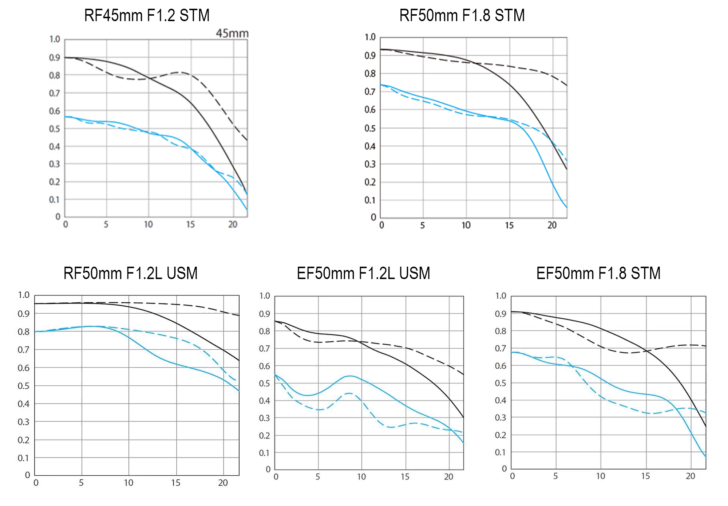
Grabbing a copy of most of the other lenses in this similar category, we see that the Canon 45mm f/1.2 STM closely resembles the response from the RF 50mm f/1.8, with a smoother fall-off in resolution. I like how the saggital and merdonal lines match up well for both contrast and sharpness – more so than the 50mm f1.8, which should indicate that this lens will have less astigmatism and also improve bokeh.
The contrast lines (black) do fall far more in the corners than I would expect from a modern lens, worse than the EF 50mm F1.8 STM, and certainly less contrast than the Canon RF 50mm f/1.8 STM. The Canon EF 50mm F1.2L, which I have heard some mention, certainly had a very curious wide-open resolution performance, and fell off more gradually in terms of contrast than the Canon RF 45mm f/1.2 STM.
Of course, the 45mm f/1.2 STM doesn’t come close to the two lenses that Canon has created to dominate the 50mm space, the RF 50mm f/1.2L USM and the RF 50mm f/1.4L VCM. Then again, it doesn’t have the same price either.
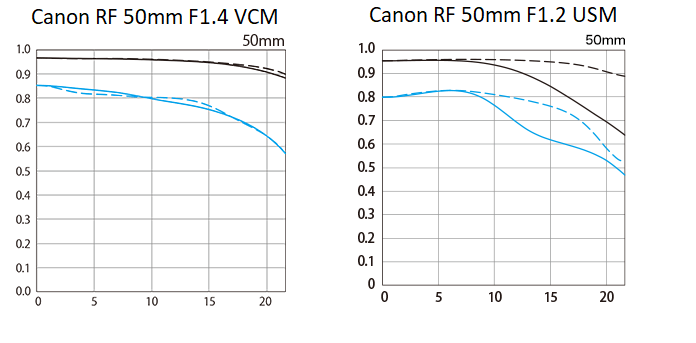
Canon certainly knows how to create stellar 50mm primes when it needs to.
Contrast and AutoFocus
When I usually talk about lens MTFs here at CanonRumors, I typically don’t mention the contrast that much because it’s generally decent across the frame, and doesn’t fall off as much as the RF 45mm f/1.2 STM. But contrast is more important than just your image – it will determine how accurately your camera will focus with the lens as well. The better the lens contrast, the more accurately the camera can determine the focus distance.
There are reasons why mirrorless camera systems tend to gravitate more towards sharper lenses, so let’s talk about the main one first. If you want the TLDR, I’m sure Canon has done its homework, and this lens works perfectly fine, just be aware there may be some practical limitations.
If you were happy with an adapted Canon EF 50mm F1.2L USM on your RF camera, then you should also be pleased with this lens, as the contrast response isn’t much different.
In our DSLR Past, Things Were Different
In the past, with DSLRs, they had separate sensors that had focus sensors of varying length and sensitivity. This prevented DSLRs from having focus points out to the periphery, and most had major defocus sensors to assist with a lack of contrast. As well, many DSLRs had all cross-point auto focus sensors that would at least attempt to handle low contrast focus conditions.
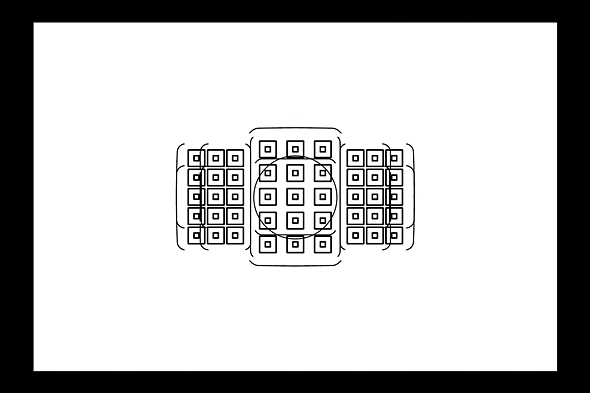
The above picture is a 6D Mark II, the DSLR predecessor of the R6 Mark III. If you notice, all the AF points are clumped up in the center. Around, for instance, the maximum of the 10mm mark on the MTF charts. This was true for most lenses, meaning that even if you picked the “corner” AF point, you had decent contrast with even a character lens such as the EF 50mm F1.2L USM.
I’m sorry if I digressed there. I’m sure some will tell me that they used the Canon EF 50mm F1.2L USM just fine on their DSLR, and I was smoking some interesting herbs while writing this article. No herbs were used during this article; I used them all up when I wrote this article.
Yes, I wrote this..
I still cannot believe I wrote that. There’s a story behind that.
Canon Mirrorless Auto Focus, aka Modern Mirrorless
We now use the main image sensor as the means to focus, with each pixel split in half, which is why the sensors in RF cameras are called (Dual Pixel Auto Focus) CMOS II sensors.
As most of you already know, the focus areas on a modern DPAF CMOS sensor are nearly 100% coverage across the frame. But this also then requires that the lens overall needs to have much better contrast (not necessarily sharpness) across the frame. If not, in some cases with legacy lenses, the camera would limit the auto focus coverage if the lens had characteristics that could not support auto focus into the corners and edges.
Because of the increased AF coverage, Canon and other manufacturers have tended to prioritize the lenses that have decent contrast and resolution across the frame. It just makes their life much easier.
Will the Canon RF 45mm f/1.2 STM have Problems?
When I wrote the announcement article yesterday, I mused a bit about this. As this is the first thing that struck me – “wow, that’s some low contrast after 15mm.” Obviously, in the center will be absolutely fine, or it wouldn’t have left the drawing board. My only thought was, and I’m sure Canon thought of this, is how well this lens focuses without having much contrast as you get out into the corners beyond the 15mm point. Interestingly, around 15mm is where APS-C lenses stop, so this lens will be very good on Canon’s APS-C cameras.
Canon does play math tricks with its focus algorithms and Dual Pixel AF sensors, as it knows what lens is attached and the characteristics of that lens. That way, the focus and distance algorithms are still accurate regardless of the lens, and also atypically handle things such as focus shift when stopped down.
I personally don’t think this lens has any problems, partly because that’s not the way people are going to use the lens. It’s not the intent of the lens to be focused off-center as much as Canon’s other lenses. So if you are using it for people and thus with a focus around the center, this lens will be perfectly fine, as well as any other Canon RF lens. However, if you put your AF point all into the corner as far as it can go in low light, then I’m not so sure of its focus capability. That’s an obvious extreme condition, but just be aware of it. At this lens’s price point, it’s certainly not meant as a replacement for the excellent Canon RF 50mm F1.2L USM.
This Isn’t a Lens for Me
As many of you know, I’m pretty huge on the bang for the buck lenses, but this lens, I think, prioritizes “character” a little too much to make it a general-purpose lens that would have a greater utility. If you are the type of photographer who loves candid portraits, in the studio, or even street shooting, then this may be an incredibly wonderful bargain lens to add to your kit. For me, I don’t shoot those disciplines much anymore, and if I did want to have that option, I’d probably find the RF 50mm F1.8 STM perfectly suitable as a substitute at 50% of the price.
For those seeking to reclaim the magic of the Canon EF 50mm f1.2L USM in a lighter, smaller, and more modern lens, this is a lens absolutely for you.
I think it’s great that Canon did this lens, and I think it was very smart of them not to make it at 50mm, as it would confuse between the intent of this lens and the 50mm lenses, and take away what this lens hopes to achieve.
Preorder the Canon RF 45mm f/1.2 STM
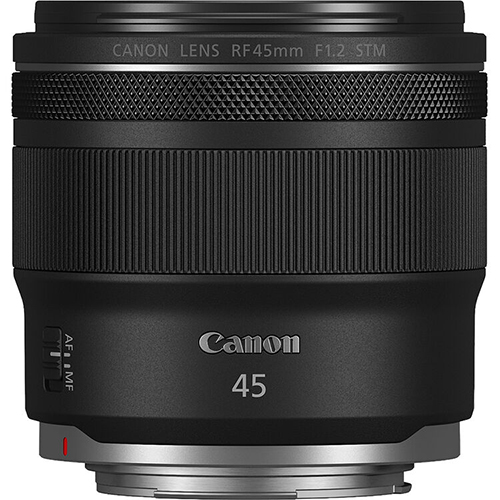
MSRP: $469 • €499 • £479
Full-Frame
f/1.2 Maximum Aperture
Compact, Lightweight Prime Lens
STM Stepping AF Motor
Customizable Control Ring







German MRSP at 499,- and size and weight is positively surprising me.
I guess this will end up in my bag pretty soon.
Now let's see the first RL hands on and measurements.
And until then all the whiners whine about not offering all the things you get from twice as big and heavy lenses or 6 times more expensive lenses 😉 😛
To me those of the RF 45 look significantly smother and sharper up to the midframe than the ones if the EF 50 L.
Could be optically even better, but we'll see.
You're right, I really liked the EF 50 f/1.2L USM, I used it professionally for years. No lens will ever have the cool shape that it did. 🙂
It was weird to be told that it was presented as having similar image quality as the EF 1.2, that turned out to be true.
As expected from the MTFs the 50STM is sharper at max aperture, but if you stop down the 45 to f/1.8 this one wins in the center and mid-frame.
Corners of the 45 are something we should cast a veil of silence over 😉
Flare looks well controlled.
Overall very interesting for its price and size.
If you want the vintage 1.2 look, you can already buy a used EF 50mm 1.2 L for a similar price. You get better build quality, weather sealing and USM on top. In that sense, this new lens doesn't really add much to the table. I would rather get the EF lens, personally.
On the other hand, the RF 35mm 1.8 STM has superior IQ at 1.8 for the same price + IS + semi-macro. It still seems like the better lens overall, unless you only want the extreme soft look and don't want to use an adapter.
The promised similar optical performance to the EF 50mm f/1.2 L seems to be delivered, with very slightly more centre sharpness, exactly as I expected.
Size, weight and ergonomics seem great. Poor man's internal focusing is very highly appreciated, all these cheap lenses should be like this!
I'm happy it's not the 48.5mm patent we saw, because this probably has a wider field of view, so it's not a 50 labeled as a 45.
I don't know, I'll have to try it for myself.
I don't know if this level of image quality will please me. I didn't went with the EF 50mm f/1.2 L, years ago, I bought with the Sigma 50mm f/1.4 Art instead because it was sharper, but I also don't use R5s so, I have to try it.
I'm looking forward to handle this lens.
I wouldn't buy EF glass at this point, unless I needed something specific that I couldn't afford on RF, like a supertelephoto prime.
EF glass is being discontinued, needs the adapter, and this will be serviceable for much longer.
I bet a lot of EF 50mm f/1.2s will appear now for sale, because owners will probably be able to replace it with this for free or even with some extra cash in their pockets, while removing the adapter.
Given this precedent, if you can wait for it, Canon may introduce a RF 50 1.2 equivalent lens in 2037 weighing 1lb for $700. 😉
I'm taking a chance and getting one. It'll serve for those rare occasions when I actually use a wide aperture 50, and will also make a reasonably nice portrait lens on the R7.
One thing I'm noticing on my 50/1.2L (EF version) is that the DOF is so razor thin that you just about need to use a tripod to nail focus just where you want it. I took a picture of 3 darts in my dartboard, and it focused on the edge of the double-cork ring, throwing the dart's point shaft (1/4 inch behind the focus plane) out of focus. I hadn't pulled that lens out in a while, so I'm sure I could improve my technique. But 1/4 inch of movement makes a huge difference at reasonably close objects and f/1.2.