


When you purchase through links on our site, we may earn an affiliate commission. Here's how it works. |
The Canon RF 24-105 F2.8L IS USM Z jumped into the limelight with the latest announcement. This lens may not be for you. It's big, it's heavy, and pricey and Canon really wants this lens primarily for the cinema cameras. From all reports it's not fully parfocal (which means the focus will change as you zoom), but it's also not the insane price that fully cinema lenses cost either. But with the price and complexity of the addon power zoom accessories, it's safe to assume that Canon is gearing this lens for its RF C line and hoping to find that balance between performance, price and usability for the cinema line. Canon has certainly flexed its engineering and optical talent and created a lens that has never been done before. We can all be excited to see Canon push the boundaries, regardless of this being a lens in which we'd actually purchase.
Now there are MTFs to look at, and we have a few 24-105s in Canon's RF arsenal to compare against, but the one that it should be compared against is the Canon RF 24-105 F4.0L IS USM. It should be fairly noted that Canon spared no expense and no size / weight limitations on RF 24-105 F2.8L it seems, so without even comparing the charts, I would honestly expect the lens to perform nearly as well as its slower brother.

We have to bear in mind that with these MTFs we are comparing the lens wide open, but we can see that the new RF 24-105 F2.8L IS USM Z holds its own showing better contrast (black lines) throughout the zoom range, resolves more (blue lines) in the corners at 24mm and also at 105mm. While the lens is expensive, big and heavy, it matches expectations of being better than the proceeding Canon RF 24-105 F4.0L. To achieve that performance required a much more complicated lens as shown below. The left lens is the F4.0L and lens to the right is the F2.8L.
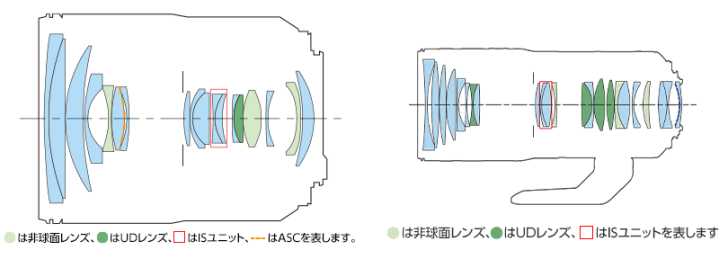
For some reason the english speaking Canon websites are lacking on details, so we had to pull that from the Japan website. The elements are as follows;
- Light green are aspherical elements
- Dark green are UD elements
- Red Square surrounds the IS elements that shift with movement
- Dashed red line is ASC or Air Sphere Coatings
The 24-70's
Some in the forums have said they would be comparing this against the 24-70 for their own use, so I'll add the comparisons here as well. Comparing a 24-70 or a 28-70 to a 24-105 isn't really that fair because as the optical zoom factor increases, optical design becomes more complex. the 24-70 or around 3x zoom factor has been the designer's sweet spot for a while, which is why you atypically have seen the standard professional grade lenses from all manufacturers as 24-70 and 70-200. Attempting to break that mold and coming out with a 24-105 in the same grade is bound to have some compromises. But the exercise is good, as we get to see just how close Canon managed to make this “compromise free”.
First up we have the 24-70 F2.8L against the shiny newcomer, the 24-105 F2.8L. For the wide end, the 24-70 F2.8L shows a higher amount of contrast and resolution in the corners, but the 24-105 has a slightly higher resolution in the center. You would be hard-pressed to see the difference between the two on the wide end (24mm) in practical terms. If we compare 70mmn and 105mm we see that Canon has a slightly better contrast and resolution over that of the 24-70 F2.8L. Of course, this doesn't tell us if there are any soft spots in the zoom range, but at the two extremes, Canon is looking like it's done an excellent job of managing the difficult task of making a 4x zoom as good as a 3x zoom.

In case you are one of those people who have the 28-70mm F2.0L and are looking at the 24-105L as a smaller edition, what do you gain and lose? The 28-70 F2.0L is a magical lens and it's certainly harder to compare that against the 24-105L, as the 27-80 has an even smaller zoom range so they can optimize the optical quality.

The 28-70 certainly more a smoother resolution falloff as it goes into the corners, it also has better bokeh at 28mm F2.0 than the 24-105 has at F2.8. The 24-105 has a slightly higher resolution at the center though. At the telephoto end, the 28-70 has better resolution, slightly better contrast, and better bokeh as well. Overall the 24-105L has slightly better resolution in the center at the two extremes, but not as good in the corners. Bokeh should be far better on the 28-70 overall.
All in all, we can see that the 28-70 certainly is the dream lens for Canon and it doesn't disappoint. It's a bridge too far for a 24-105 to compete head-to-head against it. Canon designed the 28-70 to have zero compromises and it shows. However, to be fair to the 24-105L it holds its own, and outside of bokeh, you would be hard-pressed to see any difference in real life.
In summary, this is a landmark lens from Canon. One user commented somewhere that for the longest of times, people said they wanted this lens, and others said it would be big, heavy, and expensive. Guess what? It is. But innovation comes at a premium, and if this is a lens you have been waiting for, then Canon made your dreams come true. You can also use how you feel the Canon RF 24-105 F4.0L's performance as a basis of comparison as the new lens should be better. So if you are satisfied with the performance of that lens, you should be pleased with the new RF 24-105 F2.8L.
Preorder the Canon RF 24-105mm f/2.8L IS USM Z
- B&H Photo (US): Canon RF 24-105mm f/2.8L IS USM Z $2999
- Adorama (US) : Canon RF 24-105mm f/2.8L IS USM Z $2999
- Midwest Photo (US): Canon RF 24-105mm f/2.8L IS USM Z $2999
- Canon USA (US): Canon RF 24-105mm f/2.8L IS USM Z $2999
- Camera Canada (CA): Canon RF 24-105mm f/2.8L IS USM Z $4099
- Wex Photo (UK): Canon RF 24-105mm f/2.8L IS USM Z £3439
- Park Cameras (UK): Canon RF 24-105mm f/2.8L IS USM Z £3439
- Foto Erhardt (DE/EU): Canon RF 24-105mm f/2.8L IS USM Z €3599
- Foto Koch (DE/EU): Canon RF 24-105mm f/2.8L IS USM Z €3599




"Give me an RF 24-105/4 II with that MTFs at f/4 or f/5.6, and I'm in." 😉
This one is to big and heavy for me, but I am happy for those wanting it.
And a lot of people say: how much more IQ do I get when spending so much more money.
Of course, you are right, that staying in the f/2.8 line-up, the 24-70 could be another comparison partner, too.
Or even better: Gordon's diagonal Brighton Pier views...🙂
Richard, another fantastic summary. Maximilian, I'm exactly that guy comparing it to my 28-70 f/2 and wondering which I'd like more. All the camera companies have long given photographers the devil's bargain of using a 24-105 that had "junior varsity" optics versus a "pro" 24-70. This one is interesting because the optics are much better.
Now, I find myself again in a similar position. I have the very nice 28-70 f/2 (and it's already pretty chonky), so would moving to the 24-105 f/2.8 make me happier for the greater range in exchange for the loss of a stop?
Pros:
0) Range is often limited at the long end with the 28-70, I find, for the way I shoot, so the added range would definitely be exploited
Cons:
0) Would lose a stop of light
1) MTF charts show the 28-70 much better on contrast, and - particularly - much less astigmatism (distance between the blue solid and dotted lines)
2) I can fit the 28-70 in a single lens bay in my backpack, even though it's a chonkster, while the 24-105 would take up two, fitting sideways
3) $3k is an awful lot of money for an f/2.8 lens. I have a suspicion this will be one that sees sales more often than others in a year
4) I have the 135 f/1.8 and a nice, cheap 85 f/1.4, and this is a good excuse to use them paired with the 28-70
5) Missing the semi-macro feature that the old Canon 24-105s used to have. They were typically around a 0.5 magnification ratio, where this isn't as good (around .1 to .3 through the zoom range). Respectable at .3, but not as good.
... so I think I'll not sell the f/2 lens and get the new 24-105 f/2.8. But I might have if I was shooting the 24-105 f/4 previously instead. Also, I have the sense that if it wasn't a "Z" video-oriented-featured lens, then it would be 25 percent less in cost. Feel like I'm paying a lot for something I won't use.
I'm looking forward to getting the 24-105 f/2.8 in my hands and comparing it to the 28-70 which I own. I have a feeling they'll feel completely different in hand.
I need a high optical quality lens for mountain hikes, lens changing is never safe or easy in these environments. That's why I bought the RF 24-105 f4. I was disappointed with it, and sold it. Replacing it with the excellent 28-70 f2? Not wide enough. Replacing it with the 24-70 f2,8? Not long enough.
If MTFs are as good at 35 and 50mm as they are at 24 and 105mm: a very easy choice! This is the lens I have been waiting for.
Its weight? I'm used to carrying 2 bodies and lenses from 18 to 400mm (yes, it sometimes hurts...). But the 24-105 f2,8 could easily replace 2-3 lenses.
Thank you, Canon!
Canon already has hybrid CNE lenses but those are more for cinema cameras.
Of course, Canon had the 1D C so we can argue that they were perfect for that camera.
They do not even work right on most Canon photo cameras.
These are arguably photo first.
I would say that they are perfect for the R5 C but it loses 3 stops of shake reduction.
It seems to me that it is best for mirrorless cameras performing cinema work.
I think it will live on my R3.
--> 28-70 is significantly sharper even cropped! and that's about ~105 F3.
however i full acknowledge that that's photo centric and for video cropping is partically comparable (APS-C mode).
So i'm more interested in the extra 4mm at the wide-end.
otherwise, form factor seems interesting choice as well:
- better without battery grip as its not extruding beyond the level of the body
- harder to fit in the backpack!
- (looks uglier)
When hiking in the Alps or elsewhere, I always have the 5 D IV + EF 100-400 L II on my Capture Peak clip. But always without battery grip.
The clip adapter plate is mounted on the body, not on the lens. Never had a single issue in 9 years...🙂
PS: what is a cotton carrier? You don't mean a carrier bag, do you?
MFD is practically the same as the f/4 version. One lens to rule them...