


|
When you purchase through links on our site, we may earn an affiliate commission. Here’s how it works. |
This article has been percolating in my mind for a while now, and as I got further into the various designs and Canon’s mentality, it became more of a synopsis of Canon’s methodology to date. The RF system has been very disruptive to Canon in terms of switching the mount and also the ergonomic design decisions. This article is a look at where Canon came from and where they seem to be heading. This article is long and fairly detailed, and I’ll warn you, it’s opinionated too. I originally wanted to split it up into multiple articles, but the Boss said to give it to you all in one go. Ergonomics are always in the eye of the beholder; some will like certain features, and some will hate them. But for me, it’s the consistency that I find important and also what I have admired most from Canon over the years.
This article will be a “living article” that we update over time as Canon adds new cameras to the mix.
Canon Ergonomics – History
Canon has a very rich history of the ergonomic design of the EOS system going back to well, literally before the EOS system was developed. The T70 and T90 developed in 1984 and 1985, respectively, set the groundwork for the ergonomics that we currently enjoy. We can easily pick up one of those FD mount cameras and feel at home with the camera fundamentals, layout, and organization.
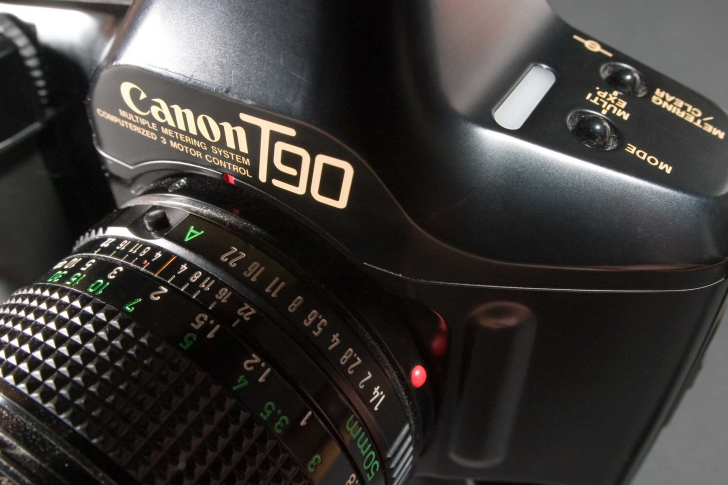
That was always one of the hallmarks of Canon’s overall system that I appreciated throughout the years. As someone who went from the 20D up the lineup to the 7D Mark II and also the 5D series cameras, and also from the EOS-3 to the 1 series and to the 1DX Mark III – Canon’s ergonomic choices made a lot of sense to me. The prosumer and professional paths differed with the ergonomics, but if you were in the same segment, the ergonomics were generally consistent. In general, the more you could do with buttons in direct controls atypically the more professional the camera was. This was especially true when comparing Rebel up to the 5D/7D series cameras.
For instance, I could pick up a 7D APS-C camera, and feel completely at home with its ergonomic sister the 5D Mark II. Same with the 70D and the 6D cameras. I could use the 20D, 30D, 40D, 50D, and the 7D blindfolded by feel. Sometimes in dark studios, it felt that way because we all know Canon didn’t like to put illuminated buttons on their cameras.
The RF System Challenges and Complexity
The consistency enjoyed by the EF mount was far easier because of the nature of the EF mount and the deep mirror box assembly. The EF system always had a consistent amount of real estate on top of the camera. So, it was much easier to maintain a consistent ergonomic layout across various cameras.
This simply isn’t as easy with the RF system as the top real estate is far more cramped and to provide increasingly smaller cameras, Canon’s designers have a far harder time maintaining consistency. I think this is where Canon is experimenting, creating the smallest possible cameras (and thus, limited top plate real estate) while maintaining as much as possible of Canon’s ergonomic methodology.
The Age of Experimentation – Enter the RF System
Canon seems to be using the RF system to experiment with various ergonomic designs. I suspect that they just haven’t decided what would be a good layout for cameras with no top plate LCD versus cameras with a top plate LCD and various haptic controls on the right side of the camera. So, I think they are still in the experimentation phase and listening and watching how consumers respond.
An early attempt was the original EOS R with the multifunction touch bar. A feature that I don’t think anyone asked for, and hardly anyone liked. I remember going to a Canon Canada showing of the RF system in September of that year, and Canon was quite proud of that bar, which was almost universally hated and will certainly never see the light again.
Another good example is the Canon EOS R7 – which is a completely redone back dial that supports the AF joystick. This is unlike any other Canon camera. I’m not sure if people like it that much – I know Craig liked it. Many people found the more traditional spot for Canon’s rear dial to be awkward. I always find the rear dial a little difficult to get to, and I’m sure I’m not the only one.
Conversely, the new joystick control carried over from the DSLR 1DX Mark III into the R3 is I believe a stroke of genius that I hope we see on Canon’s more professional cameras in the future outside of the “1 and 3 series”.
I like the fact that Canon is exploring various ergonomic designs and seeing generally how one is liked and hated and going from there. This isn’t a bad option, because everyone will have different opinions on ergonomics.
Outside of the ergonomics of the beginner cameras (RF’s Rebel lineup) which seems to be more consistent, everything else seems to go on ergonomic generations based on year versus camera series. Before the R7 was released, and even before the R3 was released. I would have bet money on what the top plates would look like for either of those cameras. I would have lost and lost big.
The RF System Challenge – the top plates
When I was chatting to Craig earlier this year, he told me that he felt “off” with the R3, like it wasn’t quite right. My theory on that was because he was so used to the 1 series camera, that the ergonomics were simply getting in the way of him naturally using the camera, the same way as 2 decades of 1 series camera before it. So that leads into this segment, the top plates of the Canon RF cameras.
Canon seems to have consistently laid out specific sections of their top plate. For example, the shutter button and front mode dial cluster that includes the mFn button and the record button. If we look at the R5, R6, R8, R6 Mark II, and even the R7 RF-S camera, where your right index finger moves off the shutter to use the mode dial or the mFn button or the record button is pretty much in the same spot consistently across the cameras. That means that for the most part, if you are even swapping in between cameras, you are going to find those buttons without having to take your eye off the viewfinder. Even the lower tier R50 shares a commonality and shows an ergonomic progression into more sophisticated button layouts going from the beginner camera to the prosumer and professional camera systems.
I always loved Canon’s preference for the right index finger being in control of the camera in terms of settings and function, more than just a shutter button. So, I’m happy that they are standardizing on one aspect of that. There is some variation from that under your index finger but much of that is governed by the depth of the camera and if it has a top LCD panel.
I wish they kept the 4-button / LCD layout from the EF mount system, but there isn’t enough room for all that on the much smaller RF system cameras.
The ergonomics are also consistent from the R/RP, R5/R6, and the top plate organization makes a lot of sense. The higher prosumer / professional R5 and R are the same, whereas the RP and R6 are like each other as well. We can see that the R6 also inherited the R5’s lock button as well, instead of the switch that was on the RP, making a more consistent layout across the three cameras – and illustrating that the R6 was more a prosumer camera, than the RP.
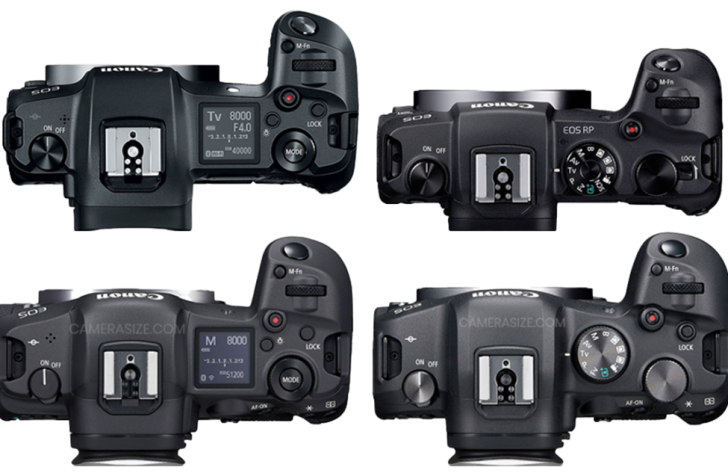
Up to this point, we can look at Canon’s layouts and agree that they seemed to have a good idea of what they wanted to do ergonomically.
Divergence in Design
Up to around the R6 Mark II, Canon seemed to have a good level of consistency with the camera bodies, with clear delineation of form and function depending on the category of the camera body. But not everything was good, and here we get into some of Canon’s more puzzling design decisions.
The Off/On and Lock buttons
The Off/On switch and lock control were always a source of angst in Canon land. The feedback from various sources was that people found Nikon’s placement of the off/on switch far more convenient and people were claiming they were getting carpal tunnel and various ailments over Canon’s traditional DSLR placement. (I exaggerate only a little – the dpreview forums were crazy back in the day). So, I can’t even fault Canon on this one. I personally never had a problem with it, but I was assured by Nikon users, that they simply could not operate a camera with such an awkward off/on switch.
In response to that, Canon seems to be struggling a bit to find a good place now for the off/on lever and lock function. Up To the R6 Mark II, Canon had the idea of keeping the off/on to the left side of the camera. I assume the thought was that you should be reaching up with your left hand to support the lens, so, at the same time, you can turn the camera on.
The R6 Mark II
Now comes the R6 Mark II. Canon decided on two different off/on switch positions that are nothing similar to the prior R6. Even more confusing is that the physical dial placement is like the R6, but those dials have different functions. Also, the lock switch now becomes part of the off / on button, instead of its separate button. I don’t like this arrangement at all. I can’t recall a time that Canon so drastically changed the control functions on a subsequent camera body generation.
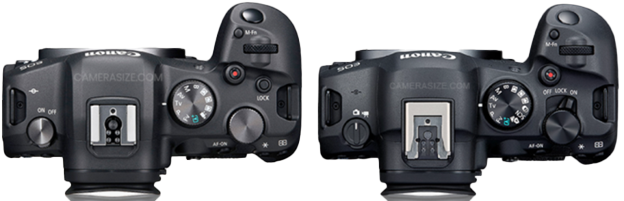
I’m not sure if this is a general experiment, or something more permanent. We will probably have a better idea when the R5 Mark II comes along. If it’s a hybrid of the R6 Mark II and R5, with the on/off button on the left side versus the right, then Canon indeed has decided to do another major shift in ergonomics. I’m going to assume that the R8 is a one-off in terms of design because its design is limited by trying to make the smallest possible full-featured, full-frame camera.
The Full Frame Design Solidifies
With the release of the R5 Mark II, I think we see that Canon has settled on a format for its cameras. Much like the R6 to the R6 Mark II, the R5 to the R5 Mark II also shifted the ergonomics, especially the on-off button.
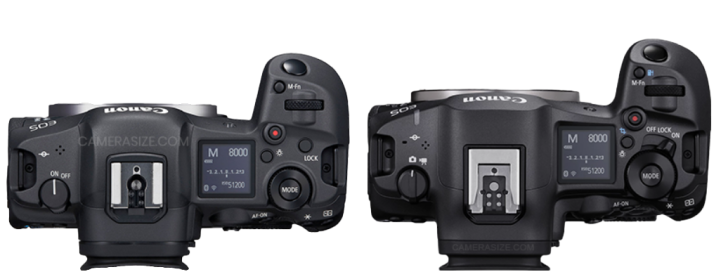
The R5 (on the left) and the R5 Mark II probably confused some people and would have certainly been awkward if you were using the two cameras at the same time. That, for me, would drive me crazy.
But if we look at the current full-frame cameras, we see that the design has moved more or less to be consistent across all the cameras.
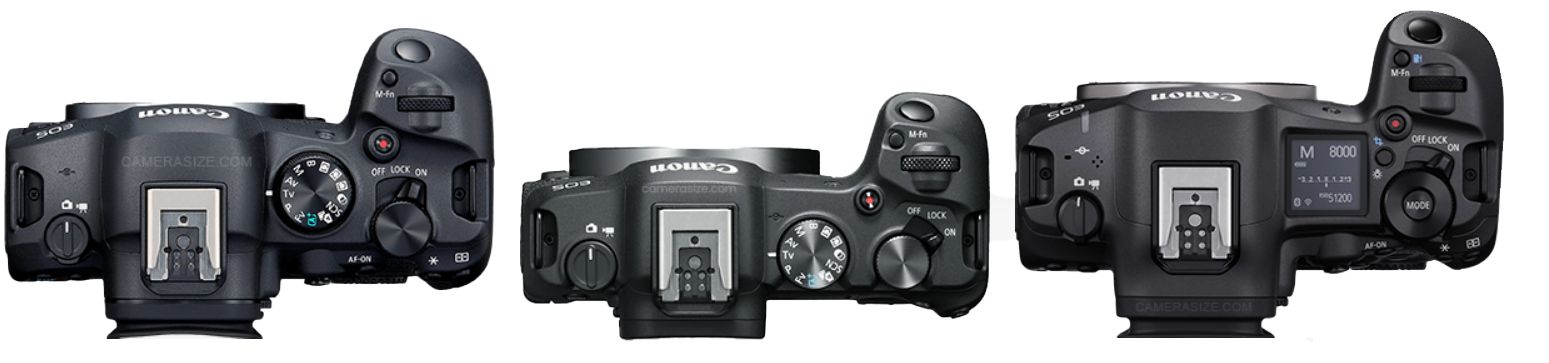
So, while the experimentation was a little painful, it appears as if Canon has settled on a format where the ON/OFF button is on the right-hand side, and the movie switch is on the left.
The RF APS-C cameras
The R7 was a huge disappointment in terms of handling, in my opinion. I expected a similar camera in terms of handling to the R5, and it turned out to be more like the R6. I guess that was Canon’s way of saying. This camera isn’t meant to be a high-end professional camera.
But even then, it didn’t directly mirror any of Canon’s full-frame lineup in terms of handling. Canon has designed small cameras in the mirrorless realm with a switch of some function on the right-hand side but decided to forgo it with the more professional R7 which was supposed to be the RF equivalent of the 7D. The 7D ends up mirroring no full-frame camera and stands alone. I guess it’s generation is a combination of the R8 and R6 Mark II. This is certainly something I’m curious about when the R7 Mark II comes out, hopefully later this year.
As far as the other cameras, I think a lot of this had to do with the decision to shave off a few mm’s in width from the camera, which negated the ability to put an off / on button on the right-hand side, but it feels like Canon decided on a camera size, and then decided what controls they could place on the camera given the size constraints. While for the R50 and R100 (which are very consistent)
In a span of literally less than 2 years, Canon has managed to come up with 3 different designs of off/on/lock/movie command dials for the 4 APC-C cameras. Since all of them are in the first generation, it’s hard to say if Canon has standardized on any mode for the camera segmentation. I’m hoping they will pass that down to the APS-C cameras now that Canon has figured it out on the full-frame models.
Going Forward with the RF System
I think this entire section is now almost completed (thanks, Canon). It appears as if the R5 Mark II has settled the issues for operation, specifically the on and off switch for at least the full frame cameras.
The APS-C cameras are a little of a hot mess, but next year is supposed to have a few of the APS-C cameras released.
I would love to see general consistency in the off-on-lock switch position and operation continue, at least by camera classification (consumer, prosumer, professional, 1 series). I think, given that Canon won’t put the off / on button around the shutter dial, that asking for a consistent approach across every camera is simply too much, given the amount of free space on the top plate.
I would like to see the R1 set the standard for the ergonomics of Canon’s professional cameras and the DNA baseline for prosumer cameras. While the real estate on the top plate is entirely different from the two mirrorless camera classifications, there should be some consistency.
I hope that Canon settles on a design and normalizes the cameras into generations like what we had before, for a few reasons. It makes it a lot easier to swap between cameras in a hurry, and as someone who would always shoot with both an APS-C and a full-frame camera, having the ergonomic similarities I always found made my life easier. The camera is supposed to get out of the way. Standardization is one way of making that a reality. Since cameras of each classification would typically have the same size, this should be easier to make consistent.
None of this, of course, impacts Canon’s sales, but it does determine how comfortable the cameras are to us overall, and our comfort. I mean we all picked up a Sony camera and recoiled in horror, we don’t want that in a Canon camera, do we?
Credits
Image Credits:
Canon RF Camera images Camerasize.com
Canon T90 wikipedia
R3 Top plate Image dpreview
Changes and Additions
1/7/2025 – We’ve added our thoughts with the R5 Mark II and the R1 and revised the article to our newer formatting
3/15/2024 – Corrected the R3 joystick as coming from the 1DX Mark III (not sure how I forgot that) and some other minor issues to the article.




There are 5 pages to this, so you have to click the page buttons at the bottom to advance the article. Something that Craig and I are experimenting with - we have some other things cooking for your reading pleasure in the coming months.
I'd wager to say you meant left/left hand here?
Looking at ergonomics at each camera on its own is a valid critique of their design. But I think a number of people particularly take issue with changes in camera ergonomics especially when they use multiple cameras in the lineup. Some people use an R5 and R7 for example, and I've heard it can be quite jarring when switching between the two bodies.
But, I'd say most people in the enthusiast/non-pro segment only own the one camera in a given range, so they get used to the ergonomics without worrying about overlap or confusion. But interested to see what others have to say. Great work Richard!
and yes I'm one of those people that would work with the 7 and 5 series cameras interchangeably at the same time. so the consistency of those two lines for me on the RF system is sad.
I came from the 5D-Line and had a the original "R" parallel to it. The R was ok. But i liked the 5D-Line better. Touchbar was aweful 😵
Than i had the R6 an shortly after it i paired it with a R5. Great combination. Ergonomics felt great. It felt ok to let my 5D go.
I now switched the R6 to the R6II. I struggled a bit in the first weeks and often forgot to turn my R6II to off. Switched to movie-mode instead 🤣 But i got used to it. I now like my R6II very much. Only thing to complain: i like the concave formed joystick of my R5 more than the convex formed of my R6II.
Before I sold my R5, I found it confusing to switch between the R5 and R8, with just one camera there is no confusion anymore 🙂
Oh! and another thing, I know a lot of people didn't like the move of the power button, I think once they make it standard between all the new cameras it will be fine however, I hate the new joystick thingy button, I think having the jog wheel doubled as the joystick (like in the 80D) would have not only free up some real estate but because of the distance between the directional buttons, it gave better control of the autofocusing points when moving them.
In all Canon is still the king for ergonomics and menu design.
I just hope they don't switch the articulating screen design. It's perfect as a side screen for video and even better for portraiture when acquiring different angles, thank God gone are the days of lying on the ground to get that dramatic look with a bride. I found it funny that all people talked about was using it for vlogging when most of use portrait photographers used it to get better angles of our framing. Just hope they don't touch it. It works find.
R7 wheel-joystick combo is a interesting design and I think it should implement on all lower end models. However I can see people with big hands(especially big thumb) hate this design.
The R50...... while I love the camera... where the back AF button is drives me nutty. Tiny camera, big hands... but it's too far to the right IMHO. It was also $500 and is pretty great for what I want it for.
Continuity will be coming, and it'll be based on feedback.
But, even when hiking, I far prefer the size of the 5 D IV over the R5/R6.
Not everybody has baby-hands, these cameras are hard to use without protheses like battery-grips or body "extensions". Isn't it a bit silly having to graft a piece of cast aluminium on a camera so one can comfortably handhold it?
How about a normal-sized EOS R* ?