

When you purchase through links on our site, we may earn an affiliate commission. Here’s how it works. |
I want to take a look at Canon’s top affordable cameras for video under $1000. Given all of our collective uncertainty with the economy, there’s no reason that you need to break the bank for good video quality this holiday season.
Good Things Come In Packages
The holiday season is almost upon us, and that means one thing—everyone and their mother asking me “what camera should I buy?” I get it, the inevitable Black Friday discounts that flood the camera marketplace certainly make this time of year prime GAS time. But unlike the dozens of other buyers guides out there, I want to do something a little different.
Instead of focusing on the latest and greatest releases, this article is going to be about the low end of the price range. What are the best Canon cameras, for video, that one can buy under $1000? I’m going to include some new models, as well as older cameras that are still hold up today which can be found affordably on the used market.
There’s no reason to break the bank when buying a camera, especially when there’s so many good used options out there. In a world of high resolution downsampling from R5 Mark IIs and R6 Mark IIIs, we forget that the majority of people looking to buy a first video camera aren’t necessarily interested in specs. Some people want something that just works and can deliver a noticeable improvement over their smartphones. Besides, when we watch a YouTube video, it’s often a crushed 1080p image on our phone screens anyway.
I get asked for camera recommendations all the time, and every year I spend hours writing up individualized emails to friends and family members with advice, caveats, considerations, and thoughts on what’s “worth it,” especially as a step-up camera for a film student or budding videographer looking to graduate from a smartphone. We’ve grown so accustom to the convenient, horrendous image quality from our smartphones that I understand how the concept of spending money on a dedicated video-making device could feel foreign. Have no fear! Zack is here. Let’s get into it.
Canon EOS R50V & Powershot V1
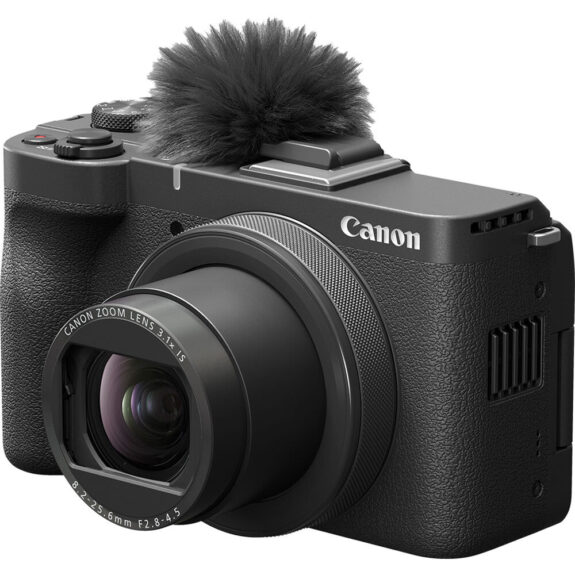
2025 was a great year for content creator-friendly devices, which saw Canon dive head-first back into a market sector that everyone thought they outright abandoned (myself-included when I wrote for a previous publication). 2019’s G7X Mark III had a viral resurgence in recent years thanks to TikTok, but these days it’s looking a bit outdated, especially for a $900 point and shoot. Unless you’re in the market specifically for a photography-focused device or a pocketable 24-70mm equivalent lens, for video there are better new options.
The Powershot V1 is a new iteration on the point and shoot design, and it’s far more useful as a vlogging and TikTok camera than the G7X ever was thanks to the wider 16-50mm equivalent lens. Canon is (again) taking some clear cues from Sony, notably the ZV-1’s large, built-in directional microphone that’s perfect for direct-to-camera presentation. With a robust body design coupled with a fan, overheating shouldn’t be a problem. The only thing stopping me from already pulling the trigger on one myself is the price. For just under $1000, you’re sacrificing image quality-per-dollar for the ability to carry the camera AND lens in your pocket.
Canon PowerShot V1  22.3MP 1.4" CMOS Sensor 16-50mm Equivalent f/2.8-4.5 Lens Full-Width 4K 30p; 4K 60p with 1.4x Crop Optical Stabilization; 3-Stop ND Filter 10-bit Recording; Canon Log 3 Active Cooling Extends Shooting Times |
That’s where the EOS R50 V comes in. Sort of the V1’s big brother, I guess. Here’s where you get slightly better image quality than the V1, but it lacks the portability of being a pocketable camera. However, the R50V’s party trick is just how good the image is that you’re getting for the cost. If you are already invested in RF glass, especially the very good non-L Series primes, you’ll find yourself with a quite formidable video camera. Whatever magic sauce Canon added to the original R50’s processing here is pretty remarkable, resulting in the best looking APS-C/Super 35 sensor on this list from a non-cinema camera. Especially for the body-only price of less than $700.
The R50V also has a plethora of video-friendly improvements over the V1 and original R50, notably a 1/4”-20 connection on the handle for cage-free vertical shooting. The UI even rotates when you’re shooting vertical.
The original R50 is my go-to recommendation for beginners or first-time camera buyers. The R50V, if you don’t really care about taking photos, is better in every other way.
Canon EOS R8
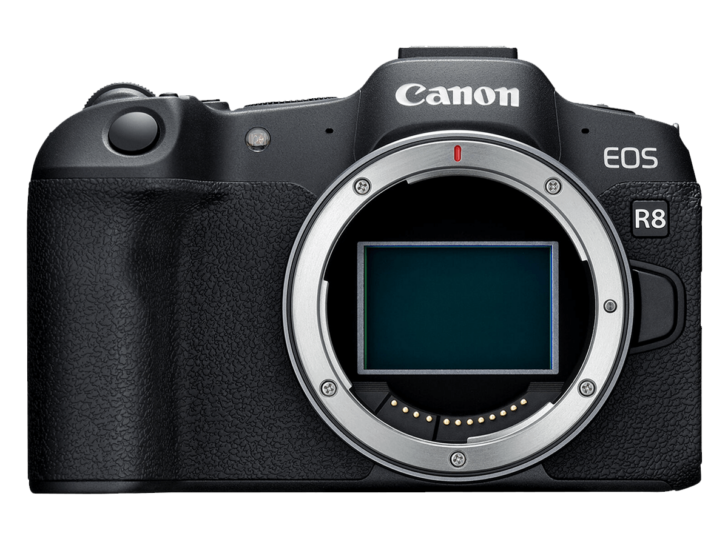
I’m not gonna spend too much time on the Canon EOS R8. It’s identical in video quality to the R6 Mark II, which is fantastic, but already has been covered in depth all over the internet. It’s great at just about everything. At the time of this writing, the R8 is north of $1000, so it technically shouldn’t even be on this list. Keep an eye on it however, because every now and then Canon Refurbished or Amazon will drop it under $1000 for short flash sales, and if you can find it discounted, it’s definitely worth it.
Of course, it has some personal pain points. As someone who has a drawer full of LP-E6 batteries, I’m irked at how it uses the smaller LP-E17. I’ve had the overheating warning get dangerously close to shutting down on a shoot once. Which, at the end of the day, just can’t happen. Period. Also, the battery door has a small amount of give when it latches into place, unlike higher end models where the battery door is solid and flush against the rest of the body when closed. That’s a small gripe, but for $1000-ish, I want a camera that feels well built, you know?
On the plus side though, I actually highly recommend it for vlogging and quick social media hits. It’s super lightweight, and there’s no IBIS. It’s wonderful. “What? I thought IBIS is super necessary for everything all the time?” Nah. At 16-20mm, which is in my opinion the best focal length for vlogging and self-facing video, those corner wobbles of a stabilized sensor drives me nuts. The R8’s digital-only stabilization works on your favor here.
Canon EOS R

The original EOS R got a whole internet’s worth of outrage when it first arrived on the scene in 2018. Canon’s initial prototype in the mirrorless camera space was mostly a vehicle for the new RF mount, repackaging the 5D Mark IV’s still-incredible, albeit-older, 30-ish megapixel image sensor in a fully redesigned body. Canon’s big pivot in design language from the previous three decades of SLRs was a big pill for a lot of reviewers to swallow at the time, notably for the inclusion of a touch-sensitive slide bar akin to what Apple was auditioning in the MacBook Pro. However, as is customary for Camera YouTube outrage, it didn’t take long for everyone to start using it and, sure enough, almost every poor review was walked back due to its ease of use and intuitive interface.
I’ll get to the video performance in a second, but humor me for a moment: the original EOS R feels amazing in the hands. Still. It’s clear that Canon R&D engineered this camera with handling in mind, because it’s luxurious. I find my R5 to be a better camera in every single possible way, however, it doesn’t quite feel the same. Canon nailed the premium feel of the EOS R. Every R-series camera below the R5 since feels like a downgrade in texture. Even the R6 Mark II feels a smidge plasticy in comparison.
Anyway, the EOS R has stellar video—if you’re cool with 1080p. It’s the most robust 1080p codec that Canon has ever put into a consumer camera, and most importantly: it shoots in All-I, which is both easier to edit with due to the lack of compression (less compression = less work for your computer), and also has better image fidelity with moving subjects. The 1080p is so good that many YouTubers at the time fooled viewers into thinking it was 4K by upres-ing it in Premiere to export at 4K.
Also, it does shoot 4K. It feels like everyone forgot that. Sure, it’s with a crop that’s slightly tighter than Super 35 and APS-C, but it’s nowhere near as difficult to work with than Panasonic’s Micro 4/3. There are plenty of workaround options for it though, including using Canon’s 0.71x focal reducer adapter (or other Metabones-adjacent models) to get a full frame look in 4K with EF lenses. There’s also some stellar 3rd party APS-C lenses, like Sigma’s EF-mount 18-35 f1.8. Combine that with Canon’s drop-in ND Filter Adapter, and you got yourself one hell of a YouTube camera.
Unlike its successor, the R5, and its infamous overheating issues, the original EOS R won’t overheat at all. The only downside to shooting 4K are the file sizes. They’re not as large as the horrid Motion JPEG codec on the 5D Mark IV, but they’re still quite hefty for a h.264 wrapper.
As I’m sure you can tell, I’m a big fan of the original EOS R, and I regret selling it. You can typically find one on the used market for around $800ish, but if you happen to get lucky and see someone selling one on Facebook Marketplace in the $600 range, assuming it’s not damaged, it’s a steal!
Canon EOS 5D Mark III & Canon 7D Mark II
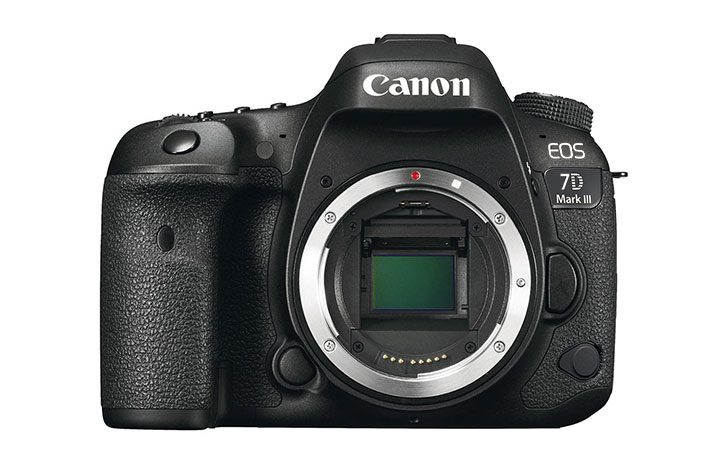
Rewinding the clock back a little bit, the 5D Mark III and 7D Mark II are two stellar options for video shooters with the right glass. When I was at graduate film school at Columbia University, one of our resident DP classmates shot all of his directing exercises (“homework assignments”) on a 5D Mark III with Zeiss primes, and his stuff looked like it was being shot on a RED or an Alexa. I’m not joking. Get some quality glass on higher-end DSLR and you can do a lot with a little.
The video specs here are nothing to write home about nowadays, especially the autofocus, but with both of these models going for around $600 in good condition on KEH, it’s worth taking a look into (I’m excluding the 6D Mark II from this grouping because there were just too many compromises both inside and out in my opinion). The 5D Mark III at one time was THE camera. The 7D Mark II is practically identical in build, save for its crop sensor. However it does have one party trick over its full frame counterpart: 60fps at 1080p. That was huge way back when.
There is one more thing though that makes shooting on a 10+ year old DSLR in 2025 worth considering: both of these cameras can boot up Magic Lantern. The hackers over there just reopened for business this year and released a build for the 7D Mark II. Alongside the much-iterated-upon 5D Mark III build, it’s an extremely economically efficient way to get oversampled raw video in resolutions larger than 1080p, alongside a bunch of exposure tools, overlays, and custom video-focused shooting settings.
Canon Cinema EOS C100 Mark II
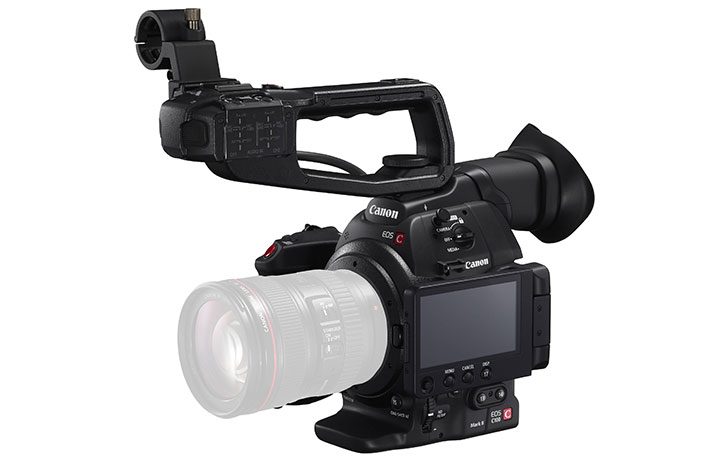
Finally, I’m gonna round out this list with a bit of a black sheep in Canon’s video lineup: the C100 Mark II. The original C100 was good at the time, but the small improvements of the Mark II’s articulating EVF and LCD screen, Dual Pixel AF, and 1080p 60fps make it a very strong package for someone looking to dive into video. While capped at 1080p resolution, the image is actually downsampled from the native 4K sensor, producing an incredibly sharp picture with Canon’s famous color science. Go look up YouTube videos of footage shot on this thing, it’s pretty impressive.
Sure, it’s got a weird shape and it’s very goofy to hold, but if you can get past that, there’s a lot to love here. The top handle with full sized XLR inputs is something that current C70 and C80 owners are yearning for, making this a great package for ENG and documentary shoots. I’ve directed several short films shot on a C100, and to this day I’m very pleased with how well the image has held up over the years.
Conclusion
There are plenty of good options out there for video cameras. This is by no means a definitive list, nor an objective “best” by any means. If anything, I just hope that if you’re considering buying a new camera, and have an iPhone’s amount of money to spend, that you consider some of the incredible options that Canon has put out over the years. Like fine wine, these cameras have aged gracefully in both performance and affordability. Just because it’s being tossed to the wayside in lieu of the latest and greatest like the C50 or the R6 Mark II (or the R5C as I like to remind everyone), doesn’t mean yesterday’s top camera models or today’s current pro-sumer content creator tools can’t get the job done.






I have to pick up a R6 one of these days. I keep reading it feels plasticy compared to the R5/ R. I always thought they were identical in terms of ergonomics.
Mine hasn't frozen once, nor has it ever overheated or had any other kind or mechanical or electronic issue. A most reliable camera, like its predecessors 5D III & IV.
Fortunately, the internet haters failed to convince me to buy another brand.
Of course, it was not perfect (EVF, touch-bar, lack of joystick), yet, totally reliable. I use it less often now, having replaced it with R5 IIs, but if I quickly need a camera or a backup, I know it won't let me down!
Interestingly, in 2018 my EOS 1000d failed me (actually I failed it because I let a huge wave in Havanna hit the camera) and was looking for new cameras and tested several models and brands. I read about the EOS R when photokina opened and my initial reaction was "naaaah". Two or three days later I was at that photokina, shot with the R and knew: I want this camera 🙂 ever since I don't believe in internet reviewers anymore. Most of them are just talking BS and don´t know or use their cameras.
Yes, as mentioned very often. It's flaws :/ I was always hoping for a EOS Rmkii, but the R5 basically is that. Better in almost every way, expect for heat (and maybe cold weather?).
When I got the R5 I sold the R because I thought I´d never use it again. Funnily, I never keep unused stuff. I sell it, invest the money otherwise and keep away from collecting. But this camera still lets me dream. Maybe I'll get a used copy to reminisce.