

When you purchase through links on our site, we may earn an affiliate commission. Here’s how it works. |
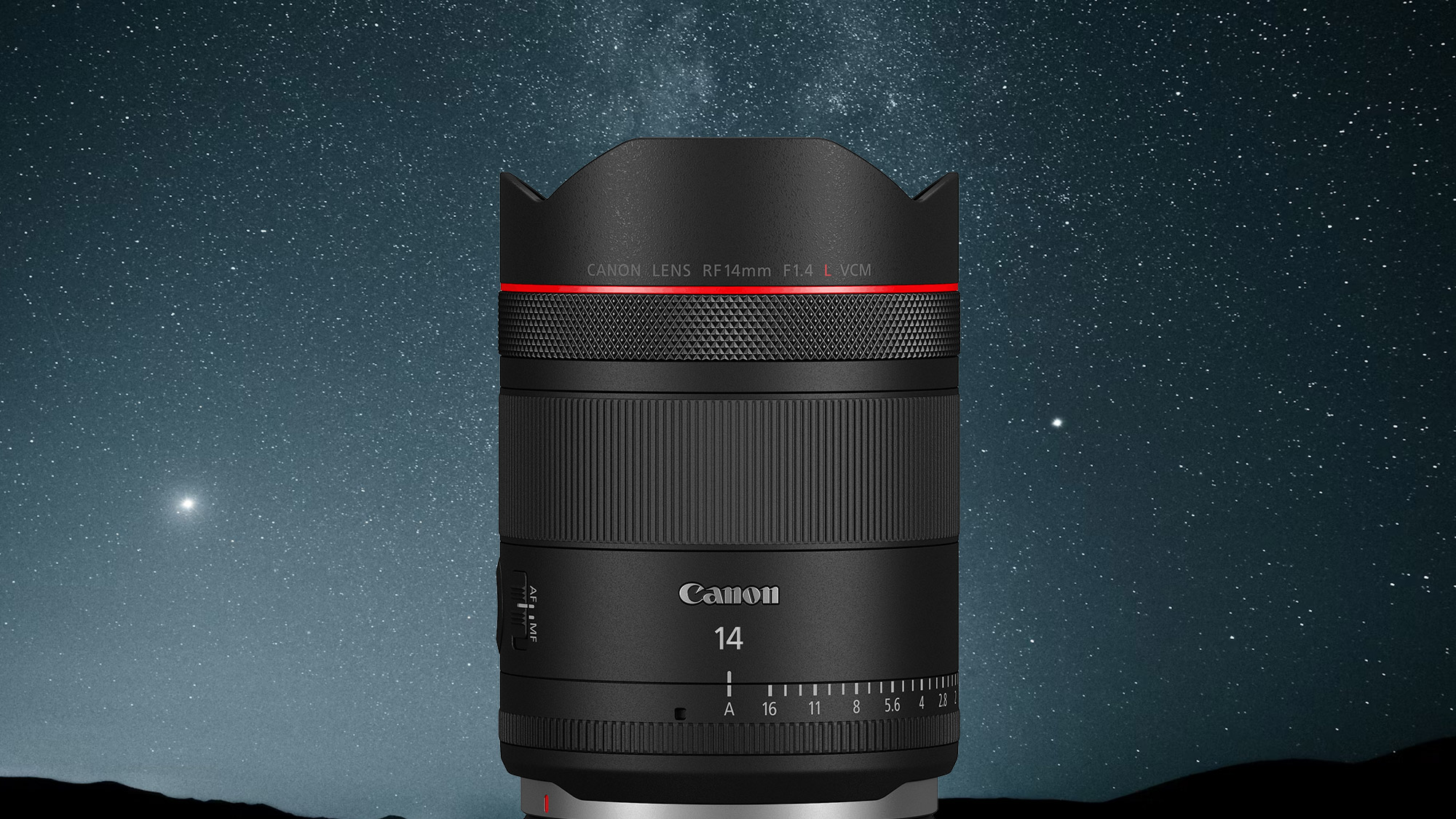
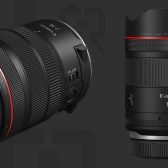
This is certainly the lens that astrophotography landscape photographers have been waiting for Canon to make, as today Canon has announced the Canon RF 14mm f/1.4L VCM. This lens is the latest in the lineup of Canon’s f/1.4 L series VCM lenses that feature the Voice Coil Motor for extremely fast autofocus suitable for both video and stills photography.
This VCM includes the 85, 50, 35, 24, 20, and now the 14mm. With an extremely fast aperture of f/1.4 – this is the fastest 14mm available today. Canon certainly knows how to flex.
Unlike the other VCM lenses, this lens also supports rear filters, making it simpler to use filters with the 14mm field of view. The lens, like the others, is weathersealed with Fluorine coatings on the front and rear elements to ease in keeping the lens clean.
This lens is approximately the same size as the other VCM lenses at a lens length of 109mm (it has a built-in lens hood) and weighs in at 475 grams. This is similar in size and weight to the other VCM lenses, which have all strived to maintain the same weight and size for easier lens swapping on gimbals and rigs.
The declickable aperture dial is usable on newer Canon professional and prosumer camera bodies; otherwise, you leave it on the “A” automatic setting and control the aperture through the camera, as you do with other EOS-mount lenses.
The Canon RF 14mm f/1.4L VCM also includes a custom control ring and a function button to round out its impressive suite of features in a small package.
Canon RF 14mm f/1.4L VCM Key Features
- Full-Frame | f/1.4 to f/16
- Ultra-Wide Hybrid Lens for Photo & Video
- Voice Coil Motor + Nano USM AF System
- De-Clickable, Manual Aperture Ring
- Custom Control Ring and Function Button
- BR, Fluorite, UD, & Aspherical Elements
- Super Spectra, SWC and ASC Coatings
- Rounded 11-Blade Diaphragm
- Weather-Sealed Design & Fluorine Coating
- Built-In Lens Hood, Rear Gel Filter Slot
Pre-Order
I think it’s really safe to say that Canon coming out with the fastest super wide-angle lens in the mirrorless realm is going to be a huge hit. So this is certainly a lens that you’ll want to preorder as quickly as possible, or be prepared to wait until the heat death of the universe to acquire.
- B&H Photo: $2599
- Midwest Photo $2599 (Includes 2 Year Free CarPak)
- Adorama $2599
- Canon USA $2599
- Foto Erhardt: €2499
- Wex Photo: £2399
Lens Construction and MTF
It’s not often we get a cut-in-half image of a new lens, instead of simply the lens optical diagram that comes out with the lens announcement, and it’s very quickly apparent why this lens carries with it the price tag that it does, as it’s an extremely complicated element design.
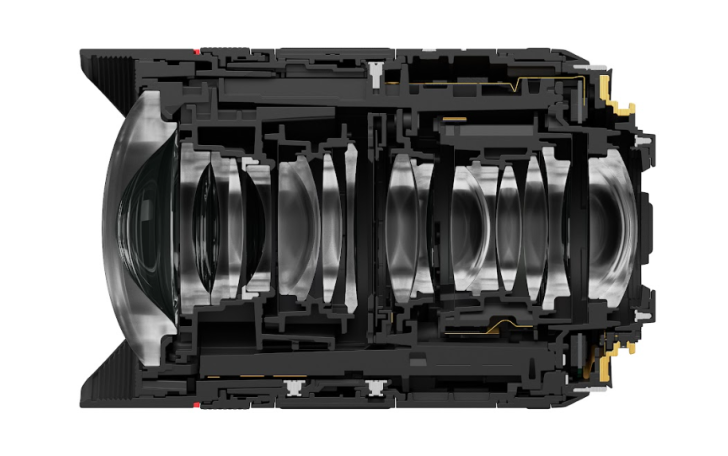
There are limited lenses that are as wide and fast as the Canon RF 14mm f/1.4L VCM – the only one I can think of is the Sigma 14mm F1.4 DG DN Art, but it’s a monster of a lens made for DSLR mounts and adapted for mirrorless mount cameras. The sigma lens is 1160g, and with a diameter of 101mm and a lens length of 150mm, the Canon 14mm is impressively compact. Sigma and Sony both make smaller 14mm f/1.8 lenses, but nothing to match the speed of Canon’s newest VCM lens.
As far as the elements, Canon threw in all its tech to make this lens.
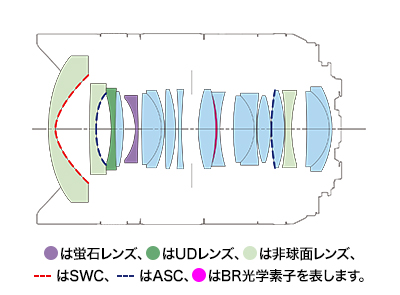
Above is the optical element layout of the Canon RF 14mm f/1.4L VCM. The Purple element is a flourite element, dark green is UD, light green is glass molded aspherical, red dashed line indicated SWC coatings, blue dashed line indicates ASC coatings, and the pink sandwiched in between two elements near the center – is the BR organic resin layer.
Whew.
I honestly don’t think we can marvel at this enough. This lens is a modern optical engineering accomplishment for its size, weight, and aperture speed, and now we talk about its MTF, which is where you see where Canon really flexed its optical engineering muscle.
This MTF diagram, assuming that Canon’s quality assurance matches it, is extremely impressive, with contrast near perfect across the entire field of view, and resolution exceptional across the entire frame. As well, coma looks reasonably controlled as well.
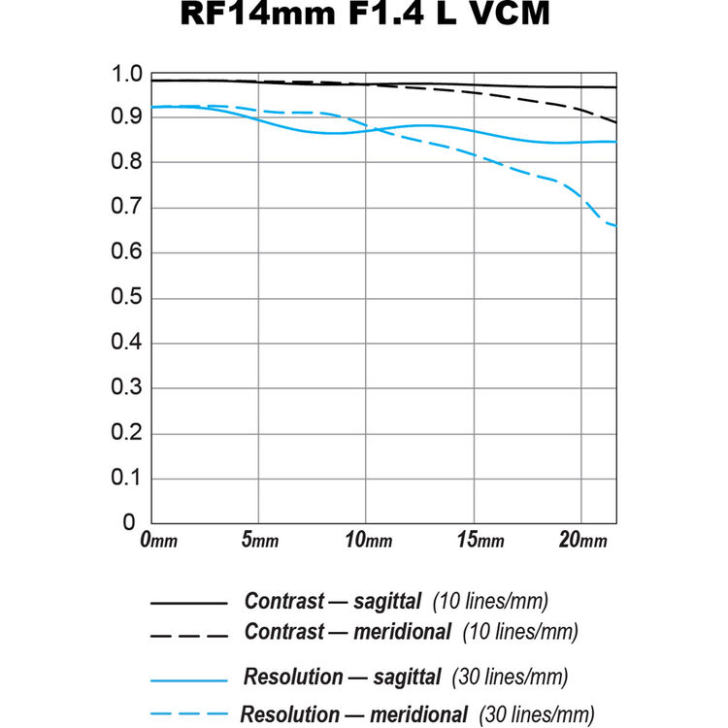
I remember when Canon released the EF 14mm f/2.8 and was roundly trounced by the Nikkor 14-28 f/2.8 zoom lens in terms of optical performance. Those days are long over, and this lens shows that Canon, unlike in past eras, can create ultra-wide angles without peer.
Coma
Coma performance is going to be a major factor for those who want to use this to photograph stars, as the distortion that you get in the corners can be difficult to correct if the lens exhibits a significant amount of coma aberrations. Going by the MTF, we figured that there would be some coma, but not a significant amount.
Byran from the-digital-picture has already posted some deep corner coma images, and the results were about what I expected.
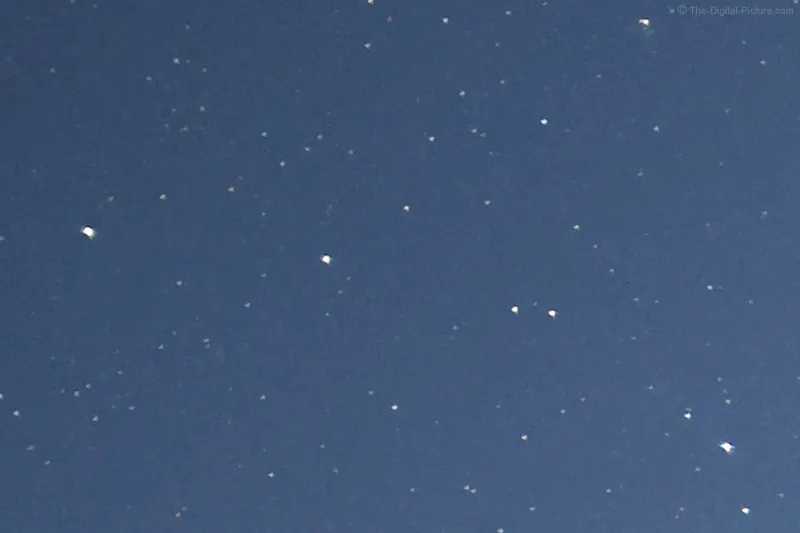
This is the test I was anxious for. The image below is a 100% crop from the top-left corner of an R5 II image captured at f/1.4. That result is not quite perfect, but it is impressive for any lens, and extremely impressive for 14mm f/1.4.
I agree, for a f/1.4 lens, this is exceptional results – this would be considered very good results for a much slower f/2.8 lens, let alone a lens that is almost 2 stops faster.
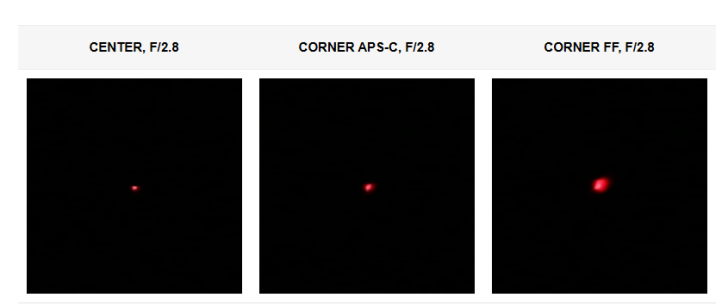
For instance, this is a coma test from one of the best astrophotography lenses you can get, the Samyang 14mm f/2.8 (if you get a good copy). It’s f/2.8 and considered to be excellent. The Canon RF 14mm f/1.4 is almost 2 full stops faster than this lens and as good.
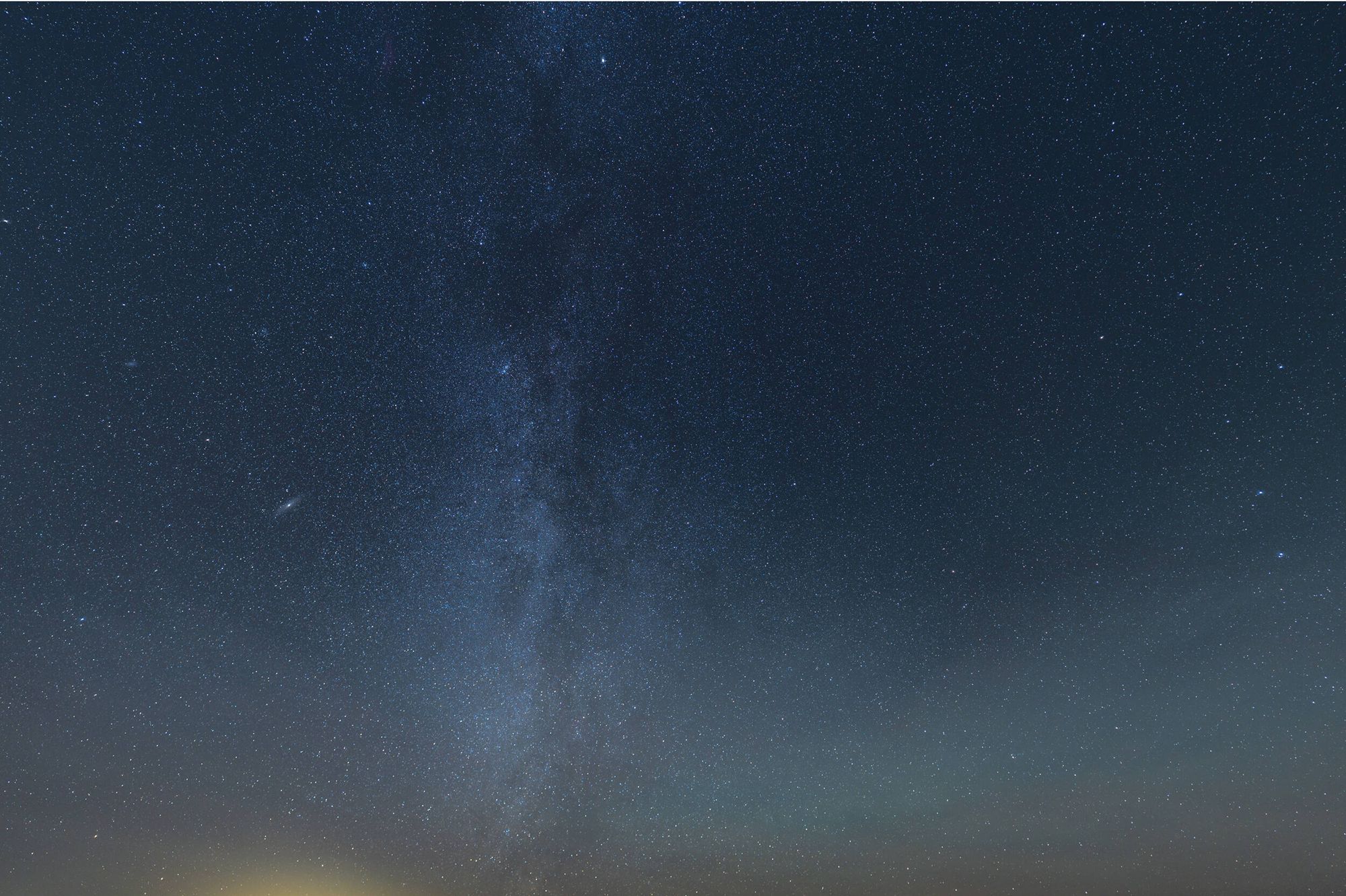
Landscape astro imaging is one discipline where lens speed really matters, so this lens will be a welcome addition to anyone’s kit who is looking at doing some Milky Way images. Don’t forget that, as a bonus, CanonRumors has an advanced celestial shutter speed calculator for you to use on your night sky image calculations.

Using this calculator you can accurately determine what your shutter speed should be for any given focal length and position on the globe.
Press Release
Canon Continues Wide Angle Optical Excellence with Launch of RF7-14mm F2.8-3.5 L Fisheye STM Zoom Lens and RF14mm F1.4 L VCM Prime Lens
MELVILLE, N.Y., February 4, 2025 — Canon U.S.A., Inc., a leader in digital imaging solutions, today announced the launch of the RF7-14mm F2.8-3.5 L Fisheye STM zoom lens and the RF14mm F1.4 L VCM prime lens. Building on Canon’s legacy of innovative optics, these new RF-mount lenses expand the diverse lineup for professional photographers, videographers, and hybrid creators. The RF7-14mm F2.8-3.5 L Fisheye STM zoom lens introduces the world’s widest angle zoom lens1 with a 190° field of view, ideal for dynamic fisheye imagery in sports, landscapes, and virtual reality. The RF14mm F1.4 L VCM prime lens delivers Canon’s brightest ultra-wide1 angle interchangeable lens ever produced, a 14mm lens with a bright f/1.4 aperture, perfect for astro, architecture, and video applications.
Canon RF7-14mm F2.8-3.5 L Fisheye STM zoom lens redefines versatility in ultra-wide angle fisheye imaging. Continuing the heritage of the groundbreaking EF 8-15mm f/4L Fisheye USM, the world’s first fisheye zoom lens2, this new RF lens pushes boundaries further for professionals seeking impactful, distorted perspectives. It supports a wide range of unique use cases including sports, landscapes, starscapes, video, and virtual reality.
Key features include:
- Canon’s widest single lens3 with a maximum 190° field of view, achieving both circular 190° fisheye at 7mm (wide), and diagonal 180° fisheye at 14mm (telephoto), with its’ 7-14mm zoom range.
- Variable maximum aperture of f/2.8 at 7mm (wide) and f/3.5 at 14mm (telephoto), brighter than its EF predecessor for enhanced low-light performance and background separation.
- Built-in support of Canon EF-to-EOS R mount adapter drop-in filters (Clear, CPL, Variable ND) plus Lens Lock/Limit, Lens Function button and Control Ring.
- High image quality with 5 UD lens elements, 2 replica aspheric lenses, and Air Sphere Coating (ASC) applied in 3 locations to reduce ghosting.
- Leadscrew-type STM focus drive with position sensors for smooth, video-capable operation and reduced focus breathing (0.4% at wide, 1.5% at tele).
- Fisheye images shot with the RF7-14mm F2.8-3.5 L STM zoom lens can be converted using Canon EOS VR Utility for viewing on a PC or head-mounted display. Conversion of 2D VR images is possible with cameras such as: EOS R5C, EOS R5 Mark II, EOS R5, EOS R6 Mark II.
- This lens appeals to professional photographers and videographers seeking dynamic imagery and VR studios desiring a lens for monoscopic shooting, offering wider angle zoom, brighter aperture, and more video capabilities than the EF 8-15mm.
The Canon RF14mm F1.4 L VCM prime lens empowers professional photographers, and hybrid creators with Canon’s brightest ultra-wide-angle interchangeable lens ever produced, an extremely compact and lightweight ultra-wide lens with incredible optical performance. Updating the legacy of the EF 14mm f/2.8L II USM, this lens provides ultra-wide angle views with a fast f/1.4 aperture and controlled distortion and rectilinear characteristics from the center to image. It’s designed for pro still photographers capturing landscape, astro, and starscape imagery, as well as architectural and real estate shooters, and videographers and time-lapse creators.
Key features include:
- Canon’s brightest ultra-wide-angle (14mm) interchangeable lens for hybrid Photo / Video use.
- Ultra-wide 14mm prime with f/1.4 aperture for outstanding low-light performance and background separation, brighter aperture than the EF 14mm f/2.8. Dual VCM (Voice Coil Motor) focusing for fast, precise autofocus in photo and video, with reduced focus breathing (3.0%, or 2.3% up to f/20).
- Compact and light weight at 4.4” (L) x 3.0” (D) and just 1.27lbs, providing a similar size, weight and design complimenting the comprehensive F1.4 L-series lens series (RF20mm/24mm/35mm/50mm/85mm F1.4 L VCM lenses).
- Amazing optics for high image quality and sharp rendering of point light sources with Canon’s first Fluorite element in an ultra-wide-angle lens, and featuring BR Optics, 1 UD lens, and 3 GMo aspheric lenses, plus Sub-wavelength coating in 1 location and Air Sphere coating in 2 for minimized ghosting.
- 11-blade aperture for smooth, circular bokeh.
- Iris ring compatible with EOS R1, EOS R5 Mark II, and EOS R6 Mark III cameras; plus Lens Function button and Control Ring.
Availability
The Canon RF7-14mm F2.8-3.5 L Fisheye STM zoom lens and RF14mm F1.4 L VCM prime lens are currently expected to be available by the end of February 2026, for estimated retail prices of $1,899.00 and $2,599.00 respectively4. For more information about Canon’s latest innovations and products, please visit www.usa.canon.com.
1 As of February 3, 2026 according to Canon data
2 As of August 23, 2010 according to Canon data
3 Among full-frame lenses manufactured by Canon with a focal length wider than 20mm
4 Specifications, availability and prices are subject to change without notice.
Specifications
| Principal specifications | |
| Lens type | Prime lens |
| Max Format size | 35mm FF |
| Focal length | 14 mm |
| Image stabilization | No |
| Lens mount | Canon RF, Canon RF-S |
| Aperture | |
| Maximum aperture | F1.4 |
| Minimum aperture | F16 |
| Aperture ring | Yes |
| Number of diaphragm blades | 11 |
| Optics | |
| Elements | 18 |
| Groups | 13 |
| Special elements / coatings | 1 flourite, 1 UD, 1 BR, 3 aspheric, SWC, ASC, flourine coatings |
| Focus | |
| Minimum focus | 0.24 m (9.45″) |
| Maximum magnification | 0.11× |
| Autofocus | Yes |
| Motor type | Linear Motor |
| Focus method | Internal |
| Distance scale | No |
| DoF scale | No |
| Physical | |
| Weight | 578 g (1.27 lb) |
| Diameter | 77 mm (3.03″) |
| Length | 112 mm (4.41″) |
| Sealing | Yes |
| Colour | Black |
| Filter notes | Slot for rear gelatin filters |
| Hood supplied | Yes |
| Hood product code | 14B |
| Tripod collar | No |




The surprising thing to me is the end of February availability date, sooner than I had expected.
They have thrown everything in one lens and hoping that users needing just one feature will pony up the $$$$
4.4” long vs EF 3.3" + 0.9" adapter if my non-metric is correct.
Same weight (unadapted) though so saving the adapter weight.
Would you use the circular polariser drop in filter with a fisheye? I've never tried it.
The variable NF filter is normally problematic for wide angled but this would be next level.
Nice to add 11 blades vs 7 for the EF version.
My EF8-15/4 does suffer from bad CA around the outside so I normally have to circular crop part of the field of view as I can't correct it. Hopefully the new one is better.
https://cloud.my.canon.com.au/powershot-g7-x-mark-iii-limited-edition
https://www.bhphotovideo.com/c/product/1948715-REG/canon_7563c001_powershot_g7_x_mark.html
Sigma makes an older 14mm f/1.8 that is available in EF mount. But of course, as good as f/1.8 is, it isn't f/1.4, so we can't compare price directly. There may be other technical differences in terms of AF performance, weather sealing, size & weight as you noted, and so on that also matter to some people in some circumstances... we'll have to see how this new lens reviews first.
The sigma 14/1.4 was never out in the EF mount. Only the 14/1.8 was released for the EF mount, and it's not even available anymore. Do you propose to take a time machine back and purchase one?
Not to mention that this simply is not "just" an astro lens
But using your astro example, in many cases, you need to hike to your location. I'm sure a few people wouldn't mind shaving bulk and weight off their kit if it even was available, or the poor disadvantaged person decided to use the sigma 14/1.4 with a Sony camera.
we're ignoring that for now. Craig is going to write that one up because he doesn't trust me to do so 😉
I have to really dive into how the "twill front ring" will change everything.