

When you purchase through links on our site, we may earn an affiliate commission. Here's how it works. |
It's a new year and for the 23rd straight year, Canon is claiming the #1 sales spot in Global Interchangeable-Lens Digital Camera Market for 2025. This is quite the accomplishment, even if quantifying the claim is murky at best.
This includes both mirrorless and DSLR cameras. Canon is still selling a lot of DLSRs, having sold somewhere around 600,000 of them in 2025. Canon's overall markshare has been hovering around 48% for a long time, as Sony has remained stagnant, and Nikon has obviously lost marketshare. We're still waiting on the final tally in that regard for 2025.
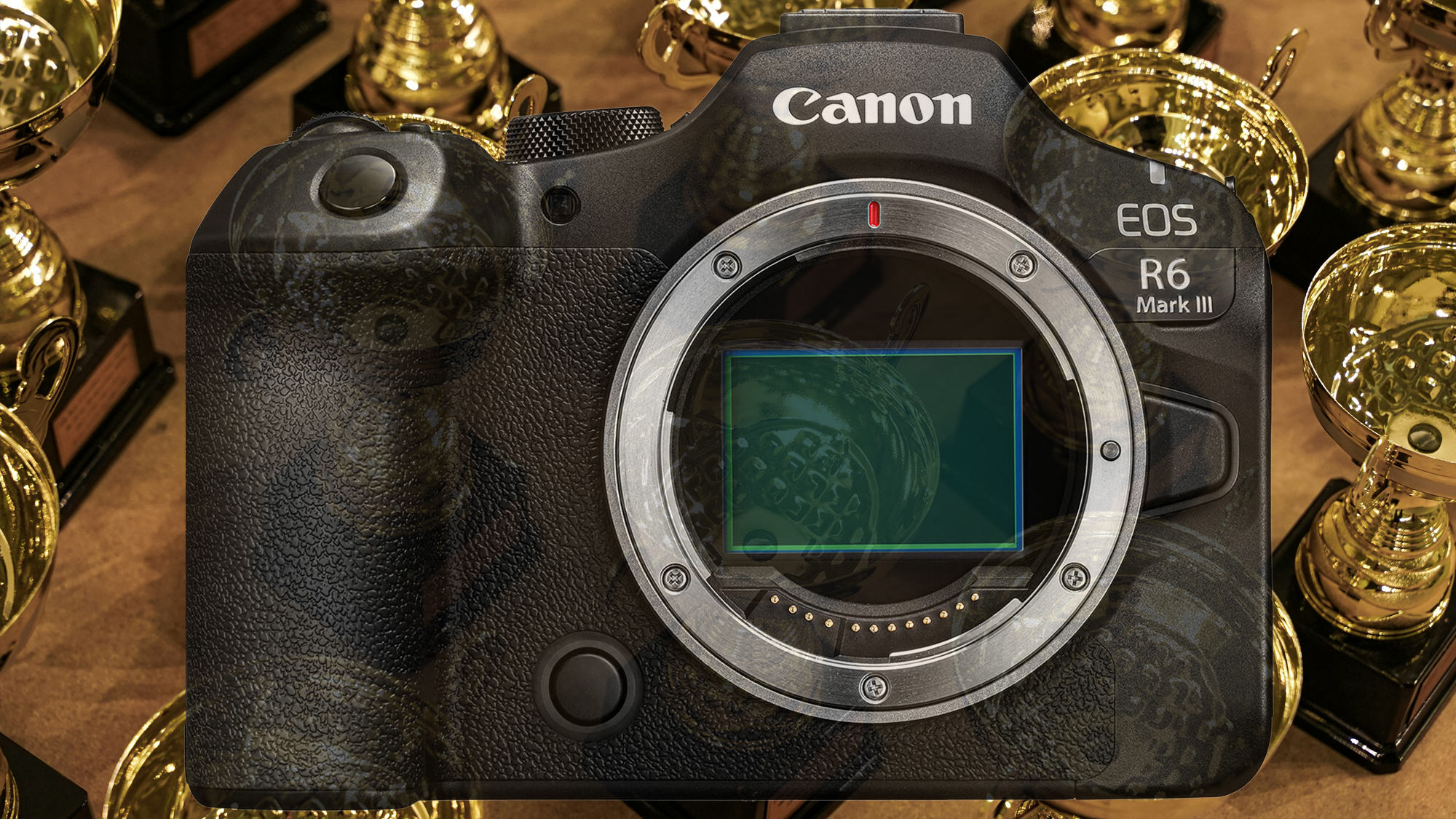
Key Features: Built to be the high-performance all-arounder for creatives who work in both photo and video, the Canon EOS R6 Mark III deftly combines an array of hybrid capabilities, upgraded imaging, and revised handling and design to suit shooters working in a wide variety of scenarios. |
It seems Canon make these claims through a “Canon Survey”. I have no idea how the survey works and Canon doesn't expand on exactly what the survey is. So take this claim with a grain of salt if you care. I do not, but it makes for good internet fodder. Go check out the Sony comment sections…….
I expect Sony will soon announce that they are #1 as they did last year soon after Canon's 22nd year of being “number 1|”. Canon's financials have been very positive for quite some time and their imaging division remains extremely profitable, which isn't something many others can say. Sony hides their camera and lens performance hidden in their financials, so who knows? Their sensor business makes up for any financial shortcomings they may have from cameras and lenses.
Press Release
MELVILLE, N.Y., February 23, 2026 – Canon U.S.A., Inc. today announced that its parent company, Canon Inc. is celebrating that the company’s interchangeable-lens digital cameras (digital SLR and mirrorless cameras) have maintained the No. 1 share 1 of the global market for 23 consecutive years from 2003 through 2025.
Canon’s EOS series of interchangeable‑lens digital cameras is an imaging system based on the basic concept of “Speed, Comfort, and High Image Quality,” for which the company has developed proprietary key components, including CMOS image sensors, the DIGIC image processors, and interchangeable lenses.
Putting together a wide‑ranging product lineup—from high‑performance flagship models that are highly trusted by professionals to entry‑level models that allow users to enjoy full‑scale shooting with easy operation, as well as a rich selection of 1132 RF and EF lenses that enable a wealth of creative expression—Canon continues to support the diverse needs of customers.
During the dawn of digital SLR cameras, Canon introduced its breakthrough EOS Digital Rebel / EOS 300D / EOS Kiss Digital (product name varies by region) in September 2003. By launching this groundbreaking camera, which was competitively priced and featured a compact, lightweight design, Canon spurred growth in the digital SLR market, capturing the top share of the global market and heralding the age of digital SLR cameras.
Canon has since continued to introduce innovative products, including the professional model EOS-1D series, as well as the EOS 5D series, which played a leading role in popularizing video recording with digital SLR cameras.
In October 2018, the company launched the EOS R System, which further expands the boundaries of visual expression, followed by the full‑frame mirrorless EOS R5—the world’s first3 camera to feature 8K video recording, released in July 2020, and the flagship EOS R1, released in November 2024, which combines advanced autofocus performance, high image quality, and high reliability to meet the demanding needs of professionals. Canon continues to pursue new possibilities in imaging expression.
In 2025, Canon expanded the EOS R System even further by releasing the APS‑C mirrorless EOS R50 V (May 2025), the first model in the new EOS V series that offers creative video functions, along with the full‑frame mirrorless EOS R6 Mark III (November 2025), which condenses excellent shooting performance into a single camera to meet the wide‑ranging needs of advanced amateur users.
In addition, Canon released seven models of RF lenses4 in 2025. Through these continued efforts to enhance the EOS R System, Canon secured the No. 1 global market share for interchangeable‑lens digital cameras for the 23rd consecutive year since 2003. Going forward, Canon will continue to refine its proprietary imaging technologies while bringing fulfillment and excitement to people’s daily lives as well as promoting the spread of photo and video culture by providing products, services, and solutions that meet its customers’ diverse needs.
- Based on a Canon survey
↩︎ - Types of lenses sold vary according to each market. Includes 4 types of extenders. Among lenses announced as of February 24, 2026.
↩︎ - Among digital interchangeable‑lens cameras released prior to July 8, 2020. Based on a Canon survey
↩︎ - RF lenses released in 2025 (including RF Cinema lenses) are: RF16‑28mm F2.8 IS STM (February 2025), RF20mm F1.4 L VCM (April 2025), RF75‑300mm F4‑5.6 (May 2025), RF‑S14‑30mm F4‑6.3 IS STM PZ (July 2025), RF85mm F1.4 L VCM (September 2025), CN5×11 IAS T/R1 (November 2025), RF45mm F1.2 STM (November 2025)—for a total of seven models
↩︎






Hard pass.
Previously, Sony has claimed the #1 spot based on camera revenue, presumably because when they consider units sold they are clearly #2, and being #1 sounds better even if you need to define that in a way your competitors don’t.
Where does that estimate come from? Canon doesn't report that in their financial documents.
4000D, 2000D, 250D, 5DmkIV and 1D X mkII
But sheesh that's a lot of DSLRs still selling. Is it because commercial photographers are keeping a like-stock handy (less training) or because some people just like DSLRs? In Canada the price really hasn't budged, unlike EF lenses where discounts can be found every few months due to "overstock".
I'm mixed in my opinion about the state of lens craft, but I think that the R series cameras are the best of the full frame options out there these past few years.
- Developing countries where COGS/revenue for photography businesses is low. I did rough calculation of wedding photographers in the past covering China/India and Indonesia equating to ~40% of global population with (back of the envelope) calculation of middle class Gross National Income between USD1k-14k/yr. Choosing middle class as low income is less likely to afford a photographer and high income will pay handsomely anyway.
Having a DLSR is a key "professional" selling point vs a phone camera.
- Specific photography sectors to maximise profit eg cruise ships and school photos.
Of course, there are others anywhere in the world where people want a step up from cameras, buy the cheapest "proper" camera and realise that their phone is better and leave them on the shelf.
5Div/1DXii are for replacements for the rusted-on optical viewfinder/long battery life users. Film cameras are still being sold.....
...none other than 15 year old me on Christmas morning, holding my first SLR fresh from the box – a Pentax A3000.
Here’s me in 1973 with my first SLR – Canon FTb.
Currently, my hair is considerably shorter on the sides and almost nonexistent on top. Paisley (shirt) prints must have gone in and out of style five times since then.
If R6 mkii is still sellling in 2025, I don't think A7V help a lot.
Edit: I forgot my ME...
I have a personal interest in the Medium Format digital market and discovered that Fujifilm is the clear leader. They own about 65% of the market because their GFX system is more affordable than competitors. Hasselblad holds roughly 22% of the share and the rest belongs to niche brands like Leica and Phase One. This segment is much smaller than full frame but generates high revenue per camera sold.
As @John Wilde and @justaCanonuser noted DSLRs still have a presence despite the shift to mirrorless. CIPA data shows 690,000 DSLRs were shipped in 2025 which is a 31% drop from the year before. Most of these sales come from Canon’s entry-level models like the 2000D. @David - Sydney correctly points out that these remain popular in developing countries because they are cheaper than mirrorless options. Been living in the Philippines for a few decades and I was told locally that dSLR bodies/lenses are not being imported here anymore for the past few years. I know because I made inquiries about the 5D Mark IV, 1D X Mark III in 2020 and even that 2000D this month for a picker friend. My personal guess is that developed markets like the US & EU where the mindshare among consumers is "dSLR" and not mirrorless so they reflexively ask for "dSLR" even when the whole market is moving to MILCs. However for professionals and those interested in "full frame or bigger" the market has moved almost entirely to mirrorless bodies like the R5 Mark II or the Sony A7 series.
neuroanatomist and @P-visie mentioned Pentax but their sales are insignificant in the global share for full frame or medium format. While @Del Paso calls them boutique cameras they do not compete with the "Big Three" in unit volume. For those tracking the top of the market the competition is strictly between Sony, Canon, and Nikon for full frame, and Fujifilm for medium format.