
Canon Continues to Research Sensor Cooling

Richard Cox
7 Min Read

When you purchase through links on our site, we may earn an affiliate commission. Here's how it works.

Life was grand before IBIS (in body image stabilization) because camera manufacturers could simply slap a hunk of metal onto the back of the sensor, and things would stay cool, as heat would transmit through the camera body chassis and dissipate.

However, when the camera is stabilized, the weight and size of the platform that has the sensor attached have to remain lightweight.  The larger the platform, the more mass, and the more mass requires more energy to move. This makes it harder for IBIS to react to motion, and also for IBIS not to drain your battery before you have even taken a photo.

So the manufacturers tend to make those sensor platforms now as small and light as possible for IBIS, but this, on the other hand, makes heat problematic, as there's not enough means for heat to move away from the sensor because it's not fixed to the camera body.

Canon has patented metallic strips that transmit heat away from the camera’s sensor, and this looks to be an expansion on this.

Essentially, in your camera, there are flexible strips, some of them transmit the signals to and from the sensor, such as thin ribbon cables that have a high degree of flex, but there are also others that have the primary responsibility of shunting heat away from the sensor as quickly and easily as possible.

This will never be as easy as a directly attached sensor to a camera frame, which is why you tend to see record times more problematic on cameras that have IBIS.

Not only does heat affect the long-term stability of the sensor, even for stills, having a warm or hot sensor will degrade the sensor’s high ISO noise capabilities, which is why most astrophotography sensors are actively cooled.  The cooler the sensor, the less noise.

Canon has recently published three patent applications dealing with this, and all of them go into a great deal of mechanical engineering details on the sensor assembly and camera body. It’s an insight into what Canon does under the hood to attempt to deliver the best possible camera system to us, so we can complain about it – naturally.

Patent Publication No. 2025-176889

Canon discloses the problem that they are looking to resolve:

In recent years, imaging devices that perform shake correction by moving the imaging element in a direction perpendicular to the optical axis to improve image quality have become widespread. Even in imaging devices that perform shake correction, sufficient heat dissipation is required because heat generated in the imaging element during operation of the shake correction mechanism, continuous shooting, and video shooting affects image quality.

In this patent application, Canon discusses a flexible member that joins the sensor platform and the camera body, allowing heat to more efficiently move off the sensor.
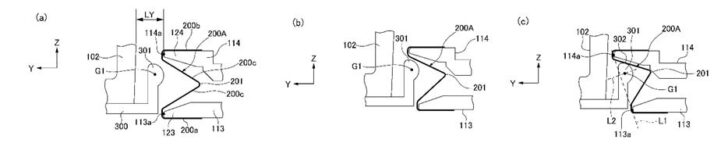
Canon IBIS Cooling patent side view.

In this rudimentary cross diagram, the camera base (immovable) portion is 113, and the sensor movable platform is 114.  The flexible membrane to move heat from the sensor (114) platform is 200.  Figure (a) is when the IBIS platform is at a neutral position, and (b) is when it’s at its maximum shifting position.  Figure (c) interestingly is when the camera is powered off, and the platform is locked and at rest.  I always wondered what that looked like.

This patent application, as Canon states, hopes to improve the heat dissipation and not affect smooth IBIS motion.

Patent Publication No. 2025-176890

This patent application deals with, essentially. Hey, your fancy patents are all cool, but how do we actually put them together? This patent discloses a more optimized design that can be manufactured easily.

The present invention has been made in consideration of these problems, and aims to provide an imaging device that is easy to assemble without impeding the drive controllability of the moving parts while sufficiently cooling the heat from the image sensor.

This patent application deals with how to attach the heat dissipation item between the moving part of the sensor platform and the fixed portion. Interestingly, we see a little on what that conductive strip is made out of as Canon mentions “graphite sheet or the like laminated with a PET sheet and the like.”, which is a pretty common heat spreader material that Canon is using.

Patent Publication No. 2025-176965

This patent application is looking closer at the strip that conducts the heat from the sensor platform to the base, and making it easier to flex. If you consider that an IBIS sensor platform has to move in all directions, you have to appreciate that it's much easier to move lengthwise to the strip, but more resistance when you move the strip's lateral direction. Moving in the lateral direction forces the strip to bend more stiffly, and probably even worse, applies more force to push back against the sensor platform.

How Canon is combating this in this patent is by cutting slits in the heat conductive strip to make the strip easier to flex in the lateral direction.
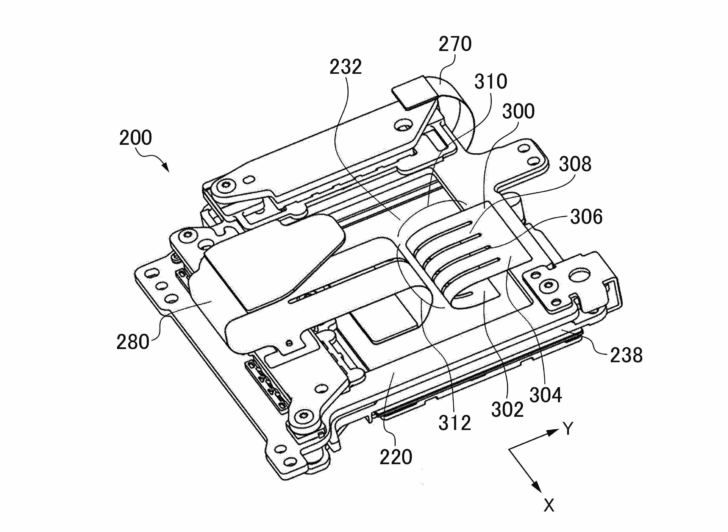
Canon Patent of IBIS unit, showing slitted thermal ribbon

You can easily see this on the above diagram, where the heat conductive strip is 308, and the slits are 306. The same sort of slit seems to be present in the main data flex cable, 280, which is used for data transmission. The smaller 270 flex cable used for data (or perhaps power) does not have a slit, but it's a much smaller flex cable.

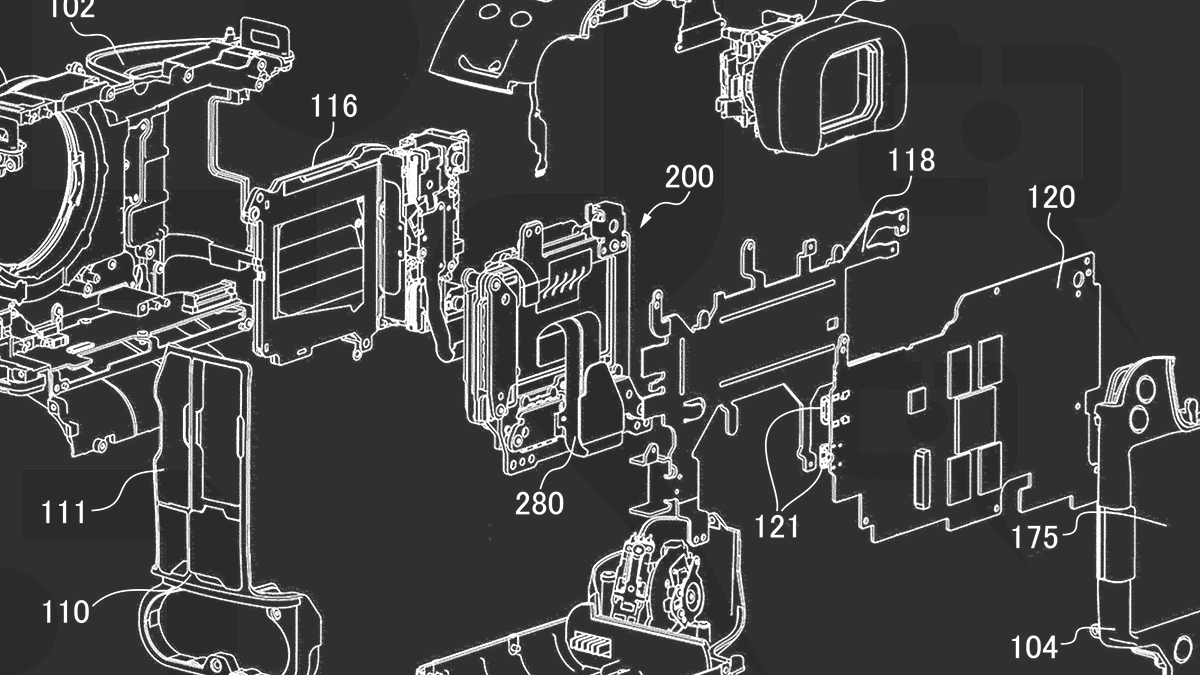
Interestingly, the breakout mechanical design of the overall camera shows an integrated vertical grip, such as a 1 or 3 series camera.
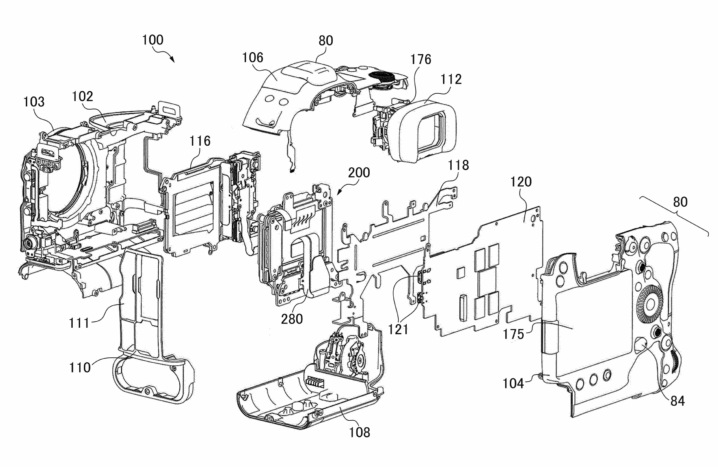

Exploded Diagram of a 1 or 3 series camera body showing the IBIS unit

Go to discussion...

Share This Article
Follow:
Richard has been using Canon cameras since the 1990s, with his first being the now legendary EOS-3. Since then, Richard has continued to use Canon cameras and now focuses mostly on the genre of infrared photography.

30 comments

  1. I'm curious if it'll be better to use oil/liquid cool. The fluid itself can dampen the sensor, and wouldn't the cooling be more effective as there's more surface to conduct the heat away from CMOS.
  2. Thanks for sharing @Richard CR

    I hope they can keep fans or else away from the body by the use of that - at least for stills mainly cams. I'm not interested in long time video, but others are.

    I'm curious if it'll be better to use oil/liquid cool. ...
    The thermal conductivity λ (lambda, GER) or κ (kappa, INT) of copper is ~ 380 W/(m·K), the one of oil 0,15 W/(m·K) and of water 0,5562 W/(m·K).
    So many metals are about 600 to 1000 times more effective in thermal conductivity than liquids.
    Silver would be the best metal (429), graphene (5300) the highest mentioned in (GER) wiki.
  3. I'm curious if it'll be better to use oil/liquid cool. The fluid itself can dampen the sensor, and wouldn't the cooling be more effective as there's more surface to conduct the heat away from CMOS.
    IBIS is not the dampen the sensor. It is trying to counter act the whole camera moving in people handheld situation. Anyways those liquid are not good heat conductors.
  4. Thanks for sharing @Richard CR

    I hope they can keep fans or else away from the body by the use of that - at least for stills mainly cams. I'm not interested in long time video, but others are.


    The thermal conductivity λ (lambda, GER) or κ (kappa, INT) of copper is ~ 380 W/(m·K), the one of oil 0,15 W/(m·K) and of water 0,5562 W/(m·K).
    So many metals are about 600 to 1000 times more effective in thermal conductivity than liquids.
    Silver would be the best metal (429), graphene (5300) the highest mentioned in (GER) wiki.
    Liquids don't have great conductivity, but they make up for that with convection (i.e. they move). This is why water cooling is the most efficient way to cool your CPU (in that case, forced convection with a pump). The catch with liquid cooling would be managing the refractive index of the liquid (and avoiding bubbles)
  5. Liquids don't have great conductivity, but they make up for that with convection (i.e. they move). This is why water cooling is the most efficient way to cool your CPU (in that case, forced convection with a pump). The catch with liquid cooling would be managing the refractive index of the liquid (and avoiding bubbles)
    The convection and heat effects on refractive index would be just like those on using a long telephoto lens on a hot summer's day with the sun baking the ground!
  6. Liquids don't have great conductivity, but they make up for that with convection (i.e. they move). This is why water cooling is the most efficient way to cool your CPU (in that case, forced convection with a pump). The catch with liquid cooling would be managing the refractive index of the liquid (and avoiding bubbles)
    Liquids are used to cool CPUs because those are better than air (!!!). But worse than solid metals.
    Just with air the heat sink would become too big for most.
    I have fully passive cooled PC with an air heat sink filling almost half of the PC housing.
    Guess what‘s the connection between CPU and heat sink?
    Yes! Massive copper bars!!!

    Liquid cooling is cheaper to bridge the (longer) distance between heat source and sink in most other applications.
    And for convection (passive or pumped) you‘ll need space. Difficult in a camera housing.

    I know what I‘m talking about because I work a lot with power semi conductors like IGBTs - liquid and air cooled.

    And when you think about a heat pipe, this is just another physical principle. But not liquid cooling.
    That is a heat-transfer device that employs phase transition to transfer heat between two solid bodies.
  7. The convection and heat effects on refractive index would be just like those on using a long telephoto lens on a hot summer's day with the sun baking the ground!
    Yes, front side liquid cooling would be a challenge. If a proper seal could be made, backside liquid cooling is a possibility. Just think, a micro-miniature CPU cooler, pump and all 😉. It could be very lightweight and would not be subject to dust like a fan. The coolant hoses would likely be more flexible than the graphene strips in the patent.
  8. Liquids are used to cool CPUs because those are better than air (!!!). But worse than solid metals.
    Just with air the heat sink would become too big for most.
    I have fully passive cooled PC with a heat sink filling almost half of the PC housing.
    Guess what‘s the connection between CPU and heat sink?
    Yes! Massive copper bars!!!

    Liquid cooling is cheaper to bridge the (longer) distance between heat source and sink in most other applications.
    And for convection (passive or pumped) you‘ll Need space.

    I know what I‘m talking about because I work a lot with power semi conductors like IGBTs.
    Unless you have a river handy, the heat has to be eventually dissipated to air. Some metals have great conductivity, but typically, the closer you can get a moving liquid to the heat source (i.e. the less metal in the way), the better the result will be. Your "passive" cooled CPU is still air convection cooled. The massive blob of metal is just an extended heat spreader. CPU "air coolers" actually use vapor phase cooling, which can be fully as efficient as liquid cooling, but for CPUs, water cooling has more capacity, simply because you can get more surface area on a radiator (for that final connection to the air) than will fit on top of the CPU "air" cooler. I, too, have cooled many power Semis over the years along with some engines and other things that make heat and noise.
  9. Unless you have a river handy, the heat has to be eventually dissipated to air. Some metals have great conductivity, but typically, the closer you can get a moving liquid to the heat source (i.e. the less metal in the way), the better the result will be. Your "passive" cooled CPU is still air convection cooled. The massive blob of metal is just an extended heat spreader. CPU "air coolers" actually use vapor phase cooling, which can be fully as efficient as liquid cooling, but for CPUs, water cooling has more capacity, simply because you can get more surface area on a radiator (for that final connection to the air) than will fit on top of the CPU "air" cooler. I, too, have cooled many power Semis over the years along with some engines and other things that make heat and noise.
    I don’t understand why you‘re trying to explain air cooling to me, when I already explained it.
    To original topic was liquid vs. solid body heat transfer.
    Of course, all heat losses have to be transferred to air - in the end.
    Or do you have your private river in your camera bag?

    Again: „heat transfer“ is what I argue about.
  10. I don’t understand why you‘re trying to explain air cooling to me, When I already explained it.
    To original topic was liquid vs. solid body heat transfer.
    Of course, all heat losses have to be transferred to air - in the end.
    Or do you have your private river in your camera bag.

    Again: „heat transfer“ is what I argue about.
    I was responding to your statement "Liquids are used to cool CPUs because those are better than air (!!!). But worse than solid metals". I was simply pointing out that moving (or boiling as in vapor phase) liquids can be more efficient at heat transfer than the best of metals. You used your "passively" cooled CPU as an example, but you would have a hard time "passively" (i.e. conductively) cooling an RTX 5090, no matter how big the block of copper. Vapor phase or liquid are the only practical means that will move 600 watts from an area that small while keeping the temp under 100 deg. So, yes I was talking about heat transfer (and disagreeing with your statement).
  11. I I was simply pointing out that moving (or boiling as in vapor phase) liquids can be more efficient at heat transfer than the best of metals.
    The better the longer the heat pipe is, I know.
    But how long could it be inside a camera body?
    And how many flexible heat pipes do you know?
    Just imagine why the patent mentions metal or graphene/graphite strips.
  12. The better the longer the heat pipe is, I know.
    But how long could it be inside a camera body?
    And how many flexible heat pipes do you know?
    Just imagine way the patent mentions metal or graphene/graphite strips.
    Graphene is useful in this context because of its anisotropic thermal behavior (over 100 times more lateral heat flow than vertical). It sort of resembles a solid-state heat pipe. Flexible heat pipes are possible but not common, but liquid lines can be very flexible and that was where I started this discussion.
  13. Graphene is useful in this context because of its anisotropic thermal behavior (over 100 times more lateral heat flow than vertical). It sort of resembles a solid-state heat pipe. Flexible heat pipes are possible but not common, but liquid lines can be very flexible and that was where I started this discussion.
    If you know so much better than Canon developers (read the patent) why not apply at their R&D?
    If they know better what they‘re doing, it seems that my argumentation is closer to their developments and patents than yours.
  14. If you know so much better than Canon developers (read the patent) why not apply at their R&D?
    If they know better what they‘re doing, it seems that my argumentation is closer to their developments and patents than yours.
    I never suggested that I know better than Canon developers. I just suggested that liquid cooling could a viable possibility (with some obvious hurdles to be overcome). Graphene is a unique material and clearly an interesting choice for the application. I suspect Canon's engineers would avoid the complexity of liquid cooling if at all possible and that makes tons of sense. You do seem a bit cranky about your rather absolutist statement being corrected. Sorry if I hurt your feelings.
  15. We use liquid helium at 4.2K to cool our NMR coils. Might be a bit inconvenient for a camera sensor but should eliminate most of the circuit noise at low iso.
    But the camera sealing must be very good then. Not to avoid dust/moisture getting in, but H2 He from getting out. 🤣
  16. We use liquid helium at 4.2K to cool our NMR coils. Might be a bit inconvenient for a camera sensor but should eliminate most of the circuit noise at low iso.
    Convenience be damned. Go for max DR. 🤣
  17. But the camera sealing must be very good then. Not to avoid dust/moisture getting in, but H2 from getting out. 🤣
    That would be He 😉. It is even sneakier than H2.
  18. … Sorry if I hurt your feelings.
    I didn‘t get hurt.
    I just can‘t understand, how much space you think could be in a camera.
    If it was, of course heat or liquid pipes would be the much cheaper solution than copper bands or graphene.
    That would be He2 😉. It is even sneakier than H2.
    Your‘re partly right: just He.
    But thank you for correcting me.

Leave a comment

Please log in to your forum account to comment