

|
When you purchase through links on our site, we may earn an affiliate commission. Here's how it works. |
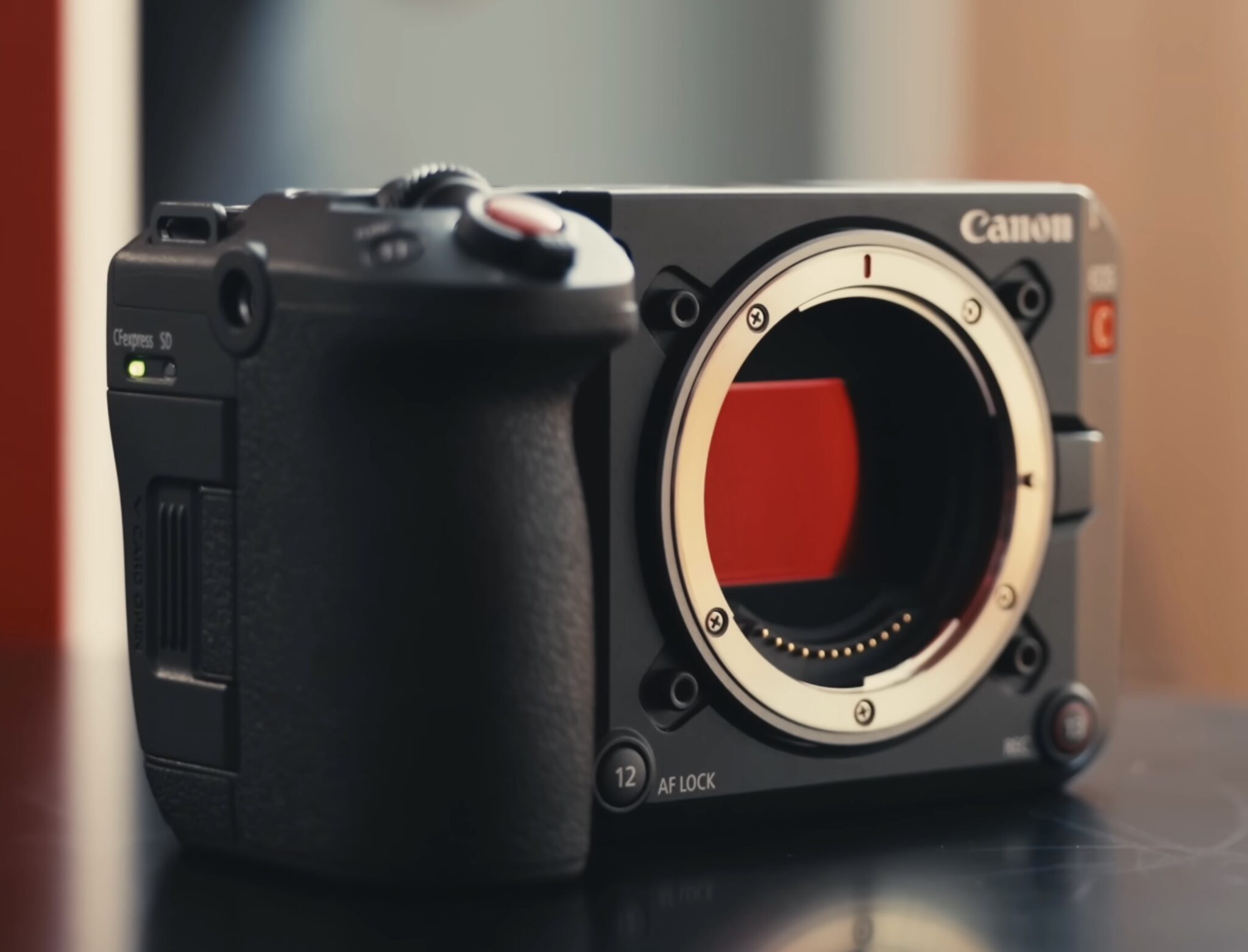
I have Canon's latest Cinema camera in the office, and I'm putting it through its paces. Is this the next great filmmaker's camera?
The Canon EOS C50's announcement sent a shockwave through the camera universe, signaling to everyone that Canon is ready to take big swings again in the professional video space. Now that the camera is out in the wild and fully in stock in most places, I figured it's about time I get my hands on one for a test drive.
This is a first impressions review of the Canon EOS C50, and a full length, in-depth review is still to come. What I noticed right away however is that Canon's new “entry-level” cinema camera is a fully-featured production tool that will undoubtedly become a camera bag staple for creators of all levels.
This review series is sponsored by the good people at Midwest Photo. Thanks again to Ken and the team for providing a loaner unit.
Body, Build & Ergonomics
The Grip
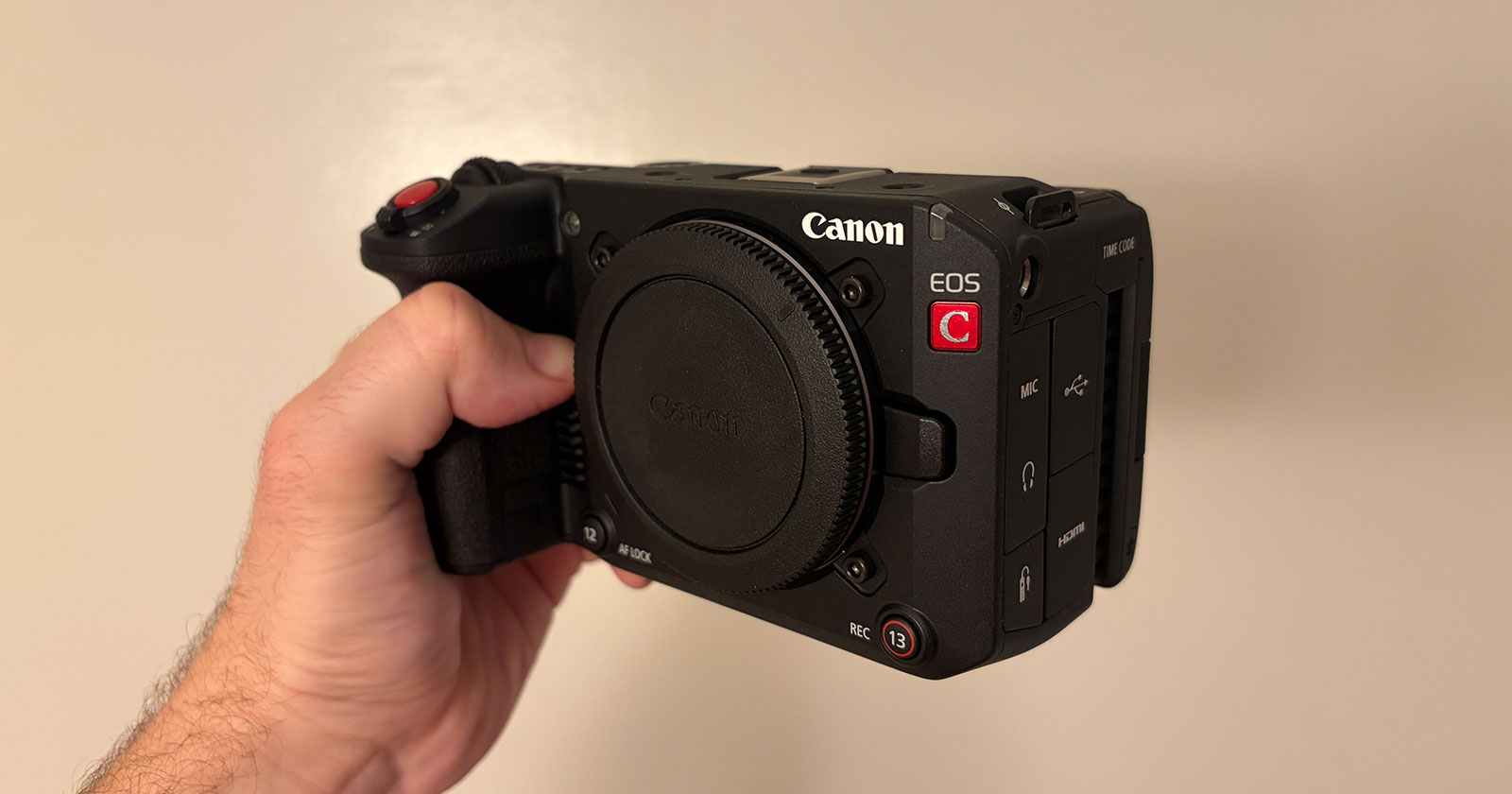
When you hold a Canon EOS C50, it's clear how much thought and care went into its design. The grip is chunky, moreso than a R5, but feels really great to hold. The extra space for an exhaust fan allows those with larger fingers to get nice and full hold on it. And if you're like me and used to gripping Canon mirrorless cameras with your middle, ring, and pinky fingers and latching your pointer over the top in line with the shutter button and front dial; you'll feel right at home.
Buttons and dials
That familiar feeling extends to the button layout as well. In the past with Canon's cinema line, the early C300 and C100's design language stood apart from their DSLR counterparts. Compared to today, and the user interface of the C50 is a lot closer to what you would find on the back of a R5 or R6.
All the buttons are more or less in the same place, with some mild changes in arrangement. This is great in my opinion, allowing the C50 to better integrate into a multi-camera shoot alongside Canon mirrorless cameras (or, more importantly, allowing a single operator to more-easily switch between a C50 and, say, a R6 Mark III on a dual-camera shoot).
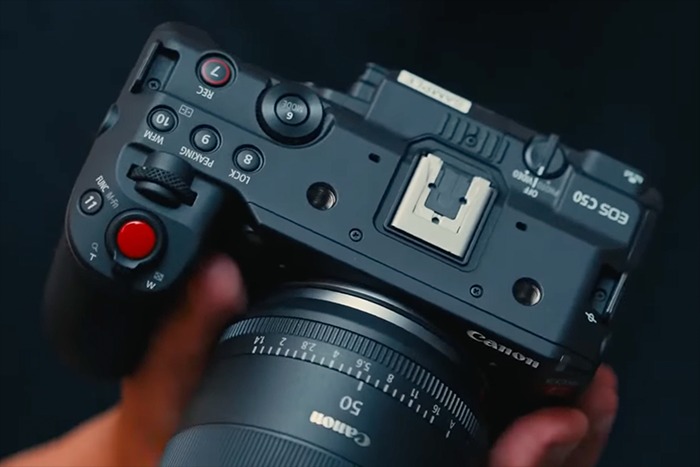
It's as if the design thesis of the Canon EOS C50 was meant to be an evolution of the R5C's “true-hybrid” ethos, in a Sony FX3-style body. This is evident by the lack of a viewfinder hump and the various 1/4″-20 mounting points on the top of the body.
The three-way Photo-Off-Video switch from the R5C is back, though it's a lot easier to land on the center Off position than the previous model. Also like the R5C, the buttons all have two sets of markings, white for video and gray for photo.
Zoom Rocker
Personally, the zoom rocker on the front does nothing for me because there aren't any true power zoom lenses at the moment. The (stellar and expensive) 24-105 f2.8L Z and 70-200 f2.8L Z both require an additional external power zoom unit, and given the weight of those lenses, I could imagine it's a bit front-heavy for the little zoom rocker to be useful.
Any time I've used those lenses I'm gripping them from the barrel and manually zooming. I could be wrong though, and maybe it would be handy in tripod-mounted situations—I don't own either of those to test out. Here's hoping Canon continues to develop small, internal power zoom lenses like they did with the R50V's kit lens, the RF-S 14-30.
XLR Handle – Worth The Extra $1000 Alone
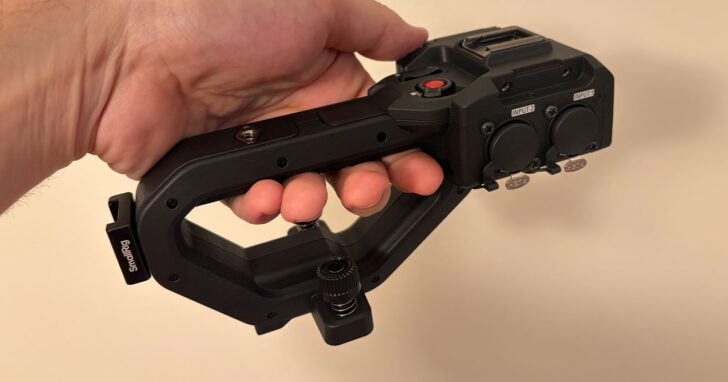
Let's talk about that gorgeous top handle, which in my opinion is the main selling point of the Canon C50 compared to other Canon mirrorless cameras. In short: it's fantastic! Canon has had top handle designs like this going far back as early 2011 with the XA10 camcorder.
I owned that camera and shot a ton with it in college, and the removable handle that allows full size XLR connections for shotgun mics with phantom power was enough to make the difference between a home video camcorder and a professional video production tool.

Handle Grip & Inputs
On the Canon EOS C50, the top handle is the best feeling handle I've held in a long time. Maybe that's cause I'm used to the Black Mamba cage for my R5, but I also recall the C70 and C80's grips being just ok. The grip is thick and rubbery, with a great indent for your thumb and pointer finger to brace against for extra support.

The handle allows for two channels of audio to be captured via the full-size (thank God!) XLR inputs. The other side has a covered audio control panel with full featured gain dials, manual-auto switches, and a switch for Line, Mic, and Mic + phantom power (for those that don't know, some traditional shotgun microphones require power directly from the XLR input). The dials are responsive and easily adjustable on the go, and don't have any plasticy clicking or rattling that some audio panels ironically come with.
Handle Build
The handle attaches at the base via the EOS C50's multi-interface shoe, and is secured with two spring-loaded 1/4″-20 screws. It's incredibly satisfying when you secure the handle into place because it feels solid, as if it's all a single piece. There's zero give or wiggle in the handle. Bravo, Canon.
With the handle attached, you lose access to the top plate's mounting points, but the handle itself has two additional 1/4″-20s on the top and rear. You can see in these photos that I attached a SmallRig cold shoe to mount my Rode Wireless Pro receiver.
The rest of the handle is pretty straightforward with an additional zoom rocker, a record button with a locking switch to prevent accidental triggering, a cold shoe for mounting accessories, and a tally lamp on the front. It also comes with two screws to attach a microphone holder on top. The mic holder works great, and uses a shock mount to absorb micro jitters. My Rode NTG-3 fit snug without the need to wrap it in gaff tape.

I have two complaints with the C50's top handle unfortunately, and both feel like huge oversights on Canon's part.
Firstly, the front box of the handle that houses the XLR connections doesn't have a stereo mic. The original Canon EOS C100's top handle had this brilliant inclusion of a stereo mic & grille, so if you had the handle attached but didn't run any XLR microphones into it, you could still capture decent audio. The C50 on the other hand doesn't have that, so without running a microphone into the handle, you're limited to the scratch mic on the camera body.
It's not that big of a deal in the long run because anyone using the C50 is extremely likely to have an external audio solution for their shoots, but it feels like a missed opportunity to add some extra better-than-scratch-audio benefit to keeping the handle attached in b-roll or MOS scenarios.
However, the larger complaint I have is in comparison to the Sony FX3's implementation of this design. Sony includes a plastic connection cover in the box to protect the handle's connection point, similar to the multi-interface shoe cover.
The few times I've built out a FX3 I found this to be extremely clutch. I'm always nervous about the connection pins being exposed, and it appears to be an easy point of failure for this design. A small bit of plastic to keep them covered while not using the handle feels so straight forward, and I was disappointed when unboxing the handle that Canon doesn't include a cover for the base of the handle.
Image Quality – It's Everything You Expect

Great Image Quality
I don't have much to say about the overall image quality of the Canon EOS C50 that hasn't already been said, here or elsewhere. It's just great. Expectedly, it can handle just about anything you throw at it. The YouTube shoot I brought it on last week was shot in 4K 24p, in XF-AVC S 422 10-bit.
Based on how I know Canon's Cinema operating system to work, the footage was downsampled from a full 7K sensor readout. Naturally, because it was for YouTube, the creators didn't want to deal with color grading, so I shot in standard Rec.709.
Brief Thoughts on Image Quality Debates
I think for me, when I'm shopping for a camera that's going to be a workhorse like the EOS C50 can and should be, the image quality itself is not something I'm particularly interested in. We're at the point nowadays where just about anything you use is going to look top notch.
The main things, in my opinion, that set one camera apart from another in 2026 is stuff like ease of use, build, ergonomics, menu situations, and lens mount. It's the “ease of use” stuff that makes or breaks a camera's overall shooting experience.
Much like I mentioned in my R6 Mark III review, menu quirks and other interruptions that take me out of shooting and force me to fiddle with buttons or dials are what will deter me from bringing a camera onto a job.
Basically, anything you shoot will look good.
Battery Life – It's Not Great

I understand why Canon chose to give the EOS C50 the LP-E6P battery. It makes sense. Again, looking at this camera as a continuation of the “true-hybrid” approach from the R5C, keeping batteries consistent with the full frame mirrorless cameras of the R5 Mark II and R6 Mark III makes the C50 more purchasable by current Canon owners.
If you look at the flip side, the reason I ended up selling my Canon R8 and haven't purchased any of the consumer-level cameras from Canon is primarily because having multiple battery systems is enough of a headache to make me not want them.
Limitations of the LP-E6P
The LP-E6P battery is by and large the best version of this battery that Canon has released. That said, it's limited by the form factor of an over-20 year old design.
Needless to say, the battery life on the EOS C50 just isn't that great. I had two LP-E6P batteries on me during my shoot, which, for a 3 hour shoot where cameras were rolling the entire time, just wasn't enough. One more would have had me covered without worry, but two didn't cut it.
I don't know what it is about the Cinema operating system that has a larger power draw than the standard EOS photography menu, but this is a bug that Canon needs to figure out and fix—especially if they're going to continue making true-hybrid cameras that can boot up either system for photo or video mode. This was the bane of the R5C's existence, and despite the better performance of the new LP-E6P battery overall, the main issue is still unnecessary power draw in standby mode.
Using Older LP-E6NH Batteries
For those with bags full of the older LP-E6NH batteries, they will work on the Canon EOS C50 in a pinch. However, unlike the R5C where you were simply limited to standard frame rates and base, lower-resolution recording modes—the C50 also claimed to cut power to the lens mount when running older batteries. For anyone shooting with fully manual glass, this might not be an issue.
In my test, I already had my EF 24-70 f2.8L set to f2.8, and we were shooting at night so I didn't test out aperture control. Auto focus on the other hand was noticeably non-functional. However, when I clicked the lens to manual focus, the focus-by-wire system did work. So it's not clear whether or not this is an arbitrary restriction imposed by the cinema operating system or not.
Long story short: like with any generation of Canon battery systems, it's best to get a ton of the new ones for your bag and slowly retire the old ones.
Full Review Coming Soon
I'll have my full Canon C50 review coming soon, and yes don't worry, I'll get you sample footage of all the frame rates and recording modes that your heart desires.
Is there a particular question that you have, or a feature you want to see me test out in the full review? Drop a comment below and I'll do my best to address it.
This camera is very exciting and I'm hoping it signals Canon's renewed commitment to serious video production. Will we see features from this continue to trickle down into a Super 35 version with R7 Mark II? A C30? A R7V? I hope so.


My biggest issue right now is with its usb c.
It’s not taking PD from various accessories and it’s also glitching when trying to connect it to a dji gimbal.
Coming from the R5C you would think it would work exactly as the R5C did. Start/stop recording via usb c at the very least and have usb c pd.
Other than that, the camera is absolutely perfect for my needs.
Ps. I shoot weddings, cars, and documentary style videos. I have a professional full bolt on car rig that travels at 160mph without issues. My only issue now is the darn usb c port. Wtf canon get it together.
It would be great to add some USB-C PD supply option to operate the camera with dual supply e.g. to double the recording time with one battery.
Using the much easier to supply R50 V via PD: Works like charm. A Sony style FP battery with 70 Wh lasts for 12-15 hours of recording time if needed and is essential for longer time lapse recordings. By the way: I use a magnetic coupler to the USB-C port: Fast, easy to use, the inserted battery takes over if you remove the USB-C supply accidentally.
While I am trying around to learn video and enhance audio: Good condensor mics with phantom power are still the optimum. Small recorders are available but add to the built and create independent files which have to be coordinated to the videos (except line out into camera solutions). The TASCAM XLR → Canon digital hot shoe adapter is a great tool but it looks clunky and might add strong forces to the hot shoe if bend or loaded with heavier mics.
At the moment I am satisfied with what I have but if I see a project where I need a more advanced cinema camera C50 is a very interesting one ...