

When you purchase through links on our site, we may earn an affiliate commission. Here's how it works. |
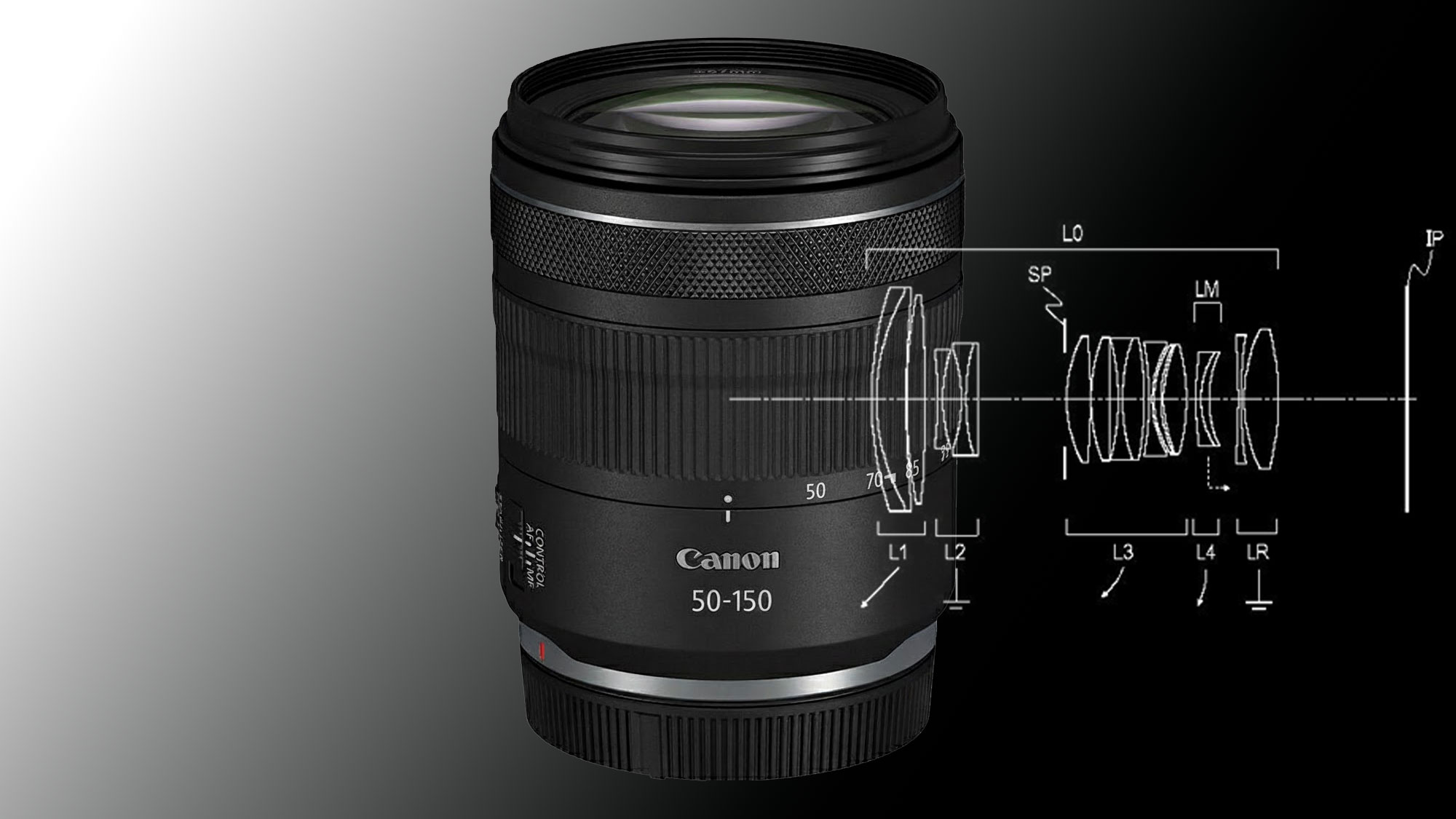
In this patent application (2026-003048), Canon explores a more lightweight zoom configuration with a focal range of 50-150mm. This is a republishing of an existing patent application from last year; however, Canon is still working through the patent offices to get this pushed through.
While this would still be a 3x zoom, with the complexities and design tradeoffs of a wide zoom range lens to deal with, this lens would provide an intriguing complement to an ultra-wide lens that ended at 28 or 35mm, allowing for full near coverage to 150mm in two zoom lenses.
So, where could I see this? Well, as a perfect pair with Canon's RF 16-28 f2.8 IS STM. Given the lack of elements and the fact that the lens does not fill the entire image circle on the wide end, I don't think this is an L-grade design, but it would make a lot of sense as a prosumer constant f/2.8 lens.
Interestingly, this lens is also teleconverter friendly, allowing you to turn this lens into a more traditional 70-200 mm F4 lens with a 1.4x teleconverter – so something for everyone.
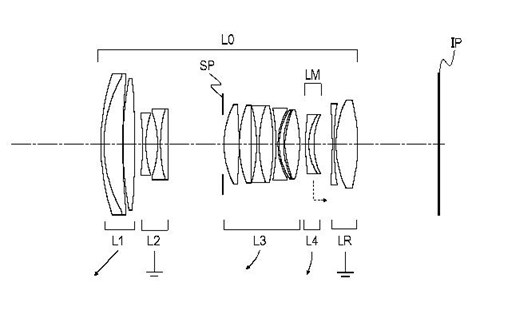
The one embodiment I'll illustrate here has a low amount of stretching at 50mm that increases quickly to the full image circle size before 85mm, and is the most teleconverter-friendly of all the embodiments.
Canon's reason for the patent application is to create a compact lens with focusing and image stabilization groups close to each other, but with small-diameter elements involved.
Canon RF 50-150mm F2.8 IS STM
This lens has a maximum length of less than 220mm with a very relaxed back focus distance of 30mm inset into the lens mount on the lens side. This allows you to insert a teleconverter without any issues, most likely up to the 2x teleconverter.
There is a bit of stretching on the wide end (with the image circle being 19.96mm instead of the 21.63mm), but it's not as bad as some embodiments for other lenses I've seen.
The element count is fairly sophisticated, so Canon could conceivably release this as an L lens as well, but I think they would settle for an STM role, especially with only one focusing group.
The groups LM and LR are the basis of this patent application. I believe that LM is the focus group. Oddly enough, the image stabilization group threw me, as I have never seen it in that position in a lens before from Canon; it's the L2 group. Go figure. I presume this way, Canon gets to have the two mechanisms further apart, which makes it easier to design mechanically.
| Wide-angle | Mid-range | Telephoto | |
|---|---|---|---|
| Focal Length | 51.50 | 85.38 | 145.50 |
| F-Number | 2.89 | 2.89 | 2.91 |
| Half Angle | 22.78 | 14.11 | 8.28 |
| Image Height | 19.96 | 21.63 | 21.63 |
| Lens Length | 176.15 | 214.79 | 236.15 |
| Back Focus Distance | 50.21 | 50.21 | 50.21 |
Closing Thoughts
This is the second time this concept has popped up in Canon's patent literature, so they are obviously serious about pushing this patent through. It's also a focal range I could see being of interest, especially for the f/2.8 STM focal range, which seems like a new prosumer area for Canon.
Just a Reminder!
With all patents and patent applications, I have to stress constantly – this is simply a look into Canon’s research; the only thing we can quantify accurately is that Canon is researching this. A patent application doesn’t mean they are going to release this in the next month, or even year, or even at all.





With 200 or else preferred.
We had this before, it was discussed before, and nobody is forced to buy this lens. Other (more expensive, but also bigger) options are available.
I won't hold my breath.
I’ve a suggestion a new Canon RF 75-300mm f/4-5.6. They could call it Canon RF 75-300mm f/4-5.6 II and that name would be the only thing they need to change.
Having said that, I agree that this is most likely a design for prosumer lens to match the current 16-28 and 28-70 f/2.8 STM lenses.
i guess i FEEL like i spend all this money on a full frame sensor (rather than a APSC) and so i want lenses that illuminate the whole thing. once the corners are dark, the digital lens correction is essentially cropping in. (2 mm-ish in the above example)
For the EF 17-40 the entire 35mm frame was covered in light but the corners were not very good. digital lens correction can make a big difference in its images and i am happy for DLC.
But, now designs are assuming digital lens correction from the jump, maybe choosing to exhibit easier to correct distortions and better control hard to correct distortions. I feel like my full frame is wasted but probably need to appreciate the size, weight, and cost savings present in the lenses. I have to say I am pretty happy with the picts from the RF 24-240. I havent owned the EF 28-300 but it looked big and heavy. BTW, I also liked the Tamron EF 28-300 as a travel lens, DLC helps it too.
Not everyone wants to spend $3000 on a lens, well.... the majority of lens buyers don't. Process corrections with DPP/DLO/NNIP.
That is not correct. It's not cropping, it's digitally correcting the barrel distortion. Light that would have filled the corners was bent further into the frame, the correction stretches it back to the corners. As an example, when comparing the RF 14-35/4 (black corners at 14mm), with correction in DxO the resulting image gives a FoV equivalent to ~13.5mm on the EF 11-24/4 (which is essentially distortion free at 13-14mm as it transitions from strong barrel distortion to milder pincushion distortion). It helps that the uncorrected RF 14-35/4 has a FoV of a bit wider than 13mm.
I like the have the cake and eat it too design approach. The full frame is not being wasted, as stated above. The advantages of designing with digital corrections in mind are evident. One need only compare the size, weight and optical quality of the EF 11-24/4 to those of the RF 10-20/4, with the latter having similar optical quality (after digital correction of both lenses), but being wider, much smaller and lighter, and cheaper into the bargain. That's a big win, in my opinion (and in my photo bag – I bring the 10-20/4 along a lot more often than I brought the 11-24/4).
I also like the RF 24-240 as a travel lens. I did own the EF 28-300L, it was big and heavy and nothing to write home about optically, especially at the long end. The wider portion was similar to the EF 24-105/4L, the longer portion was not as good as the EF 70-300L, so I switched to the combination of those two lenses and sold the EF 28-300L.
50-150mm with a different kind of f-number and not as part as the mentioned trinity sounds more intriguing imo.
HOWEVER
I would LOVE a 50-150 f/2.0
What I am trying to say is that while this might waste some pixels in the corners, it is effectively irrelevant to us users, if we still get the same image quality as we would get from a not-wasteful larger, but still equally priced lens.
I do understand that a 35/50-150 F2/2.8 is very enticing in its own right, but it does not feel quite like trinity material to me.
I appreciate the idea, but I'm afraid it's not for me.
2.8 is just not fast enough, I need to bring 50/1.8 as well anyway.
If it was a non-L 50-150/2 or /2.2, now _that_ would be a next level development, maybe a continuation of the 45/1.2 "revolution".
Otherwise just a make
85-150/2.8 which is lighter
85-180/2.8 which is longer and still light compared to L stuff
50-150/2L which would just be awesome especially if it is 100g lighter than Sony 😉
85-150/2L if it's considerably lighter or gains IQ compared to 50-150
85-135/2L macro? I mean real 1:1. omg goosebumps 😉
I any case, my usual comment. Pleeeease think about opening a new lens category - meant for "professionals" when weight matters. Mid-tier, non-L with USM.