

When you purchase through links on our site, we may earn an affiliate commission. Here's how it works. |
Canon is once again number one in the industry, selling more ILCs (interchangeable lens cameras) than any other manufacturer. Canon has held this rank since 2003.
There have been years when Canon has come close to losing it, specifically around the time of the D3 and D300 and again around the time of the D800. During those times, Nikon threatened Canon's dominance with strong sales, but Canon never relinquished the lead.
It's remarkable that Canon didn't even lose it during its significant pivot away from the DSLR EF mount and, a few years later, its complete abandonment of the EOS-M mount as well.
The Canon EOS 10D
Two notable cameras came out that year for Canon. The first we'll mention is the prosumer Canon EOS 10D. Yes, that long ago.
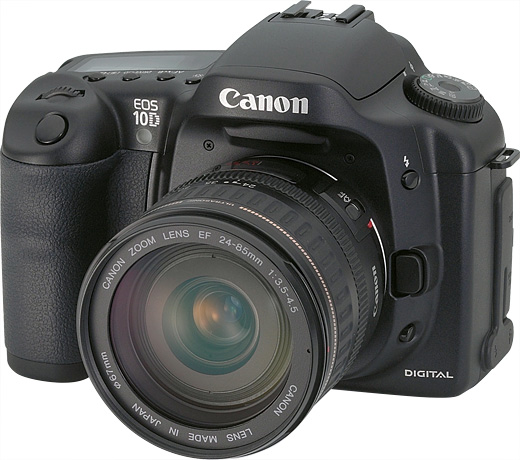
It's cool to look back into the past and see what was amazing back then. This was a well-built camera that launched the line into the 20D, 30D, 40D and 50D cameras that were very popular prosumer camera bodies for Canon.
Key features of the Canon EOS 10D include;
- APS-C 6MP sensor
- pentaprism viewfinder with 95% vertically and horizontally
- 7 AF Points
- Approximately three fps
- 1.8″ LCD Monitor
Oh, and don't forget the significant direct print button. All joking aside, I remember drooling over these specifications.
The Birth of the Canon Digital Rebel Series
But the fundamental factor in Canon's dominance can be traced to the start of the Digital Rebel series and the Canon EOS 300D or Digital Rebel. Canon also released this camera, which launched the wildly successful Rebel line. This camera was huge and insanely popular. I have some nice prints from it.
It, too, had impressive specifications;
- APS-C 6MP sensor
- Viewfinder pentamirror
- 7 AF points
- Approximately 2.5 fps
- 1.8″ LCD Monitor
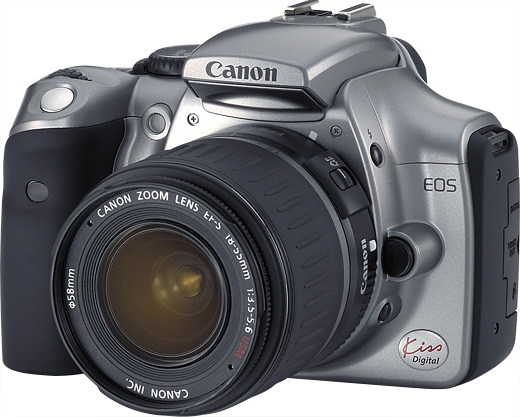
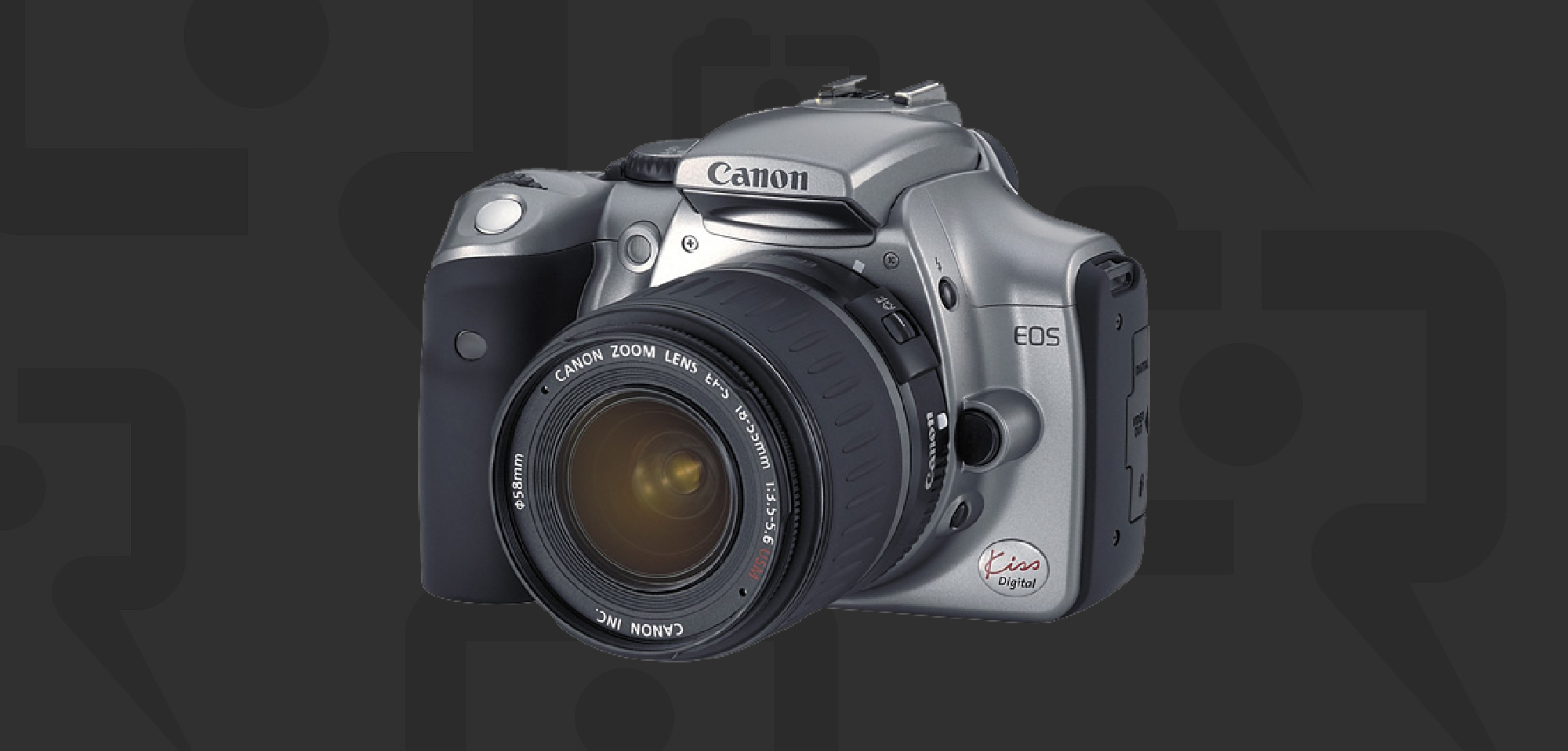
That's why you see this camera in the header of this article.
Back to 2025
Now, Canon again holds the #1 global market share position for ILCs (interchangeable lens cameras). Understandably, the EOS R100 isn't mentioned as the reason for this current dominance.
Canon Press Release
Canon Celebrates 22nd Consecutive Year of No. 1 Share of Global Interchangeable-Lens Digital Camera Market
MELVILLE, N.Y., – February 24, 2025 — Canon U.S.A., Inc. today announced that its parent company, Canon Inc. is celebrating that the company’s interchangeable-lens digital cameras (digital SLR and mirrorless cameras) have maintained the No. 1 share1 of the global market for 22 consecutive years from 2003 to 2024.
Canon’s EOS series of interchangeable lens digital cameras is an imaging system based on the basic concept of “Speed, Comfort, and High Image Quality,” for which the company has developed proprietary key components, including CMOS image sensors, the DIGIC image processors, and interchangeable lenses. Putting together a wide-ranging product lineup—from high-performance flagship models that are highly trusted by professionals to entry-level models that allow users to enjoy full-scale shooting with easy operation, as well as a rich selection of over 1202 RF and EF series lenses that make possible a wealth of creative expression—Canon continues to support the diverse needs of customers.
Throughout its 22-year history, the EOS series has led the market with a range of outstanding models. During the dawn of digital SLR cameras, Canon introduced its breakthrough EOS Kiss Digital (EOS Digital Rebel or EOS 300D in other regions) in September 2003. By launching this groundbreaking camera, which was competitively priced and featured a compact, lightweight design, Canon spurred growth in the digital SLR market, capturing the top share of the global market and heralding the age of digital SLR cameras.
Canon has continued to release further innovative cameras by launching the professional-model EOS-1D series and the EOS 5D series, which paved the way for digital SLR video recording. The company’s desire to further expand the boundaries of visual expression led to its next-generation EOS R SYSTEM, launched in October 2018, that includes the full-frame mirrorless camera EOS R5—the first camera to feature 8K video recording3—released in July 2020 and the EOS R3 in November 2021, which features tracking of fast-moving subjects and continuous shooting performance. In addition, it launched the EOS VR SYSTEM, designed to record video for virtual reality content, in December 2021.
In 2024, Canon managed to secure the No. 1 share of the global market once again for the 22nd consecutive year by further enhancing its lineup of EOS R Series cameras and lenses.
For cameras, Canon released the EOS R5 Mark II (August 2024), a full-frame mirrorless camera that combines the capability to cover shooting in a wide range of scenarios with a single camera with mobility, and the EOS R1 (November 2024), the first flagship model of the EOS R SYSTEM. Both models featured the new image processing system “Accelerated Capture” and included diverse video shooting functions accumulated through the CINEMA EOS SYSTEM for achieving high-speed analysis and high-speed shooting.
As for lenses, in 2024 Canon expanded its L-series lineup of large-aperture single-focus lenses, which contribute to full-fledged video production, and added 15 models of RF lenses4, including two types of lenses that facilitate making 3D VR videos to meet the growing demand for video and handle 3D imaging.
Going forward, Canon will continue to refine its proprietary imaging technologies while bringing fulfillment and excitement to people’s daily lives as well as promoting the spread of photo and video culture by providing products, services, and solutions that meet its customers’ diverse needs.
About Canon U.S.A. Inc.
Canon U.S.A., Inc. is a leading provider of consumer, business-to-business, and industrial digital imaging solutions to the United States, Latin America, and the Caribbean markets. With approximately $28.5 billion in global revenue, its parent company, Canon Inc., as of 2024 has ranked in the top-10 for U.S. patents granted for 41 consecutive years. † Canon U.S.A. is dedicated to its Kyosei philosophy of social and environmental responsibility. To learn more about Canon, visit www.usa.canon.com and connect with us on LinkedIn at www.linkedin.com/company/canonusa.
# # #
1 Based on a Canon survey.
2 Types of lenses sold vary according to each market. Includes 4 types of extenders. Among lenses announced as of February 24, 2025.
3 Among digital interchangeable-lens cameras released prior to July 8, 2020.
4 In 2024, Canon released the following 15 RF lenses (including RF Cinema lenses): RF-S3.9mm F3.5 STM DUAL FISHEYE (June), RF35mm F1.4 L VCM (July), RF28-70mm F2.8 IS STM (September), RF-S7.8mm F4 STM DUAL (November), RF70-200mm F2.8 L IS USM Z (November), RF24mm F1.4 L VCM (December), RF50mm F1.4 L VCM (December), CN-R24mm T1.5 L F (January), CN-R35mm T1.5 L F (January), CN-R50mm T1.3 L F (January), CN-R85mm T1.3 L F (January), CN-R14mm T3.1 L F (February), CN-R20mm T1.5 L F (March), CN-R135mm T2.2 L F (April), and CN7×17 KAS T/R1 (October)
† Based on patent counts issued by the United States Patent and Trademark Office and compiled by IFI CLAIMS Patent Services.







Nikon's camera division is profitable, but they are now a distant #3 in interchangeable lens camera market share. (13%)
maybe i should re-write that, but i meant during the time of the D3 and D3x
Always read the foot notes!
1 Based on a Canon survey. => not CIPA?? Is this only Canon USA that makes these statements where there are no supporting data?
It is the best survey, none better, marvelous, you should see it, just what I expected...
2 Types of lenses sold vary according to each market. Includes 4 types of extenders. Among lenses announced as of February 24, 2025.
=> what are the 4 types ie besides the RF2x and RF1.4x?
4 In 2024, Canon released the following 15 RF lenses (including RF Cinema lenses)
=> I didn't realise that 8 of the 15 released in 2024 were CN lenses.
This is the norm for them, but their statements have always been consistent with the market research reports.
They’re talking about RF and EF lenses, so the four types are 1.4x and 2x for each mount.
- YouTube
Compared to the Sony it’s quite heavy, but I really like it.