

When you purchase through links on our site, we may earn an affiliate commission. Here's how it works. |
Looking at this patent application (2025-179579), there are a lot of designs in here that I found intriguing, but there are certainly two that reached out and smacked me across the side of the head, and that's a Canon RF 300mm f/2.0L IS and a 200mm f/1.8L. But this is one of those patents where I look at it and go, ‘do them all, please.'
Canon doesn't say much about the embodiments in the background summary, as the continued goal of Canon's lens patents is coming up with designs that are either lower in aberrations or smaller.
Optical systems with long focal lengths are known for use in imaging devices. As the focal length of an optical system increases, it generally tends to become larger and heavier, and therefore there is a demand for optical systems that are lightweight and have well-corrected aberrations.
The two embodiments I'm going to discuss in more detail are ones that I think are the most credible element designs that Canon could look to implement in real life.
Canon, going back a few decades, has worked hard to both decrease the overall weight of its super telephotos but also to address the balance. Addressing the balance by shifting more of the elements to the center or rear of the lens has many benefits. First, the elements will be smaller in diameter, reducing the cost and making them easier to manufacture. With the elements being smaller, the overall weight of the lens is reduced as well. So not only have you reduced the effort required to hold and operate the lens, but the overall weight as well.
Canon RF 300mm F2L IS USM
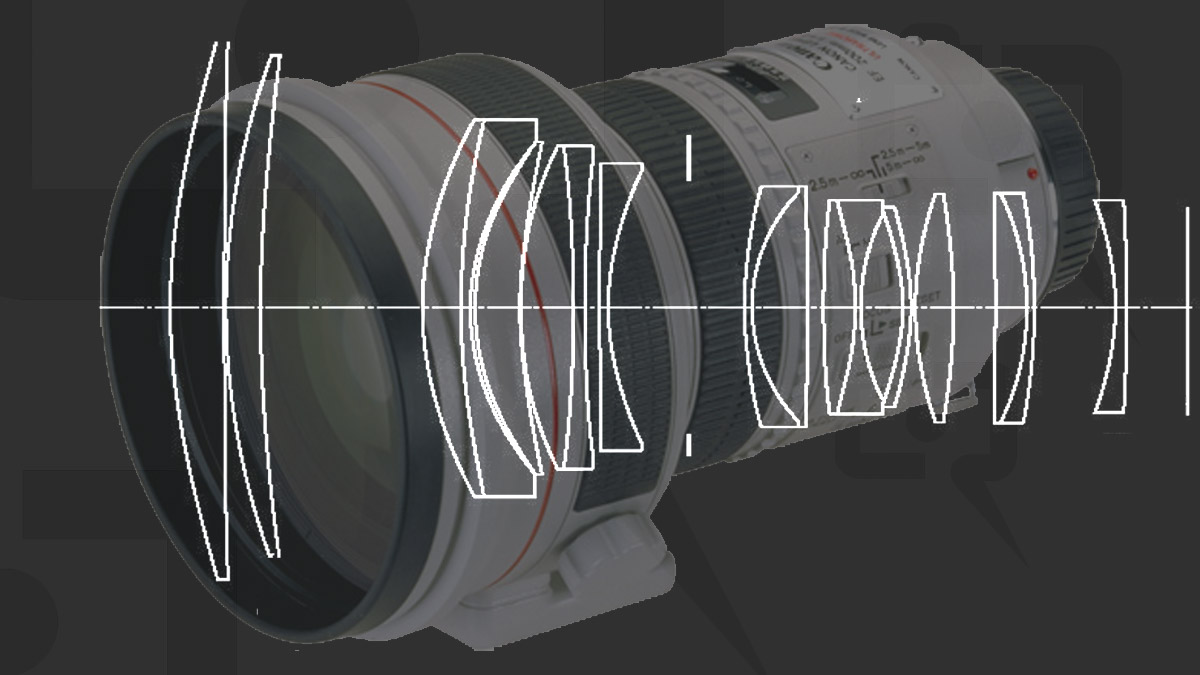
I've long wondered why Canon hasn't released an RF version of a lens that was one of its traditional super telephoto prime workhorses. Maybe they were looking at doing something special with it. If we look back at the Canon EF300mm f/2.8L IS II USM, it has the following optical construction.

If we then look at the embodiment of the Canon RF 300mm f/2L IS, we see there are far fewer elements at the front of the lens.

So this seems to be a very practical design that Canon would consider, as even the larger front elements that Canon would have to spend the greatest amount of cost in fabrication, are limited in number.
This lens also supports Canon teleconvertors with a very relaxed backfocus distance of 47mm, which suddenly makes this lens even more attractive because you can turn it into a 420mm F2.8 and a 600mm F4L with teleconvertors.
| Focal length | 294.95 |
| F-number | 2.06 |
| Half angle of view | 4.20 |
| Image height | 21.64 |
| Lens length | 330.02 |
| Back Focus Distance | 47.82 |
Canon RF 200mm f/1.8L IS USM
One lens from Canon's distant past is the legendary Canon EF 200mm f/1.8L USM. Considered one of the sharpest lenses made by mortal men at the time, it was also made with elements that were environmentally unsound, so it was discontinued and came out again much later as the Canon EF 200mm f/2L IS USM. With the recent competition from Laowa and Sigma, I wondered what Canon would do to distinguish between Canon's 200mm and the perceived competition and justify a significant price increase. Maybe going back to f/1.8 would be justification to have a much higher sticker price than the third-party lenses that have recently been released.
Canon has done some interesting work on the new design, so we have to use the Canon EF 200mm f/2L to illustrate the differences.

The Canon RF 200mm f/1.8L has a complicated element design with over 18 elements. But if you notice, there are only two large elements on the business end of this lens, with the majority of the element weight being around the center of the lens. This would make the lens feel like it has a better balance, even on smaller cameras, and feel like it was lighter to operate, even if it physically wasn't.

This has all the latest goodness which you'd expect from such a lens, including dual focus motors and an image stabilization group. There's also enough room for teleconverters as well, which a 1.4x teleconvertor would turn this lens into a 300mm f/2.5, and a 2x teleconvertor would turn this lens into a 400mm f/3.5.
| Focal length | 195.66 |
| F-number | 1.85 |
| Half angle of view | 6.31 |
| Image height | 21.64 |
| Lens length | 233.03 |
| Back Focus Distance | 37.99 |
Canon RF 145mm f1.4L IS USM
There was another lens in here which looked to be an outlier because Canon never has really done this lens focal length before, the closest of course being 135mm. Would Canon release a lens so close to 135mm? I honestly don't think so. That being said, we can all drool over the optical design and imagine such a future.
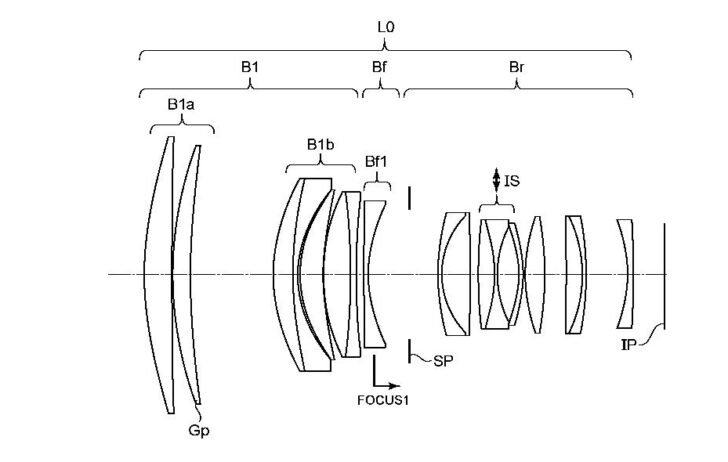
This lens is very large and also has a very short back focus distance, which is another reason I can't see it being made. Which, of course, means that this is the lens that will be produced, because Canon hates me.
| Focal length | 145.99 |
| F-number | 1.44 |
| Half angle of view | 8.43 |
| Image height | 21.64 |
| Lens length | 205.08 |
| Back Focus Distance | 12.35 |
Closing Thoughts
A Canon RF 300mm and a Canon RF 200mm are two telephoto primes that we know are coming sooner or later to the RF mount. These are two core fundamental prime lenses that, if anything, 7 years into the RF mount, seem strange that they have not been released yet.
Could Canon be looking at doing something surprising, such as a 200mm f/1.8 or a 300mm f/2.0? It's entirely plausible given the delay in the release of these two focal lengths.
Just a Reminder!
With all patents and patent applications, I have to stress constantly – this is simply a look into Canon’s research; the only thing we can quantify accurately is that Canon is researching this. A patent application doesn’t mean they are going to release this in the next month, or even year, or even at all.







300/2300/1.8 many years ago, but it wasn't sold to the general public. There are a few photos around online. Interesting lens. Nikon had a manual focus 300/2 which was also cool, but extremely heavy due to the all metal construction they were using at the time. Around 7.5kg, I think!! Considering we now have 600/4 lenses at 3kg, a 300/2 (same front element size) at around 2.8kg should be possible, and would be very usable.But price... Price is the big question. Probably above the $15k of a 600/4L as it would be a very niche product. $18k or so would not be surprising to me.
Edit: The old EF lens was a 300/1.8, not a 300/2.
See: https://petapixel.com/2017/04/27/canon-300mm-f1-8-yes-monster-lens-exists/
If affordable for my purse, the 300/2 would be more interesting to me.
But the comparison with the EF300/2.8 II is interesting.
Less elements = loss in IQ? Or did they manage to get something new to work?
Unfortunately with both Canon and Nikon apparently terrified of Sigma, Sony limiting everything 3rd party to 15fps, and Panasonic still without tracking AF, there isn't any camera that can take full advantage of either lens. At least not yet.
I've seen both the EF 1200/5.6 and the Nikkor 1200-1700/5.6-8, and several of the Nikon 300/2 lenses (with their special TCs), and oddball stuff like the Reflex-Nikkor 2000/11, but have not seen one of the 300/1.8Ls. Pretty rare beast.
They would bring some "sparkle" to Canon's RF lens lineup, showing that Canon still dares to be bold.
Or just give me my 35 1.2 darn it! 🤣
The patent example 200/1.8 is about the same length as the EF 200/2, and would presumably be much lighter.
I don't see overlapping two f/2 L zooms.
I guess Sony offering starting at 50mm and Tamron 35mm forced Canon to change their plan.