


When you purchase through links on our site, we may earn an affiliate commission. Here’s how it works. |
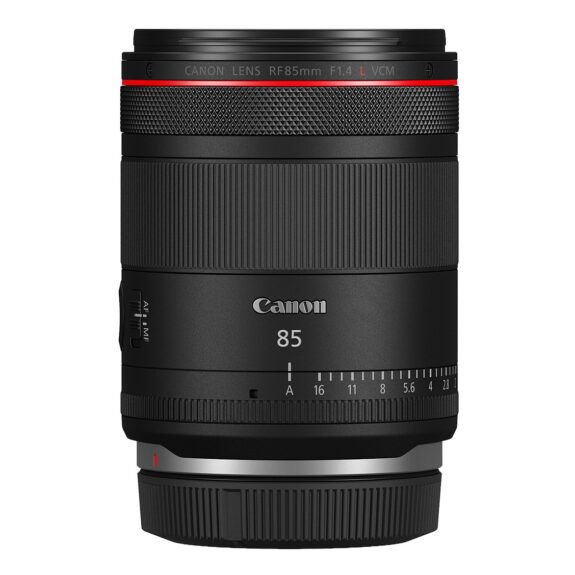
I was totally impressed with the Canon RF 85mm f/1.4L VCM when I dived into its MTF graphs supplied by Canon. You can read our Canon 85mm MTF showdown to delve deeper into that topic.
Basically, I summarized the Canon RF85mm f/1.4L VCM that as;
The Canon RF 85mm F1.4 VCM looks *that* good as most of the VCM level of primes, so it’s almost a certainty that if you have any thoughts about buying it, get on the preorder list now.
Canon RF 85mm f/1.4L VCM Features
- Full-Frame | f/1.4 to f/16
- Fast Portrait-Length Hybrid Lens
- Voice Coil Motor AF System
- De-Clickable, Manual Aperture Ring
- Custom Control Ring and Function Button
- UD and Aspherical Elements
- Super Spectra, SWC and ASC Coatings
- Rounded 11-Blade Diaphragm
- Weather-Sealed Design & Fluorine Coating
However, we now have a few reviews of the Canon 85mm f/1.4L VCM, so it’s a good time to delve into what the reviewers are saying about Canon’s latest portrait lens.
PhotoTrend
First, we have Phototrend in France, which has provided a well-written and well-photographed review of the Canon RF 85mm f/1.4L VCM. The review touches on a few things that we didn’t have firsthand knowledge of outside of Canon’s information, such as the fact that focus breathing is very well controlled for those who wish to use this lens for video. Another thing I am unaware of is that Phototrend states it’s a dual-motor lens. According to Phototrend;
The Canon RF 85mm f/1.4 L VCM’s autofocus relies on a dual motor drive combining nano USM and VCM . A moving coil system actuating the optical group each drives a different lens group, ensuring fast, accurate AF that’s smooth enough for both stills and video.
Now, this doesn’t seem to be documented anywhere, unless I missed this specification. Looking at Canon Japan’s write-up on the auto focus, they state;
The camera employs a rear-focus system, with a four-element focus lens group driven by a VCM (voice coil motor). The combination of an actuator that can drive a heavy lens unit with high speed and precision, and a four-element focus lens group, has enabled both suppression of lens breathing and agile AF.
With no mention of USM being employed in the configuration.
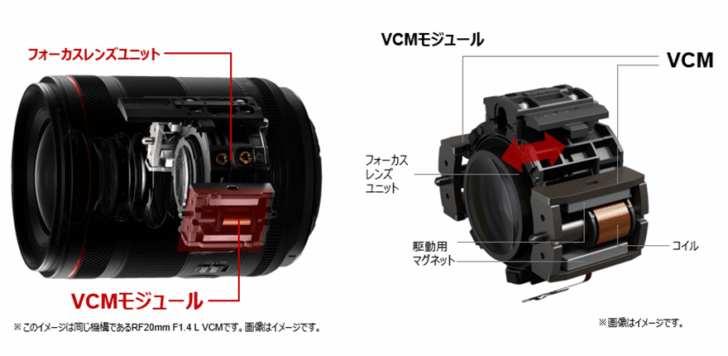
Additionally, the diagram shown by Canon for the 85mm f/1.4 lens, although the illustration used is of the 20mm VCM lens, Canon states that it utilizes the same autofocus drive as the 85mm. The drive utilizes two voice coil drive actuators, located on either side of the focus element group assembly, to drive the autofocus.
Also, if we examine the “let’s cut the lens in half with a laser” image, there doesn’t appear to be enough room or movement space to accommodate two different focus groups. Nor does it seem that two groups move.
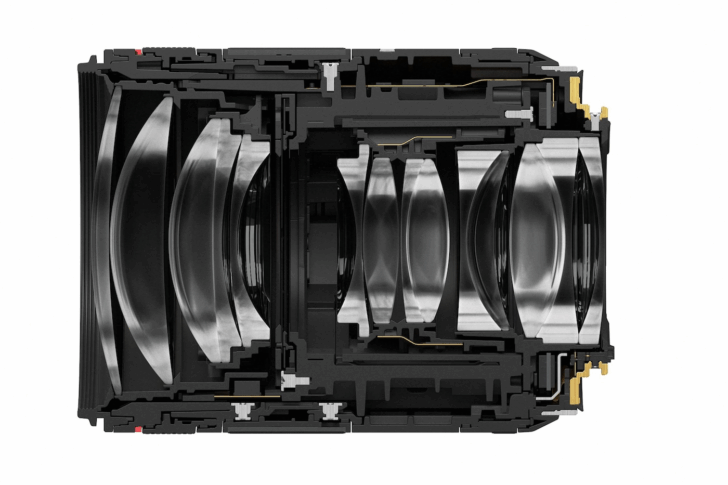
So take that to mean that phototrends may be incorrect in assuming that nano USM also exists in this lens, or they know something that Canon isn’t bragging about.
That being said, Phototrends loved the Canon RF 85mm f/1.4L VCM as much as I did, as they state in their conclusion.
the Canon RF 85mm f/1.4 L VCM appears to be an ideal solution : more accessible and handy than the f/1.2, but much more ambitious than the f/2. It is aimed at portrait photographers as well as wedding photographers or videographers looking for a high-performance and versatile lens . Canon delivers here a modern and accomplished lens, promised to become an essential reference for the RF mount.
PetaPixel
PetaPixel has also released a review of the Canon RF 85mm f/1.4 VCM, based on what appears to be the reviewer’s time in Japan. Peta Pixel also mentions that the bokeh can seem a bit busy and has a soap bubble effect, but praises it for its resolution and performance.
It turns out that the compact 85mm f/1.4 is also a sharp lens. There is plenty of detail present at f/1.4 in the center of the image, and I noticed only a slight improvement going to f/2.8. Corner performance was also strong with good detail retained even at the widest aperture. Sharpness and contrast improved slightly, along with less vignetting, when stopping down, but even at f/1.4, the results were excellent. This is a sharp lens that performs admirably throughout the aperture range.
Much like I think will be the norm everywhere for reviews on this lens, Petapixel concludes that it’s an actual hybrid lens with excellent optical qualities.
I had a great time on the streets of Tokyo and the temples of Kyoto with this handy little 85mm lens. The RF 85mm f/1.4 VCM L is ideally situated between the affordable RF 85mm f/2 Macro and the RF 85mm f/1.2 L. Canon RF users now have an option for a shallow depth of field portrait photography lens that also doubles as a great lens for cinema work.
I especially loved how much more portable it was over the RF 85mm f/1.2 and found it far more practical for almost any situation. It’s rare to get high-end prime lenses released nowadays, let alone a whole series of high-quality lenses across the board. Most importantly, I didn’t feel left out as a photographer when experiencing the 85mm, and would happily reach for it again if I needed a Canon portrait lens in the future.
This is well-deserved praise for the Canon RF 85mm f/1.2, and I’m already sounding like a broken record.
DCW (Digital Camera World)
DCW has also given out its review of the Canon RF 85mm f/1.4 VCM. DCW also states that they felt the Canon RF 85mm f/1.4 VCM was slightly sharper and crisper than the Canon RF 85mm f/1.2L USM, which differs from our own observations, as we found the contrast to be similar (presumably, in terms of crispness). The resolution was a smoother rolloff into the corners. However, I had thought that the Canon RF 85mm f/1.2 USM has slightly better resolution in the center. But slight sample variations can easily account for this discrepancy.
In addition to being shorter and much lighter, the RF version seems to be notably sharper at the corners and edges – and it might just be my eyes (again, we still need to lab test the lens) but it also seems to be a bit crisper in the center.
DCW is very happy with the Canon RF 85mm f/1.4L VCM and really highlights its great portability over the Canon RF 85mm f/1.2 USM.
Despite its hybrid status, the Canon RF 85mm f/1.4L VCM is still going to appeal massively to photographers. And at just 18% the length, 53% the weight and 55% the price of the f/1.2 alternative, with its 11-blade f/1.4 aperture still delivering delicious depth of field, it’s going to be a hot seller for portraiture (especially among APS-C shooters). And as Canon’s fifth fixed lens hybrid, it’s the same size and virtually the same weight as the other f/1.4 primes – making it an essential, gimbal-friendly addition to filmmaking outfits and creator kitbags.
Preorder
Orders for the 84mm VCM are expected to start shipping on September 30th. If you haven’t joined any preorder list, your time is running out, and who knows if this will end up on a backorder list, making it seem like a unicorn.




Cameras may be your area of expertise. English apparently is NOT.
Dived? How about "..when I dove into..." ?
I get it. You were a hall monitor in school. Right? You can stop now. We've graduated. Grading is through.
I eschew YT videos (DIY home repairs notwithstanding) but I did scrub to the ~7 min mark to see it was a noted in a focusing speed comparison with objects arranged in a table and in a portrait comparison. The reviewer failed to provide the proper technical explanation, which is unfortunate but unsurprising.
What’s really going on is that the focal length of a lens is specified as the distance from the rear nodal point to the sensor with the lens focused at infinity. When a lens appears to have a wider FoV (shorter FL) with closer subjects (as in the YT reviewer’s examples), that’s due to focus breathing. That’s why, for example, the EF 100/2.8L Macro has the FoV of a ~68mm lens at 1:1 magnification.
Canon touts the 85 VCM as having minimal focus breathing, which is desirable in a lens intended for hybrid use (lack of focus breathing is one of the reasons cine lenses are so expensive). Focus breathing is not necessarily linear with subject distance, and I suspect what’s happening with the 85 VCM is that Canon’s design puts most of the breathing closer to infinity, so there’s relatively little change in FoV with subjects at different ‘normal’ (for people) distances. Doing so is facilitated with modern focus-by-wire lenses where a microchip instead of gearing is controlling focus motor movement.
I always believed Canon's cine lenses were only photo lenses in a different mount, thoroughly checked and adjusted, maybe differently coated for identical colour rendering.
Other 85mm lenses could look more 90mm-ish at infinity due to focus breathing.