

When you purchase through links on our site, we may earn an affiliate commission. Here’s how it works. |
This subject has come up a fair number of times, and we thought it would be good for our newer users just starting out to do a bit of a dive into the differences between these two lenses, which to those inexperienced in selecting lenses may look somewhat similar.
In this we will discuss two standard lenses available for APS-C users on the Canon RF system.
Summary
Canon RF-S 18-45mm f/4.5-6.3

Pros
- Has IS
- Compact and lightweight
- Good autofocus performance
- Decently sharp throughout the zoom range
- Good flare resistance
- Video focus is fairly smooth
Cons
- Zoom ring can be a little stiff
- Heavy vignette and distortion at 18mm
- Retractable zoom transition is clunky
- No hood included
- Corners are mostly soft
Sigma 18-50mm f/2.8 DC DN

Pros
- compact and lightweight
- Nicely made with a weather sealing gasket
- Useful focal range with constant F2.8 aperture
- Great autofocus performance
- Good video AF performance
- Minimal focus breathing
- Good sharpness across zoom range
- Nice bokeh in most situations
- Fairly good coma performance
Cons
- No optical stabilizer
- Fairly strong barrel distortion at 18mm
- Some ghosting in certain lighting conditions
- Flare for RF lens mount slightly interferes with MF ring
Purchase Options
- B&H Photo: Canon RF-S 18-45mm f/4.5-6.3 IS STM $299
- B&H Photo: Sigma RF-S 18-50mm f/2.8 DC DN Contemporary $549
- Wex Photo: Canon RF-S 18-45mm f4.5-6.3 IS STM £339
- Wex Photo: Sigma RF-S 18-50mm f2.8 DC DN Contemporary £479
- Foto Koch: Canon RF-S 18-45mm f/4.5-6.3 IS STM €303
- Foto Koch: Sigma RF-S 18-50mm f2.8 DC DN Contemporary €549
Canon RF-S 18-45mm f/4.5-6.3 IS STM
Usually, the first lens you get is the one your kit has bundled. For Canon RF users of the Canon EOS R100, Canon EOS R50, Canon EOS R10, or Canon EOS R7, that may have been the RF-S 18-45mm f/4.5-6.3 lens.
This lens is usually the first one a novice will get experience with. First, we should mention that there is absolutely nothing wrong with using a kit lens. I personally have taken many shots that have hung up on 18×22″ prints using a far older Canon EF 18-55 kit lens.
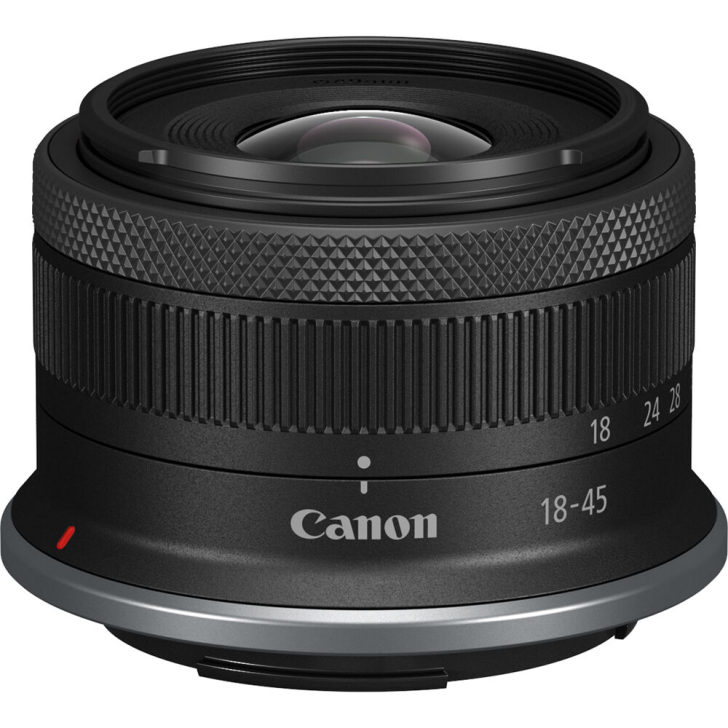
The kit lenses that come by default are usually the least expensive zoom lens that Canon can develop and manufacture. To achieve the best from a lens in terms of image quality, it’s best to “stop down” the lens from its maximum aperture. The better the quality of the lens, the less you need to stop it down.
This lens is very small and very lightweight, something when you are just starting out you will appreciate. This lens also features “IS” which is image stabilization which means that on the Canon EOS R10, Canon EOS R100 and Canon EOS R50 that do not have IBIS (in body image stabilization) the lens will still stabilize the image, leading to sharper photos at slower shutter speeds.
Key features and Specifications of the RF-S 18-45mm f/4.5-6.3
- RF-S-Mount Lens/APS-C Format
- 29-72mm (35mm Equivalent)
- Aperture Range: f/4.5-6.3 to f/32
- Two Aspherical Elements
- Super Spectra Coating
- STM Stepping AF Motor
- Optical Image Stabilizer
- Customizable Control Ring
- Rounded 7-Blade Diaphragm
The Good Things About the Canon RF-S 18-45mm f/4.5-6.4 IS STM
- Has IS
- Compact and lightweight
- Good autofocus performance
- Decently sharp throughout the zoom range
- Good flare resistance
- Video focus is fairly smooth
The Not So Good Things about the Canon RF-S 18-45mm f/4.5-6.4 IS STM
- Zoom ring can be a little stiff
- Heavy vignette and distortion at 18mm
- Retractable zoom transition is clunky
- No hood included
- Corners are mostly soft
SIGMA 18-50mm F2.8 DC DN
The Sigma 18-50mm f/2.8 DC DN is a prosumer APS-C that is now available for the RF Mount (so all Canon mirrorless). On a full frame camera, you can still use the lens but will have to switch your full frame Canon EOS camera to “crop mode”. On the Canon EOS R100, Canon EOS R10, Canon EOS R50 and R7 APS-C cameras, and whatever other cameras Canon comes out with in the future, this lens will work perfectly.
This lens is “faster” than the Canon RF-S 18-45mm f/4.5-6.3 which means you will have an easier time taking photos indoors, as you can use a lower ISO and also a faster shutter speed and still get good exposures. So if you are struggling with the kit lens and having to resort to using too high of ISO, or a really slow shutter speed, then this is the lens for you.
One notable missing element from this lens, is the lack of image stabilization. That means on cameras such as the Canon EOS R100, Canon EOS R50 or Canon EOS R10, this lens and camera body combination will not provide any image stabilization for taking images. So, for longer exposures, you either have to prop your hand somewhere steady, or use a tripod or monopod.
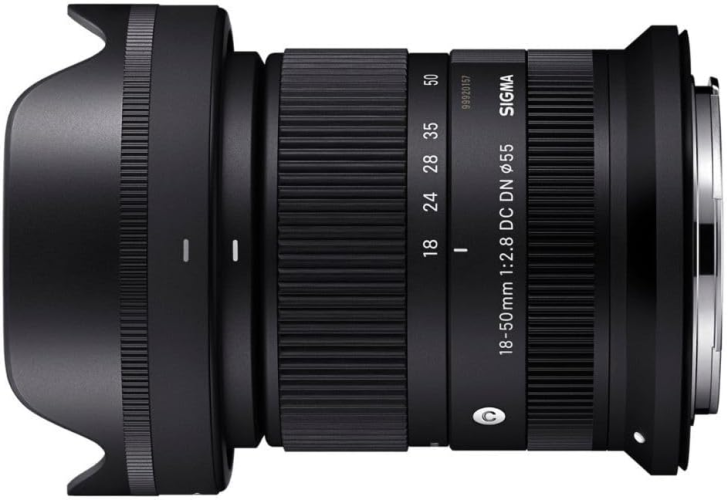
Key features and Specifications of the SIGMA 18-50mm F2.8 DC DN
- RF-Mount Lens/APS-C Format
- 29-80mm (35mm Equivalent)
- Aperture Range: f/2.8 to f/22
- Minimum Focusing Distance: 4.8″
- Three Aspherical Elements
- Special Low Dispersion Element
- Rounded 7-Blade Diaphragm
- Dust- and Splash-Proof Design
- Includes LH582-02 Lens Hood
The Good Things about the SIGMA 18-50mm F2.8 DC DN
- Fantastic job porting to Canon
- Extremely compact and lightweight
- Nicely made with a weather sealing gasket
- Useful focal range with constant F2.8 aperture
- Great autofocus performance
- Good video AF performance
- Minimal focus breathing
- Good sharpness across zoom range
- Nice bokeh in most situations
- Fairly good coma performance
- Nice build and handling than RF lenses
The Not So Good Things about the SIGMA 18-50mm F2.8 DC DN
- No optical stabilizer
- Fairly strong barrel distortion at 18mm
- Some ghosting in certain lighting conditions
- Flare for RF lens mount slightly interferes with MF ring
Purchase the Sigma 18-50mm f/2.8 DC DN
Physical Comparison between the RF-S 18-45mm f/4.5-6.3 and the Sigma 18-50mm f/2.8 DC DN
One very notable difference between the Canon RF-S 18-45mm f/4.5-6.3 and the Sigma 18-50mm f/2.8 is the physical size difference between these two lenses. While I don’t personally find the difference too much, you may.
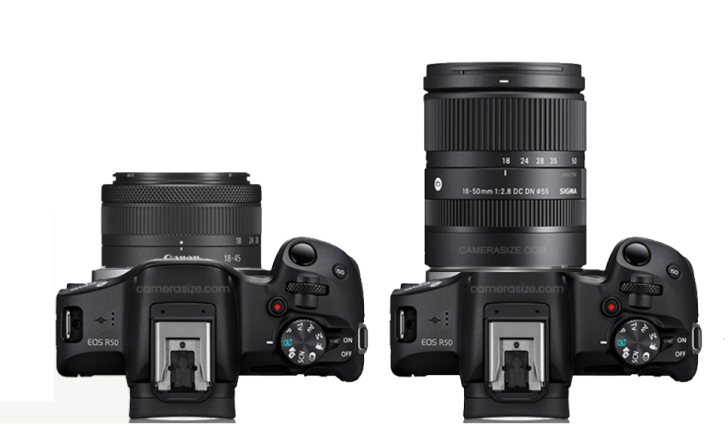
The above image shows approximately the size difference between the Canon RF-S 18-45 and the Sigma 18-50 while attached to the Canon EOS R50 camera body.
The Canon R50 and lens combination is also much lighter as well, as the Canon RF50 weighs 375g and the Canon RF-S 18-45mm weighs 130g. The Canon R50 and Sigma 18-50 combination weighs 665g, with the Sigma lens weighing 290g.
This makes the combination around 30% heavier. During a long day of taking pictures, you may find this additional weight burdensome.
The MTF Comparison between the RF-S 18-45mm f/4.5-6.3 and the Sigma 18-50mm f/2.8 DC DN
The MTF (modular transfer function) graphs are primarily used to quickly tell how the lens will perform. This is not a perfect science when comparing across lens manufactures as each manufacture has a slightly different interpretating on how they present the information, and also how they calculate the MTF.
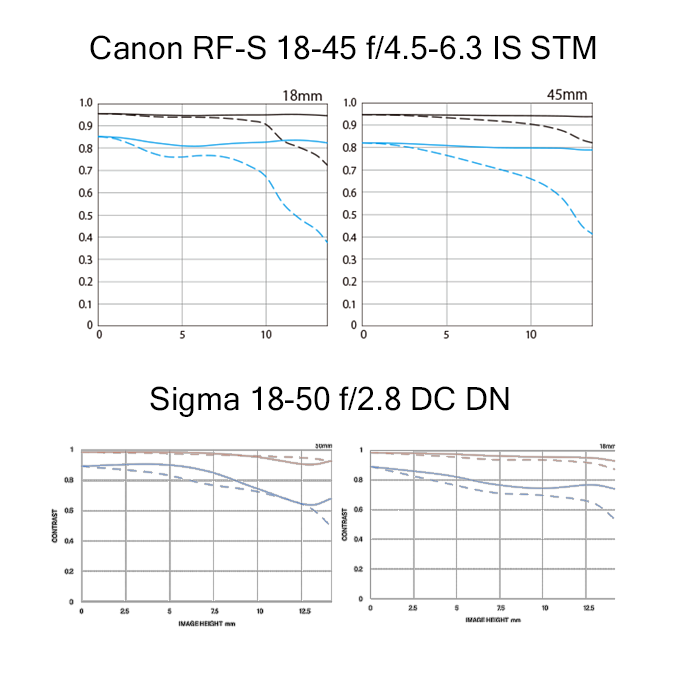
At 18mm, the Sigma 18-50, has higher blue lines then the Canon lens. this is a measure of resolution. So from the pure calculations, the Sigma lens should have greater ability to resolve finder details than the Canon lens at 18mm. That’s especially impressive when you consider that the Sigma is at f/2.8 while the Canon lens is at f/4.5.
The black lines on Canon and conversely the orange line on Sigma, is a measure of contrast. Again, the Sigma will also deliver better contrast throughout the image including into the corners.
At 45mm (and 50mm for the Sigma) it’s more of the same with the Sigma lens providing greater resolution and contrast throughout the entire range. This is even though the Sigma is still at f/2.8 while the Canon lens is now at f/6.3.
Conclusion
The Sigma 18-50mm f/2.8 DC DN is a superior lens to the Canon RF-S 18-45mm kit lens, especially if you don’t need image stabilization in your lens. If you find that image stabilization is important to you, then this lens may not be the one for you.
Also consider that your kit will be slightly larger and heavier. Make sure the bigger lens will fit into your camera bag and that you will not find the weight too much to carry around. Also remember that unless you sell the RF-S 18-45mm, you can always switch lenses if you know you are going to be out all day and wish a lighter setup.
If image stabilization is not as important and the size and weight increase is acceptable, then this is a sure-fire upgrade from your Canon RF-S 18-45mm f/4-5-6.3 IS STM. The Sigma 18-50 has a wider rage (18 to 50mm) than the Canon lens and is sharper throughout the zoom range.
The Sigma will allow for 1 or more stops faster shutter speed or 1 or 2 stops less ISO making your images cleaner and potentially without motion blur. If you take a lot of images indoors, then the Sigma 18-50mm f/2.8 DC DN will shine.
Purchase Options
- B&H Photo: Canon RF-S 18-45mm f/4.5-6.3 IS STM $299
- B&H Photo: Sigma RF-S 18-50mm f/2.8 DC DN Contemporary $549
- Wex Photo: Canon RF-S 18-45mm f4.5-6.3 IS STM £339
- Wex Photo: Sigma RF-S 18-50mm f2.8 DC DN Contemporary £479
- Foto Koch: Canon RF-S 18-45mm f/4.5-6.3 IS STM €303
- Foto Koch: Sigma RF-S 18-50mm f2.8 DC DN Contemporary €549