

When you purchase through links on our site, we may earn an affiliate commission. Here’s how it works. |
This is a curious patent application from Canon. From the designs, it’s pretty evident that these aren’t your usual mirrorless zoom lenses.
A little background first on what we use to determine use cases for lenses. It’s all about the image height.
The image height on Canon’s published applications and patents is the radius of the projected image circle required to fully illuminate the sensor. Essentially, the diagonal measurement of the sensor is divided by two.
Armed with this, we break out our handy calculator and using the size of the C300 Mark III as a baseline with a Super-35 sensor size of 26.2 x 13.8 mm, which means that the diagonal measurement is 29.61mm and that halved is 14.8mm. Now when we look at the patent application and see that the image height in teh patent application is 14.8mm, then it is almost a certainty that these lenses are meant to project an image over a super-35 sensor.
We do this with all patents, but we usually see numbers that are very similar in dimension. For example, 13.66mm is typically APS-C, and 21.64mm is standard for full-frame cameras. That wraps up the math lesson for the day; the test is scheduled for Wednesday. No calculators or AI allowed.
Now, back to this patent application. In this patent application, we see some complex inner zoom designs with an image height of Super 35, which leads me to believe that these are intended to be Cini lenses, most of which are helpful for the old EF mount.
How relevant are these when everyone’s switched to mirrorless? It’s hard to say, as there’s still a vast number of EF-mount cinema cameras in the world – it would seem odd for Canon itself not to sell lenses to those who may actually need them. These lenses all have variable aperture, which is usually frowned upon, but these may be less expensive variants than the eye watering price of the constant aperture cine zooms that start with the baseline price of “if you have to ask, you can’t afford it”
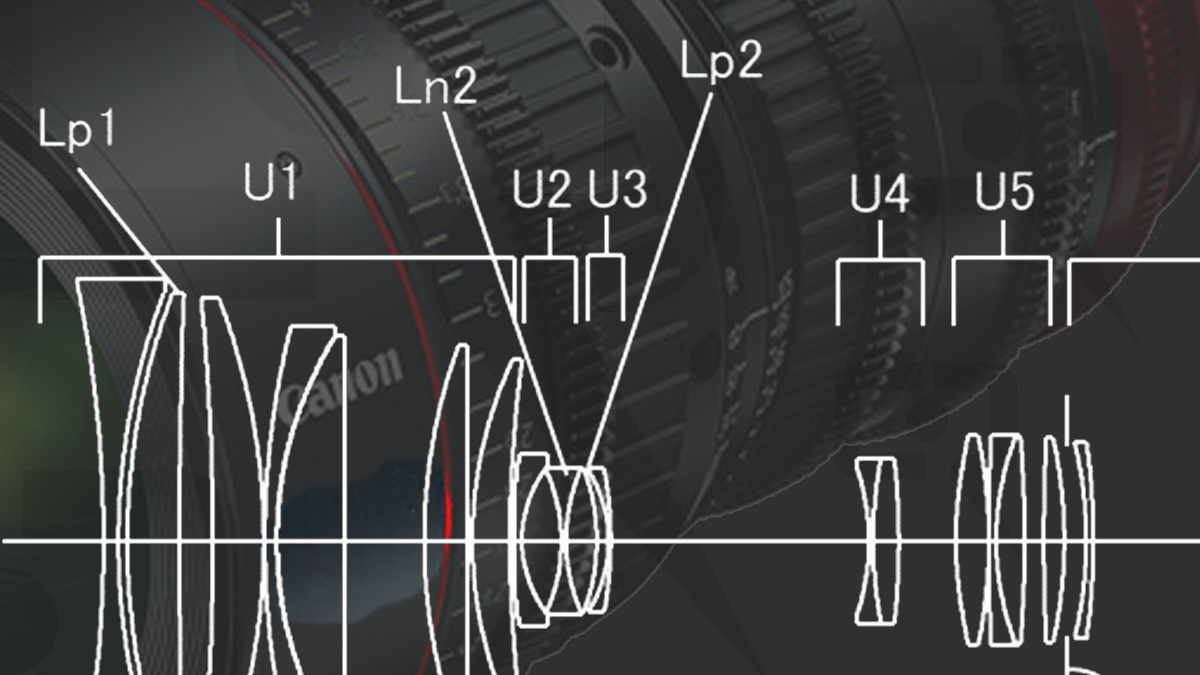
Canon CN-E 24-300mm F2.8-4
This cinema zoom is a super zoom, ranging from 24-300mm, maintaining a constant f/2.8 throughout the wide to 150mm range. That makes it a fairly credible f/2.8 zoom cinema lens, capable of zooming up to 150mm at 2.8. That may be Canon’s thinking is that there’s going to be a limit to how much you zoom in and need to keep a constant aperture, that the variable after a point does not matter. I honestly have no idea, I’m sure someone will tell me if I’m wrong ;)

| Wide | Middle | Telephoto | |
|---|---|---|---|
| Focal Length | 24.94 | ||
| F-Number | 2.73 | 2.73 | 4.10 |
| Half Angle of View | 30.69 | 5.74 | 2.95 |
| Image Height | 14.80 | 14.80 | 14.80 |
| Lens Length | 316.78 | 316.78 | 316.78 |
| Back Focus Distance | 40.00 | 40.00 | 40.00 |
Canon CN-E 15-120mm F2.8-4.0
As with the prior design, this zoom maintains a constant 2.8 aperture through its mid-range zoom distance of 85mm, making it a very interesting 15-85mm F2.8 lens with the ability to extend to 120mm with a variable aperture.
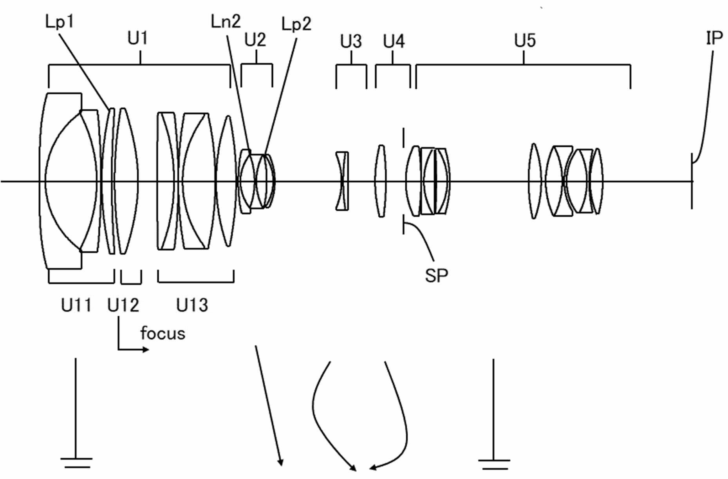
| Wide | Middle | Telephoto | |
|---|---|---|---|
| Focal Length | 15.09 | 84.97 | 116.08 |
| F-Number | 2.72 | 2.73 | 3.65 |
| Half Angle of View | 44.45 | 9.88 | 7.27 |
| Image Height | 14.80 | 14.80 | 14.80 |
| Lens Length | 339.07 | 339.07 | 339.07 |
| Back Focus Distance | 46.16 | 46.16 | 46.16 |
Closing Thoughts
Canon appears to have stagnated somewhat with its cinema line; perhaps it needs to acquire Arri and accelerate its efforts. We did mention this in the past, so Canon, you have a large war chest for this sort of thing – here’s your chance to do a Nikon, but only better.
Just a Reminder!
With all patents and patent applications, I have to stress constantly – this is simply a look into Canon’s research; the only thing we can quantify accurately is that Canon is researching this. A patent application doesn’t mean they are going to release this in the next month, or even year, or even at all.







4 comments