


When you purchase through links on our site, we may earn an affiliate commission. Here's how it works. |
Canon USA reps made an interesting comment to PetaPixel during the launch event. Canon assured them that the R3 line is not going away and will continue in the future.
I think we have to take a step back and review exactly what the “3” model was in the past.
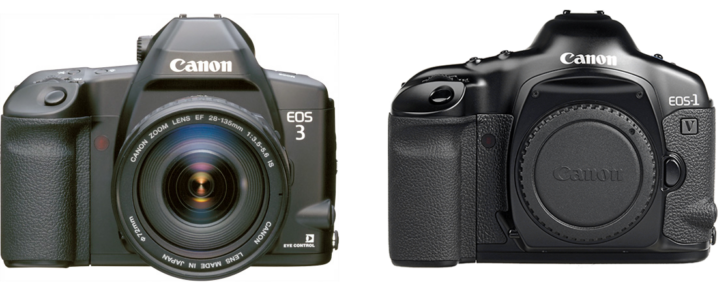
The EOS-3 came out in 1998 and sat in between the EOS-1N from 1994 and the EOS-1N's eventual replacement, the EOS-1V in 2000. It trialed for Canon a much more dense AF system (that would be used into the digital era), better AE, and featured a fast shutter and a very responsive camera overall. While the EOS-3 was a step up from the older generation 1N, it was superseded in terms of speed, viewfinder, performance, build quality, and configuration by the 1V.
The EOS-1V notably didn't have Eye control focus, partly because the system was pretty unreliable and Canon at the time couldn't fit eye control AF and the diopter controls into the viewfinder at the same time. Someone from years gone by did this comparison chart.
| EOS 1 | EOS 1N | EOS 3 | EOS 1V | |
| Year introduced | 1989 | 1994 | 1998 | 2000 |
| Size | 161x107x72mm | 161x107x72mm | 161x119x71mm | 161x121x71mm |
| Weight | 850g | 855g | 780g | 945g |
| Body type | Plastic shell over diecast aluminium frame, anti-slip fake leather | Plastic shell over diecast aluminium frame, anti-slip fake leather | Plastic shell over diecast aluminium frame, anti-slip fake leather on handgrip only | Magnesium alloy shell over diecast aluminium frame, anti-slip fake leather |
| Weatherproofing | Basic | Good | Good | Extensive (1) |
| Autofocus points | 1 | 5, in row | 45 in ellipse | 45 in ellipse |
| Cross sensors | 1 | 1 | 7 | 7 |
| AF limit of linear sensors | f/5.6 | f/5.6 | f/8 | f/8 |
| AF working range | 1 to 18 EV | 0 to 18 EV | 0 to 18 EV | 0 to 18 EV |
| Viewfinder coverage | 100% | 100% | 97% | 100% |
| Dioptric correction | Yes | Yes | No | Yes |
| Eyepiece shutter | No | Yes | No | Yes |
| Mirror blackout time | Unknown | 140ms | 105ms | 87ms |
| Multi-spot metering | No | No | Yes | Yes |
| Partial metering size | 5.8% | 9% | 8.5% | 8.5% |
| Evaluative metering zones | 6 | 16 | 21 | 21 |
| Maximum X-sync | 1/250 sec | 1/250 sec | 1/200 sec | 1/250 sec |
| Second-curtain sync control on body | No | Yes | Yes | Yes |
| Personal functions | No | No | No | Yes |
| Computer interface for recording shooting data | No | No | No | Yes |
| Data printing on film leader (frame zero) | No | No | No | Yes |
| Eye-control focus | No | No | Yes | No |
| Maximum framerate, camera alone | 2.5 fps | 3 fps | 4.3 fps | 3 fps (AI servo) or 3.5 fps |
| Maximum framerate with booster | 5.5 fps | 6 fps | 7 fps | 9 fps (AI servo) or 10 fps |
Now if YouTube and bloggers existed back in the day, people would be all over the fact that the EOS-1V is just an EOS-3 Mark II, because that's the hyperbolic world we live in now.
Canon did essentially the same thing with the R3. The R3 was announced in 2021 and the R1 was announced this year.
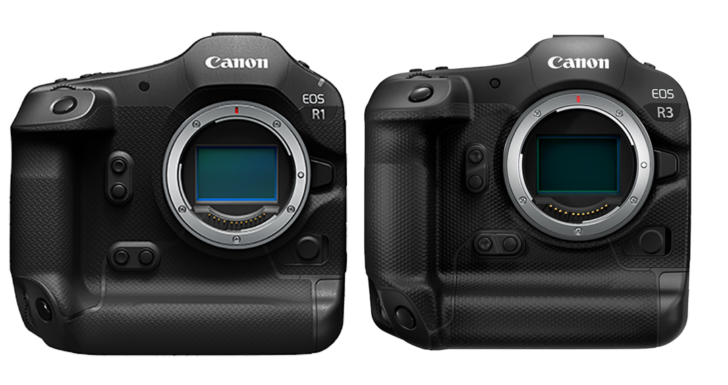
The EOS R3 was Canon's first trial of the 1 series technology on the RF mount to get professionals to use the camera and gain feedback on what to improve and what works and what does not work for the professionals. The R1, which is a better camera in every way came out after those lessons were learned 3 years later. Just like the EOS-1V and EOS-3, there were a lot of professionals who were more than happy to use the EOS-3, just like there will be some professionals who are more than happy to use the R3. Having a choice is never a bad thing.
Let's take a look in a similar way to the R1 versus the R3 and the 1DX Mark III, the last 1 series DSLR.
| Canon EOS R1 | Canon EOS R3 | Canon EOS-1D X III | |
|---|---|---|---|
| MSRP at launch | $6300 | $6000 | $6500 |
| Sensor type | Stacked CMOS Dual Pixel (cross-type) | Stacked CMOS Dual Pixel | FSI CMOS Dual Pixel |
| Pixel count | 24MP | 24MP | 20MP |
| Max burst rate | E-shutter: 40fps Mech shutter: 12fps | E-shutter: 30fps Mech shutter: 12fps | Viewfinder: 16fps Live view: 20fps |
| Rolling shutter rate | ∼2.8ms | 4.8ms | <4ms with mech shutter |
| Flash sync speed | E-Shutter: 1/320* EFCS: 1/250 | EFCS: 1/250 E-Shutter: 1/180 | Mech: 1/250 |
| Image stabilization | Up to 8.0EV | Up to 8.0EV | Lens only |
| Video options | 6K/60 Raw 4K/60 from 6K | 6K/60 Raw 4K/60 from 6K | 5.5K/60 Raw 4K/60 |
| Viewfinder | 9.44M dots 0.9x | 5.76M dots 0.76x | Optical 0.76x |
| Rear screen | 3.2″ 2.1M dots Fully articulated | 3.2″ 4.2M dots Fully articulated | 3.2″ 2.1M dots fixed |
| Battery life, viewfinder / LCD | 700 / 1330 | 440 / 760 | 2850 / 610 |
| Dimensions | 158 x 150 x87mm | 150 x 143 x 87mm | 158 x 168 x 83mm |
| Weight | 1115g | 1015g | 1440g |
| Additional Notable Specifications | |||
| Card Slots | Dual CFe Type B | CFe Type B + SD | Dual CFe |
| Eye Control AF | Improved Version | Yes | No |
| Wifi / Ethernet | Wifi 6E, 2.5Gbps LAN | Wifi 5, 1Gbps LAN | Wifi 2.4Ghz, 1 Gbps LAN |
| Precapture | Video and Stills | No | No |
| AF Priority Modes | Action and Person | Person | None |
As you can see from even these rough specifications the R1 is vastly superior to the last 1 series DSLR camera, the 1DX Mark III, and is smaller and lighter.
There have been some rather interesting alarms over the rear LCD of the R1, first of all i doubt anyone will notice the difference in resolution in the field, and secondly, the answer to why is to simply look at the battery life. Using the same battery, using the rear LCD the R1 delivers almost 100% more shots per charge than the R3. I suspect that's partly due to the resolution of the LCD which requires less power. I suspect that the users of the R1 will appreciate the longer shooting times per battery versus the microscopic differences in LCD resolution.
What's not mentioned in this table is the superiority of the autofocus between the R3 and the R1. Action priority will work to anticipate the flow of sports. Cross-type sensors may help with major defocus by giving the camera more sampling to determine distance. The R1 also by having cross type sensors will focus far quicker and more accurately. The cross-type sensors may also assist with subject recognition depending on how the contrast lines across the camera's sensor.
The R1 in a nutshell; the sensor is faster, you can shoot longer, the viewfinder is better, the eye control AF is another generational leap forward, the autofocus is better, and the autofocus features are vastly improved and class-leading. It is easy to see how Canon believes this is more than just a step up from the EOS R3 and a true 1 series camera for the RF lineup.
What will happen to the R3? The R3 has fallen to be more or less a few thousand cheaper than the R1, and I would not be surprised to see future R3 models (if there are any more), sit at this price point (~4000-5000) in the future. I see the R3 has been a Canon springboard for new technology. While it will have “stuff” that the R1 won't have, it will certainly have the Canon cripple hammer which means that if some features are better than the R1, some other features will not be. What I can't see the R3 lineup ever being is an A1 or a Z 9 camera that betters the R1 in terms of performance and megapixels.
There are advantages to what Canon may be doing, with the R3 and R1 on a cycle, Canon can release a professional-grade camera every 2 years if they wish to do so, but only if they have the technology in place to make a competitive upgrade. So we may all benefit from this.
There is of course another consideration. It could very well be that Canon USA was just giving its marching orders because Canon Global wants to sell all the R3s they have in their inventory. Just because Canon states something now doesn't mean they can't change their mind in 2 years.
Credits:
dpreview
Internet Archive




A cripple hammer of the R1 would be a tough sell over the R52 or even the 6 series, which will get some added speed for the Mark III. So would just sticking the R52 sensor in it.
The 3 series has no real heritage, they can do whatever they want with it. 5 and 1 are well defined.
Come at me!
Does anything? 😊
I think the person that would buy such a camera, would take an 80+mp over the 45. It wouldn't appeal to the hybrid crowd, but neither does the R1 or the current R3, and the R52 AF is already impressive as heck. The internet might be sort of happy?
If for the latter, maybe I would be in as I really like that smaller and lighter housing with integrated grip, compared to the R1.
If high MP, then I'd be out, but I know, it would make a lot of people here and in the world happy.
Canon, keep going on with R3 Mk XY... 😎
No, can't call you crazy. This is what I posted on 20 June 2024 on the thread about the R1 announcement coming in mid-July thread:
I think also, the rate technology is moving allows the R3 line to be an opportunity to filter up/down tech or introduce new features/tech as a test platform. For example, the new R1 accelerator chipset will probably need an update before the next R1 cycle.
Again, all speculation on my part.
I owned all three bodies, and you're right, more or less, in terms of increasing feature technical level, but as far as the lineup went, there was no way the 3 was at the 1N's level. It was a clearly a second-rung-from-the-top camera.
Unlike any of the EOS-1 series, the body was plastic not magnesium. The shutter cycle count was I think half, and wasn't top-tier x-sync and blacked out a lot longer. The shutter was also a lot louder and clickier. The viewfinder was a big step down. If I remember correctly the 3 didn't have interchangeable finder screens. (I usually had the split prism in my 1's and it worked fine with metering even though the documentation suggested it didn't. Maybe it just wasn't perfect.) The 3 couldn't take the right-angle finder. I think it also had an IR film advance sensor so you couldn't use it with IR film.
On the other hand, your article didn't mention (that I saw) the EOS-3's eye-controlled focus point selection which for me worked very reliably and I was sad to see it missing from the 1V.
The EOS-3 also had an excellent multiple-spot spot meter system. You could meter the darkest and lightest parts of a scene and see all the metered spots on the exposure meter at once. I forget if it was automatic or something you had to do manually but you could then get an exposure that would expose your darkest areas and brightest areas correctly (assuming the film had the DR for it) whether the overall scene was dark or light.
In summary the 3 was not a flagship body or finder or shutter or accessory ecosystem, but on the other hand had the latest greatest technology and specs including several features that the 1N lacked or didn't quite measure up to. I often shot the 28-70 on one body and 70-200 on the other, for reportage/wedding/street type stuff. But when I left the house to shoot landscape etc. or otherwise was just taking one Canon, it was the 1N and later 1V. Never once did I leave the house with just the 3.
(In my backpack I always had the Yashica T4 with the Zeiss 35/3.5, which was fun but honestly wasn't great. I then switched to Contax G2 with 28/45/90 as my backpack camera and loved that except for the AF noise. I also had a Mamiya 7 + 43/80/150, and a Rollei SL66+80/2.8 in those days, both phenomenal cameras that I'd totally have loved digital versions of. I then got a couple Leica bodies, a .58x and .85x, with 35/1.4 and 75/1.4, but when I got my 1DsMkI, I basically couldn't stand the hassle of film and sold everything but the Canon system.)
Someone said once "when you don't know much, you think you know everything. The more you know, the more you realize that you don't know much". People on the internet is sure that it knows everything. I watched a video about the R1, they said that they had a chance to play with it really for 45min and they already had a sounding No about the camera. I have owned an R5 for 4 years, and I am still learning how to use it. I barely know that I need something more.
You listen to the people on the internet, you will stay on the same level for good.
I have no idea on what they'll do in the future, but whatever it is - I think it will be "sideways" of the R1. it won't replace the R1.
it wouldn't surprise me, but as i was thinking about it.. i could see the R3 Mark II getting the first global shutter as well. something like a 20MP global shutter camera.
Another thing they could do - is move the R3 to APS-C - say give it a 40MP APS-C stacked sensor.
anyone's guess - but a 120MP R3 Mark II sounds good, as does a 40MP APS-C R3-S
except those that purchased the R1. So I can't see them doing that, as that would basically outclass the R1 in every way.
Personal preference:
R1S - An R1 with the same/similar 45MP sensor as the R5 II
R3 II - Stacked APS-C or APS-H sensor, lightening fast. This would differentiate it from the R1
And for a slower, ultra-high 100MP camera, open up a new sku - R2
There is not real reason that the R3 needs to stay at 24 MP but it should not be much higher.
Maybe 33 MP or something like that.