


When you purchase through links on our site, we may earn an affiliate commission. Here's how it works. |
Now and then, I read a lens patent and realize that it's never going to be released in the real world, or it's not even for our cameras – but I find the patent application so incredibly interesting that I just have to babble about it.
This is one of them.
For a long time, Canon has been a leader in broadcast lenses, and these are not inexpensive to design or manufacture. A while ago, dpreview went to the Utsunomiya lens factory and met with one of the only two master craftsmen there, Mr Saito, who described the precision and tolerances of the elements for 4K and 8K broadcast lenses as;
Mr Saito explains the incredibly fine tolerances involved in the creation of 4/8K broadcast lenses. Canon claims a tolerance of +/-30 nanometers. As such, if one of the finished elements were scaled up to the size of an Olympic stadium, the surface variation would be no thicker than a plastic grocery bag.
https://www.dpreview.com/articles/4996495413/the-home-of-the-l-series-we-tour-canon-utsunomiya-factoryThis is why Canon (and other brands as well) price their broadcast camera lenses well over $100,000.
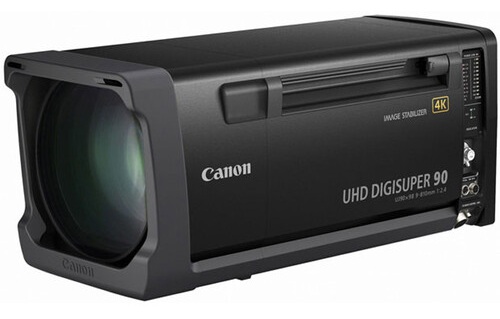
However, I should mention that this is why the patent application (2025-143884) is entirely jaw-dropping and why we are discussing it here – it is for Super-35-sized sensors, while Canon's DigiSuper lineup is usually for 2/3″ sized sensors. You could mount this bad boy (or vice versa, I suppose) with an R100, and for once, the R100 would be actually useful.
So let's take a look at these lenses and just for fun, consider them RF-S ;)
Canon RF-S 25-1000 F2.8-4.8
We'll start with the most conservative lens of them all; this bad boy is a 25-1000mm F2.8-4.8 and isn't handheld by most mere mortals. I'm going to assume it's somewhere along the lines of the other lenses in this category, and it weighs around 25-28kg (55-61lbs). Canon's original EF 1200mm f/5.6 was a lightweight 16.6kg (36.6lbs), making this zoom far less manageable.
Those front optical elements are a thing of beauty. And Price. And Weight. Conservatively, the elements would be approximately 250mm in diameter, which places them larger than the 1200 F5.6's front elements. Expensive? You bet. The total number of elements is not quite sure, but I believe it's north of 35.
What I find even crazier than the 1000mm focal length is that it's a constant F2.8 until after 600mm.

| Wide | Middle | Crazy | |
|---|---|---|---|
| Focal length | 25.50 | 596.55 | 1000.09 |
| F-number | 2.90 | 2.90 | 4.86 |
| Half angle of view (°) | 30.13 | 1.42 | 0.85 |
| Image height | 14.80 | 14.80 | 14.80 |
| Lens length | 674.06 | 674.06 | 674.06 |
| Back Focus | 66.38 | 66.38 | 66.38 |
Canon RF-S 22-1300mm F2.8-7.0
Now, some of you will look at the prior example and think that 24-1000 is a little too limiting, especially since it's not a constant f/2.8. I hear you. While there's nothing I can do to show you a continuous 24-1000 f/2.8 – I have what I think is the next best thing. Here's a 22-1300mm f/2.8-7.0 with a constant aperture of f/2.8 for half the zoom range up to 450mm. What's not to love, besides the price tag and the weight? The size is still incredibly small for its focal length, with a constant length of 667mm.
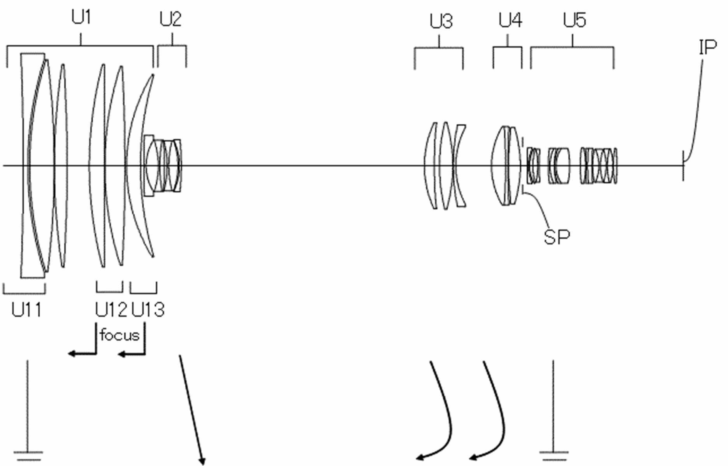
| Wide | Middle | Plaid | |
|---|---|---|---|
| Focal length | 22.88 | 450.46 | 1317.80 |
| F-number | 2.90 | 2.90 | 6.86 |
| Half angle of view (°) | 32.90 | 1.88 | 0.64 |
| Image height | 14.80 | 14.80 | 14.80 |
| Lens length | 666.62 | 666.62 | 666.62 |
| Back Focus | 52.00 | 52.00 | 52.00 |
There is also another patent application (2025-143879) that showcases other similar broadcast lens designs.
Of course, this patent article is having a bit of fun with Canon's patent application. For Canon, designing lenses that cost in the 6-figure category is serious business. It also gives us a chance to take a cursory look at the crazy optics that power these lenses.
Next time you are watching your favorite football game, there's a good chance it's one of Canon's digisuper broadcast lenses bringing the field closer to you.








And I'm sure we will soon see some sites/youtubers bring rumor of Canon making crazy RF-S superzooms ;-)
I'm honestly not sure. There doesn't seem to be any cooling, etc embedded in the camera lenses, and they seem to be mostly painted black.
Thanks for sharing.