

When you purchase through links on our site, we may earn an affiliate commission. Here's how it works. |
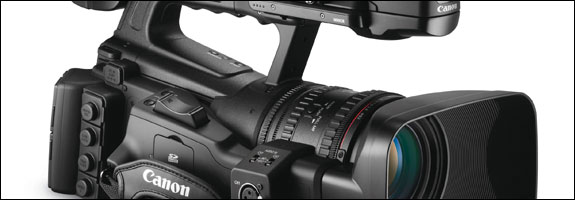
LAKE SUCCESS, N.Y., April 7, 2010 – Canon U.S.A., Inc., a leader in digital imaging, today announces the Canon XF305 and XF300 Professional Camcorders. Both new models employ an MPEG-2 4:2:2 50Mbps codec – Canon XF Codec – for capturing and recording native 1920 x 1080 video onto affordable, universally available Compact Flash (CF) cards. Uniting video, audio and metadata into a single file, the Canon XF305 and XF300 use an MXF (Material eXchange Format) File Wrapper, a widely supported open source format, to maximize compatibility with existing industry infrastructure and non-linear editing (NLE)systems. Priced under $8,000 per model, the Canon XF305 and XF300 are engineered for multiple production applications including broadcast news, documentary and independent filmmaking and event videography. Canon will be demonstrating a variety of professional applications for the Canon XF305 and XF300 at the Company's booth# C4325 at the 2010 National Association of Broadcasters (NAB) Show in the Las Vegas Convention Center.
The Canon XF305 and XF300 Professional Camcorders include a Genuine Canon 18x HD L-series lens providing documentary filmmakers and news camera operators with the focal-range versatility required in the field. Designed with input from professional users, each model includes three Canon developed and designed native 1920 x 1080 CMOS image sensors, and the new Canon XF Codec for extreme color detail required for accurate chroma-keying, color-grading and compositing for digital filmmaking. For finer transitions in tone and color, 4:2:2 color sampling offers twice the color resolution of HDV and other 4:2:0 formats. In addition, Canon's XF305 model features industry- standard HD-SDI output, genlock, and SMPTE time code (in/out) terminals for multi-camera or 3-D productions.
Yeah, this is oldish news, I was super busy today. :)
cr


Saw these, was kind of sad they didn’t move towards more dSLR tech for these cameras.
What i need this for if my DSLR shoots movies now?
Better yet…build me a full frame dslr that just takes pics. If I want to make movies i’ll buy one of these. At least i’ll have a choice.
A notable DSLR-ish aspect of these camcorders is the use of a CMOS sensor. I wonder what the sensor dimensions are, and how they’ve overcome the heat problem with CMOS.
what is the sensor size?
They have been using CMOS in Camcorders for years now.
If anything it’s a technology with serious drawbacks. :(
We need a CMOS with a Global Shutter, that would be nice.
Sensor is only 1/3″ 1920 x 1080 CMOS image sensor weak…but codec is 4:2:2 :O so it will be a lot better than the XH-A1 since it was an interlaced sensor & 4:2:0 colour sampling of HDV but this for $7K-$8K?
Don’t think so…
I’m waiting on the shoulder-mount, interchangeable lens version. However, I’m afraid of the price after seeing speculation on the price of today’s announced cams.
The 5D2 sensor may be full frame, but the video does not use any pixel binning, so the quality is no better than an image from a smaller sensor (though I’m not sure what the implications are for DOF). The 1/3″ sensors in these video cams can probably match the 5D2 for low light ability, as the number of pixels used and the pixel size are probably similar.
They have to do some kind of pixel binning because the full lens width is used in video, not a width of 1920 in the middle of sensor. I suspect that low light capabilities are also quite different (and obviously DOF).
I’m afraid they skip. If the 5DII used binning the outcome would be even more phantastic…
I see. Sounds plausible.
I was expecting an 35mm sensor and the ability to use EF lenses, maybe they will release a better one this fall/spring.
This is pretty yawn-worthy.
The extra sad thing is that a lot of the rumours regarding upgrades to video for Canon SLR cameras have been referring to these cameras. Canon have been letting snippets of information about this to the dealers for the last year or so.
Yeah, they have been using CMOS in cheap video cameras for years because they are cheap and easy to make, end of story.
Stills guys get excited by CMOS because they don’t know any better.
Have you not been keeping up with current events? It’s called the 5Dmk2!!!!!
The 5D MK II is not a pure video camera – in fact, its – on the Canon side – possibly the best landscape and studio camera you can buy, excluding the 1D and 1Ds.
The question is, are there many more features that the 5D MK II can gain in stills performance – I don’t think there is a lot of leeway, maybe some, but not a lot.
And people who complain – ISO 3200 is usable, and unless you need a large image, so is ISO 6400.
Video is possibly easy to implement, and as a lot of people wanted enhancements, they were offered.
The difference in DOF is the same as between a 5D and an Ixus, huge. 5D skips lines, but uses the full width and height of the sensor. The market for these cameras is still huge.
5D2 is missing lots of pro video features.
bal. audio input,
time code,
no record time limit,
4:2:2 ?
etc….
Sorry – yawn worthy is just your opinion. It’s actually really exciting for video professionals. Full-raster 1920×1080 chips with a native 50/mbps 4:2:2 codec on hot-swappable non-proprietary media for UNDER $7K is a huge step up in the video game.
While C-MOS may have some drawbacks like skew (which becomes less of a problem with smaller sensors), they still have many benefits over CCD imagers. They require less power, they generate less heat, they have a cleaner image with less noise, and they resolve more detail. Those are excellent reasons to use a C-MOS chipset in a video camera, especially one that is meant to sell in the under $10k market.
Don’t get your hopes up for this happening anytime soon – there are a lot of technological hurdles to overcome to make a camera like that and have it give professional quality images and still be affordable.
from my comment below:
“While C-MOS may have some drawbacks like skew (which becomes less of a problem with smaller sensors), they still have many benefits over CCD imagers. They require less power, they generate less heat, they have a cleaner image with less noise, and they resolve more detail than CCD’s. Those are excellent reasons to use a C-MOS chipset in a video camera, especially one that is meant to sell in the under $10k market.”
Only because you are comparing 7 year old CCD design to a current CMOS.
Canon and Sony switched to CMOS in their consumer products to make more profit, not increase image quality.
Independently settable sensitivity for the color channels.
You don’t clip one channel while having noise creep into an other due to to much amplification just because of white balance.
What current camera has full-raster 1920×1080 1/3″ CCD’s? Sorry, none of them. If you want to get full-raster resolution out of a 1/3″ chipset, C-MOS is the only way to do that right now.
“Canon and Sony switched to CMOS in their consumer products to make more profit, not increase image quality.” Wow – hyperbole much? Then why are so many people clamoring for C-MOS picture quality? Sony & Canon increase profit by increasing image quality in their cameras while keeping the price affordable, and thus selling more cameras. So in a way, I guess you’re right and wrong.
Seems like a lot, if there were 3 1/2 inch sensors like those you find in the SONY EX-1 or EX-3 then it would be cool at that price, but that’s not the case. I’d still go EX-3/EX-1.
Here is what I found
Sony Coming with interchangable lens camcorders that takes sony’s dslr lenses
Here is the link
http://www.dslrnewsshooter.com/wp-content/uploads/2010/05/8ido18000008y38f.jpg