

When you purchase through links on our site, we may earn an affiliate commission. Here's how it works. |
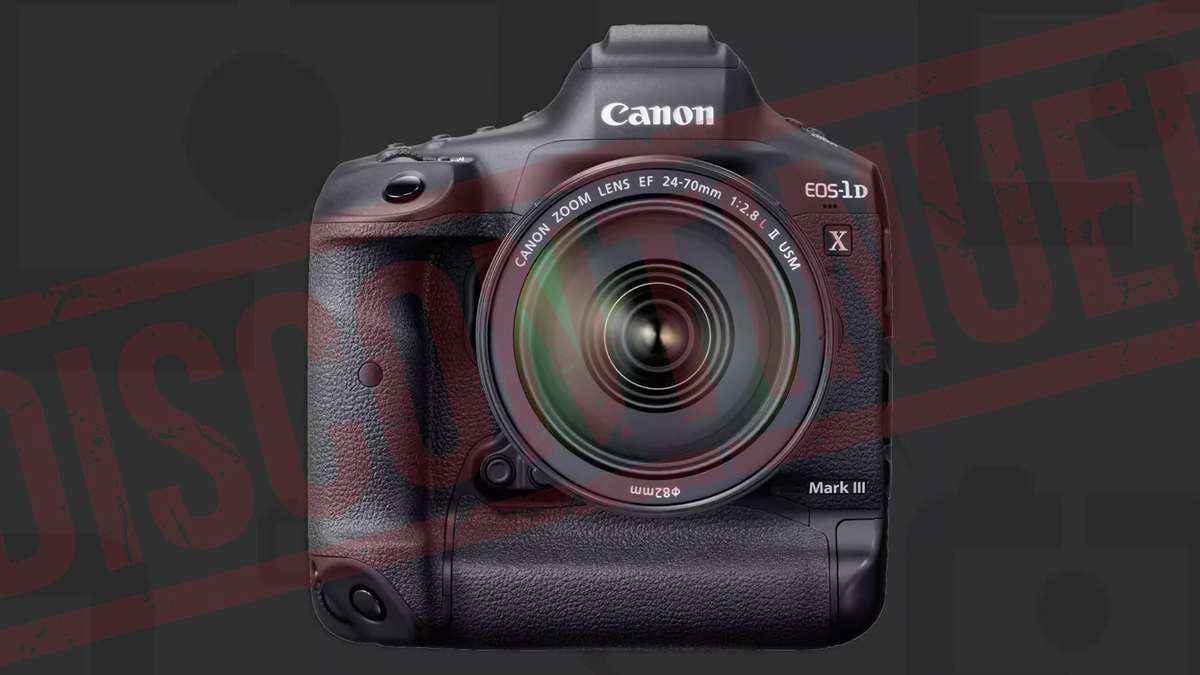
First of all, I'm a little surprised by this. Canon's 1-series cameras typically had a reasonably long lifespan. The 1DX Mark III was announced via a development announcement on October 24, 2019, and officially announced on January 6, 2020. Therefore, it's not even that old of a camera, especially by professional standards.
TOKYO, October 24, 2019—Canon Inc. announced today that development is underway on the EOS-1D X Mark III, the newest entry in the EOS-1 series highly trusted by professional photographers in such fields as sports and portraiture for its high performance and reliability. The new model will deliver enhanced image quality, continuous shooting and operability over its predecessor, the EOS-1D X Mark II (released in April 2016).
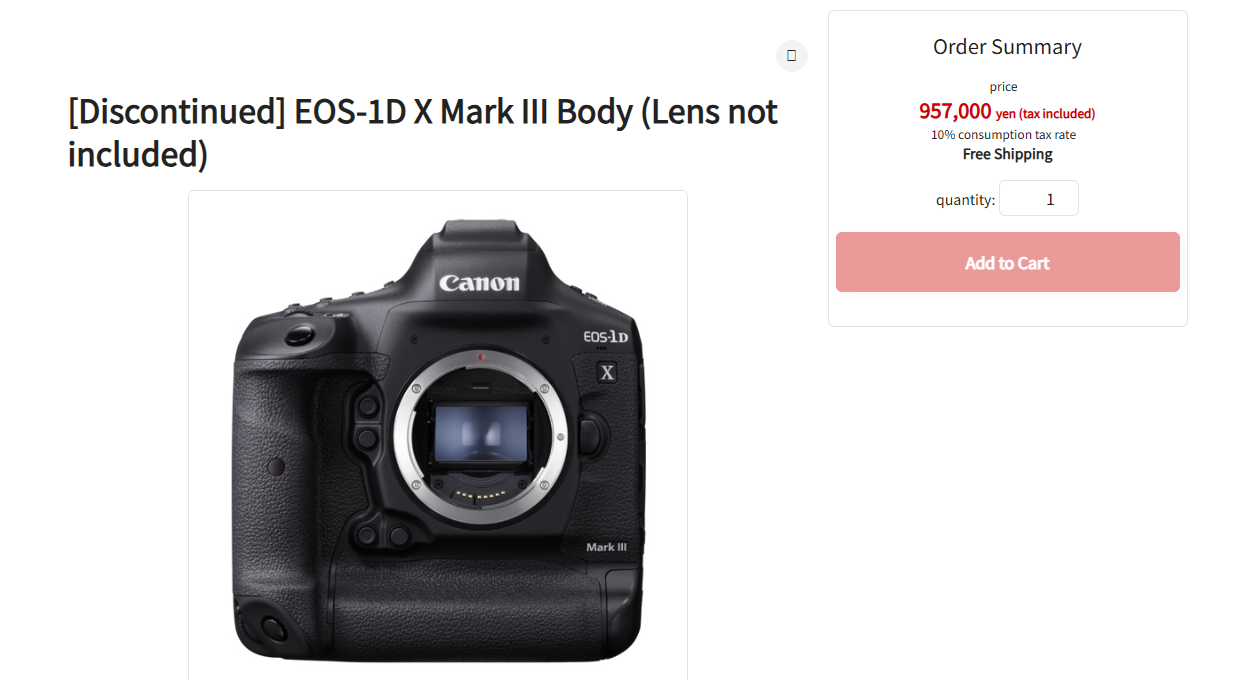
That being said, Canon has quietly but firmly closed down the EF mount around this camera, so it's no surprise that the Canon 1DX Mark III was quietly discontinued in Japan, at least. Retailers will still have stock, but once they run out, that's probably it for the 1DX Mark III and the one series DLSR lineup altogether. Be sure to give our Canon 1 series history article a read: Exploring The History of Innovation: Canon EOS-1 Series Cameras.
Key Features of the 1DX Mark III
- 20.1MP Full-Frame CMOS Sensor
- DIGIC X Image Processor
- EOS iTR AF X 191-Point AF System
- Dual Pixel CMOS AF, 525 Selectable Areas
- Up to 20 fps Shooting, ISO 100-102400
- 4K60 10-Bit 4:2:2 Internal Recording
- Canon Log and 5.5K Raw Video Support
- Wi-Fi, Bluetooth, and GPS
- Dual CFexpress Memory Card Slots
The 1DX Mark III was easily Canon's best DSLR that they have created, with a fast 16 frames per second full frame shutter and mirrorbox assembly, to be able to use its DPAF sensor with the mirror up at 20 frames per second for stills or 4K60p in video. It included Canon's Log Gamma, focus guides, and focus peaking to round out an excellent hybrid camera that was built like a tank.
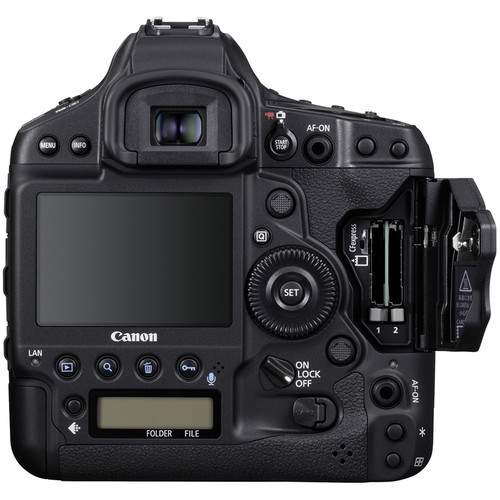
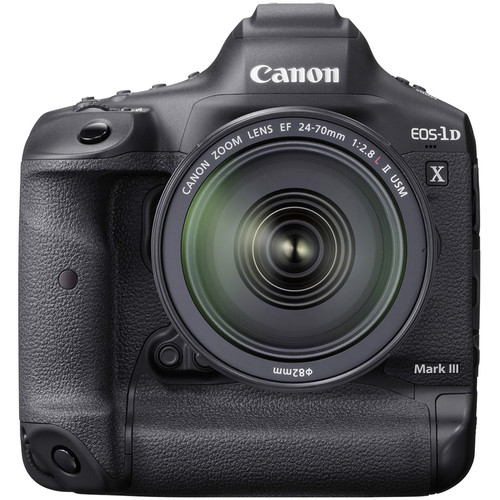
Built for speed, sensitivity, and precision, the Canon EOS-1D X Mark III is a powerful DSLR designed for sports, wildlife, and other trying and dynamic imaging applications. Designed as the flagship of the EOS system, the 1D X Mark III is characterized by its refined processing capabilities and distinct speed to suit both photo and video applications. Featuring a newly designed 20.1MP full-frame CMOS sensor and updated DIGIC X image processor, this camera is capable of continuous shooting rates up to 16 fps with the optical viewfinder or 20 fps in live view, with a 1000-shot buffer when shooting raw+JPEG. Complementing this speed is an impressive native sensitivity range from ISO 100-102400, that can be expanded to ISO 50-819200, to suit working in a variety of lighting conditions. Also benefitting the speed is the EOS iTR AF X autofocus system, which uses 191 points for quickly and accurately acquiring focus. It also enables Face Tracking and Head Detection AF functions, which use Deep Learning Technology, to maintain critical focus on moving subjects. Additionally, when working in live view, Dual Pixel CMOS AF uses 3869 manually selectable points and provides a smooth, natural focusing quality akin to the way a camcorder acquires focus.
Canon replaced the 1DX Mark III with the new Canon EOS R1, featuring the RF mount, a little over a year ago, officially transitioning the legacy of the one series to the RF mount. In every way possible (except optical viewfinder), the R1 exceeded the specifications and performance of the 1DX Mark III. Additionally, with a variety of RF to EF adapters, legacy EF professional lenses can be used on the R1, ensuring a seamless transition.
[affiliatable id='301787′]
That being said, there were a few standout reasons why some people would keep the 1DX Mark III, namely battery life and optical viewfinder, and some users may feel that the lack of in-camera stabilization and articulating LCD made the 1DX Mark III a more rugged camera capable of the most extreme environments. The ergonomics also shifted with the R1 from the 1DX Mark III, but I haven't heard anyone complain about the differences between the two camera systems.
| Canon EOS R1 | Canon EOS-1D X III | |
|---|---|---|
| MSRP at launch | $6,300 | $6,500 |
| Sensor type | Stacked CMOS Dual Pixel (cross-type) | FSI CMOS Dual Pixel |
| Pixel count | 24MP | 20MP |
| Max burst rate | E-shutter: 40fps Mech shutter: 12fps | Viewfinder: 16fps Live view: 20fps |
| Rolling shutter rate | ∼2.8ms | <4ms with mech shutter |
| Flash sync speed | E-Shutter: 1/320* EFCS: 1/250 | Mech: 1/250 |
| Image stabilization | Up to 8.0EV | Lens only |
| Video options | 6K/60 Raw 4K/60 from 6K | 5.5K/60 Raw 4K/60 |
| Viewfinder | 9.44M dots 0.9x | Optical 0.76x |
| Rear screen | 3.2″ 2.1M dots Fully articulated | 3.2″ 2.1M dots fixed |
| Battery life, viewfinder / LCD | 700 / 1330 | 2850 / 610 |
| Dimensions | 158 x 150 x87mm | 158 x 168 x 83mm |
| Weight | 1115g | 1440g |
Gallery
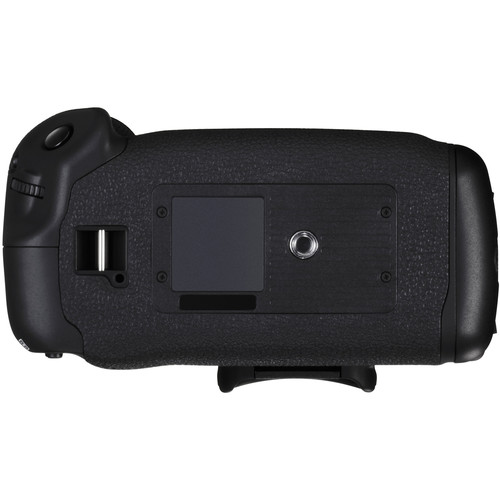

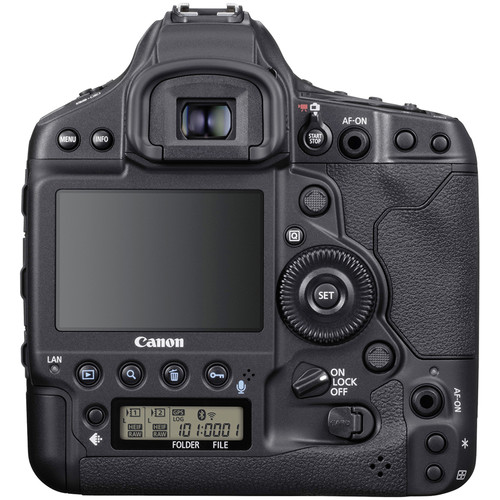
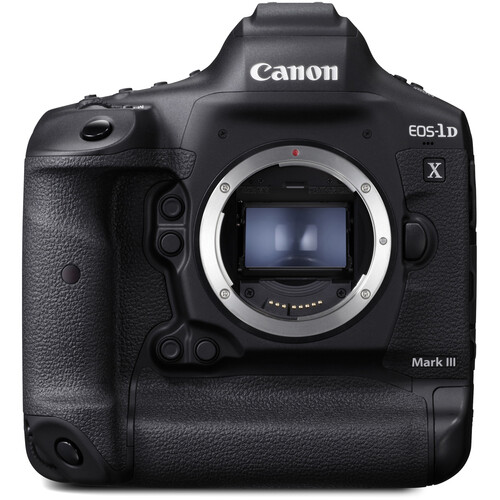

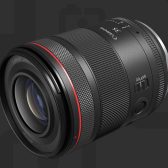



https://personal.canon.jp/product/camera/eos/old-products
Was there an announcement?
I suspect it's a stealth addition that will go into other pages soon.
Interesting if the 1DXIII gets discontinued and the 5DiV doesn't. If anything, I would have expected the 1DXIII to last much longer than the 5DIV in production. AND the 5DIV was released in 2016!
Canon USA only has 5Div and T7 (and kits). What is very strange is that they still have the 5Div with canon log as a separate option and at USD500 price premium! To be fair it looks like the log version is not currently available yet I thought that soon after the log feature was a payable/return to shop upgrade, that Canon made it standard for all new purchases with a USD100 price increase.
I also am surprised that the 1DXiii is gone but 5Div hasn't even though the R5 was released is >5 years ago vs the R1.
The serviceable life for a 1D is definitely more than ~5.5 years...
Maybe
- The sales of R1 is so overwhelming that everyone has replaced their 1DX
- Canon is forcing 1DX owners to upgrade when/if their 1DX breaks down which also doesn't sound Canon-ish
- Some components are now impossible to get at a reasonable cost so Canon has made it discontinued across some (all) Canon regions
The latter makes more sense than the situation for 5Div.
Some other stores don't even list it any more, like ac-foto.de or fotokoch.de.
😎
It's all about sales units. The 5-Series has always outsold the 1-Series by several orders of magnitude. If there are more authorized dealers around the world than the number of bodies a particular model sells in a year, it's not going to be maintained in the catalog. If a model is still selling enough units for each dealer to stock it, they'll keep it in the catalog.
In the "old days" when most 1-Series buyers were commercial organizations who issued camera gear to their staff photographers the 1-Series sold most of their units shortly after introduction. Those days are long gone, though, as the number of staff photographers in 2025 is miniscule compared to just 10-15 years ago. I imagine most well heeled enthusiasts, who are what drives the upper end of the market now, are much more into MILCs than DSLRs. The few news organizations left who still issue gear to their staff photographers started transitioning to MILCs a couple of years ago. At least that's when my friend who shoots for a Gannett owned newspaper and covers major sporting events in the surrounding region for Gannett transitioned from Canon DSLRs to Sony MILCs. It was around the same time the AP took Sony's offer of greatly discounted gear and ended their relationship with Canon.
When Canon discontinues a model they continue supporting it for at least seven years. They hold enough repair parts in reserve that they estimate will last for at least seven years. Some of these come from unsold units returned by dealers when it has been discontinued.
The last time I remember a lens dropping from the repair support list sooner than seven years after it was discontinued was the EF 200mm f/1.8 L because they ran out of parts for it.
The EF 200mm f/1.8 L was introduced in 1988 and discontinued in 2004 or 2005 (Canon never makes an official announcement, they just quietly remove items from their catalog) without an immediate replacement. It was during the period when Canon was eliminating lenses which used lead in the manufacturing process. Only around 8,000 were ever produced. The last known date codes indicate the last production run was in 1998. Lens owners began reporting Canon returned their lenses needing AF motors replaced unrepaired as early as 2006, two years before the EF 200mm f/2 L IS was introduced. By 2007 it was removed from the CPS support list in the U.S.
Since it is a focus-by-wire lens, it can't even be manually focused without an AF motor. Third party repair businesses started reporting they could no longer order the AF motor from Canon shortly after the lens was removed from Canon's catalog.
The EF 200mm f/1.8 L used the same AF motor as the EF 1200mm f/5.6 L (1993-?: less than 100 ever made and more likely around 20 - only three have ever been offered on the used market), EF 300mm f/2.8 L (1987-1999), EF 400mm f/2.8 L (1991-1996), EF 500mm f/4.5 L (1992-1999), and EF 600mm f/4 L (1988-1999). Other than the special order 1200/5.6, which was offered through 2005, all of the other lenses which used the same USM part number for focus-by-wire were discontinued by 1999 and replaced by IS versions which were not focus-by-wire and used other part numbers for the USM. It's been theorized that Canon used up all their reserve of that AF motor on the lenses that were discontinued in the late 1990s.
This shouldn't be that surprising. Historically each 1-Series camera has been discontinued shortly after its replacement was available. Since unifying the APS-H 1D Series and Full Frame 1Ds Series with the 1D X in 2012, the 1D Mark IV and 1Ds Mark III disappeared from the catalog a few short months later. The 1D X was gone shortly after the 1D X Mark II was introduced in 2016. The 1D X Mark II went away shortly after the 1D X mark III came along in 2020. With the R1 introduction in mid-2024, I'm surprised it has taken this long.
End of support date is much longer especially for L lenses. 3rd parties are likely to repair lenses part their official end of support date for as long as there are spare available.