

Are you boasting, confessing or complaining?I've recently begun studying Arthur Schopenhauer. It's changing my life.

Upvote
0
Are you boasting, confessing or complaining?I've recently begun studying Arthur Schopenhauer. It's changing my life.
Half confession / half recommendation.Are you boasting, confessing or complaining?
By chance, I was testing the RF 200-800mm on the R7 on Thursday and took a shot of a Robin at iso 8000 - this would be equivalent to iso 20,000 on FF given a crop factor of 1.6, which corresponds to 1.36 stops. This shot is from RAW straight out of DxO PL6 (yes I'm 3 generations back) with absolutely standard XDDeepPrime with no boosting. Going through back files I found a shot of a Great Tit taken by wife with the R7 + RF 100-400mm at iso 32k (equivalent to iso 82k on FF!), again straight out of DxO PL6 with no boosting of noise reduction. They look as good as I would get out of the R5 at the higher isos.Sorry, but when you tend to argue down to sensor size and adjusting to just "1 stop", I can tell you from my direct comparisons that I use my R6m2 up to ISO 6400 while I wouldn't use the R7 at higher than ISO 2000, because of s/n in the photos, given the RAW files I get out of the camera. (Of course, you can use SW to compensate this in PP)
So this is more than you say or think to calculate.
This is my direct experience, and here I would say, if Canon had to chose to get the same noise with 32 MP at ISO 3200 or 4000, or with 40 MP at ISO 2000 I would prefer s/n over resolution.
IF we are at physical borders here and it is not possible to increase s/n then it is as it is.




What causes the depth of field and background blur to change when putting the same lens on a smaller sensor is if you move the camera back to get the same framing.Equivalence means the resulting images are equivalent – same FoV, DoF and noise. It's right there in the word, equivalent is defined by the Oxford dictionary as equal in value, amount, function, meaning, etc. Equivalent doesn't mean two things are the same and one is different. That applies in any context, not just photography. You're saying that having two apples and an orange is equivalent to having three apples. Toddlers know better.
Incidentally, the difference in focal length is not what causes the DoF to change, and keeping focal length, distance and f/number constant but using a different sensor size does not hold DoF constant. Seems there is more than one photographic concept where your understanding is sorely lacking.

What cameras and lenses were used here? Since no camera you list has more than 24MP, for all we know the degraded left-hand image was an APS-C crop from from the center of a 24MP full-frame image - and is thus barely more than 9MP, not to mention the lower resolving power of a shorter lens - particularly if it's shot at a smaller aperture incurring more shot noise? Hardly fair. Doesn't "spark joy" to see such a post.It sparks joy to know that there are people out there who still believe in fairies, wizards and the magic of the crop factor.
Who needs a longer lens and a bigger sensor when a shorter lens with a smaller sensor gives the same 'effective focal length'?
View attachment 227141


Thanks for the examples, Alan!... They look as good as I would get out of the R5 at the higher isos.
DPP is absolutely cr*p at high noise reduction. It's using decades old technology (and that's not an exaggeration), which is iinadequate high noise and sacrifices detail. It's OK for well exposed images. The images I posted aren't as good as I would normally want, but they are good enough for much of what I do.Thanks for the examples, Alan!
I was looking at RAWs SOOC with Canons original DPP.
And there the results were not as good as yours look here.
@neuroanatomist is not telling you that at all. What he and those articles is pointing out is that an f/2.8 lens on a crop handles low light to exactly the same S/N as an f/4.5 on full frame (4.5 = 1.6x2.8). Just raise the iso on the FF by 1 1/3 stops and use the same shutter speed on both and you will get the noise quality on both. The crop f/2.8 and the FF f/4.5 lenses have the same diameters and areas, and throw the same amount of light onto the image. If you know that, then you will realise that a cheaper f/4 lens on FF will actually perform better in low light than buying a perhaps more expensive f/2.8 and then putting it on a crop.Telling folks just getting into photography, and are primarily concerned with whether the lens/camera combination they're looking at can capture enough light in low light situations that the f/2.8 lens they're looking at is really an f/4 lens is totally misleading to the ordinary photographer, and is primarily designed to steer them to buy more expensive full-frame gear.

No, the pixel size does affect DR, I learned that from a Zeiss engineer involved in the development of smartphone camera lenses. To put it in a simple picture: you can imagine a pixel like a bucket that is filled not with water but photons. The smaller the pixel is, the earlier is the bucket full and therefore not able to collect more photons. Btw that's exactly the metaphor used by this engineer.A pixel in a 40 Mpx sensor is only 10% smaller than in a 32.5 Mpx one of same size, as I replied to your post on wednesday. And the dynamic range of the whole image at high iso is unaffected as it depends on the area of the entire sensor, not individual pixels, and the noise is primarily due to statistical fluctuations in the number of photons at high iso.

No. But, if you ever find your way out of the circle of confusion that you are clearly trapped within, perhaps then you'll understand. That highlighted bit is a hint, you may want to google that (or not, if you'd prefer to continue in your mistaken belief that you fully understand what factors determine DoF).Leave the camera in the same place and let the framing change because of the smaller sensor and the depth of field and background blur are unchanged.
You can frame how you want and set the DoF based on your artistic choice (within the limits of your lens). Artistic choice matters when comparing what one likes best. It's irrelevant when discussing equivalence.The increased depth of field is an artistic choice tied to the choice of framing, not an immutable scientific fact.
I'm sorry that you find factual information misleading. I prefer to educate people about the facts, not suggest that they ignore them...or worse, present them with misinformation. Granted, the latter is all too common these days but I choose to be part of the solution rather than part of the problem.Telling folks just getting into photography, and are primarily concerned with whether the lens/camera combination they're looking at can capture enough light in low light situations that the f/2.8 lens they're looking at is really an f/4 lens is totally misleading to the ordinary photographer, and is primarily designed to steer them to buy more expensive full-frame gear.
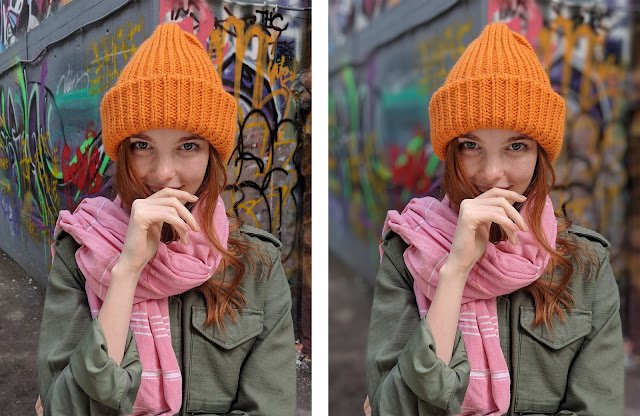
Sure, sure. I mean, smartphones don't even offer Portrait Mode because no one wants a blurred background.If a blurred background is the paramount virtue you aim for in photography, go for it - but you're not talking the language of most photographers.

 www.samsung.com
 research.google
If you post correct information, I'd be happy to thank you and move on. But if you continue to post misinformation and make asinine statements, I will continue to set the record straight.But leave the rest of us alone.
When you take a picture with one pixel, let us know and we'll be happy to agree that the DR of your picture is determined mainly by the size of your pixel. But if you use a large array of pixels to take a picture (like most of us do), then it's the size of that array that determines the DR, not the size of the individual pixels.No, the pixel size does affect DR, I learned that from a Zeiss engineer involved in the development of smartphone camera lenses. To put it in a simple picture: you can imagine a pixel like a bucket that is filled not with water but photons. The smaller the pixel is, the earlier is the bucket full and therefore not able to collect more photons. Btw that's exactly the metaphor used by this engineer.
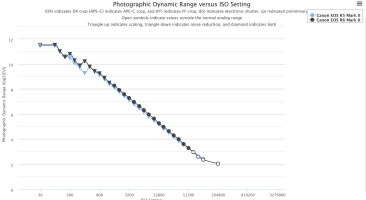
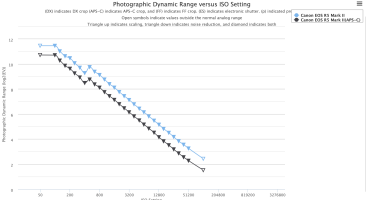
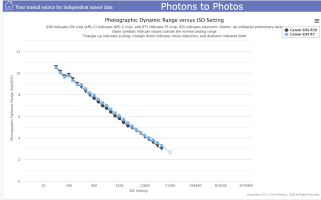
No!! You are confusing engineering DR, which is the DR of a single pixel, with photographic DR, which is the DR of the collection of pixels that make up the image. When we look at an image, we don't look at the DR of a single pixel but of the collection. To use your bucket analogy, 4 1/4 sized buckets that occupy the same area of space as a single 4xlarger bucket, hold as much water as the large one. Surely, you must have seen the DR curves on photonstophotos that have been used here 100s of times to show that photographic DR is virtually independent of pixel size. I'll show two pairs: the R7 and lower pixel R10, R5 and lower pixel R6. I recommend you read the first link posted by @neuroanatomist.No, the pixel size does affect DR, I learned that from a Zeiss engineer involved in the development of smartphone camera lenses. To put it in a simple picture: you can imagine a pixel like a bucket that is filled not with water but photons. The smaller the pixel is, the earlier is the bucket full and therefore not able to collect more photons. Btw that's exactly the metaphor used by this engineer.
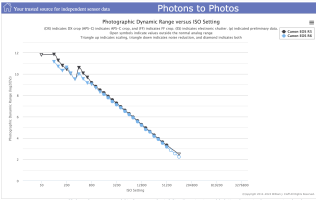

I have a very deep practical understanding of how a camera works and follow most of the details discussed above. However, the above quote and graph are throwing me off…Now compare the DR of the R5II with the R5II in crop mode. The same, exact pixels but a smaller sensor area used to take the picture. The larger sensor area does offer a DR advantage.
View attachment 227174
It's because the Photographic DR is measured on an image enlarged to a specific standard size. For the FF, the whole image is enlarged to that size. When you crop the centre to APS-C size, you have to enlarge the crop 1.6x by 1.6x more. It's described somewhere on the photonstophotos site.I have a very deep practical understanding of how a camera works and follow most of the details discussed above. However, the above quote and graph are throwing me off…
I shoot often in crop mode and will switch between crop and FF for framing and composition (light, camera, lens, exposure triangle stay unchanged). If my distance to subject is fixed, the quality of the pixels, reviewed on my monitor, at 1:1 (100%), show what I believe to be no discernible difference. The noise (or SN ratio?) is consistent whether the image was captured in FF or crop.
I believe my observations are correct; that the same number of photons are hitting each pixel bin (photo site?) on the sensor, regardless of FF or crop setting. So how is the graph showing different DR? Is that because DR and noise are independent, or not as linked as I thought?
There seems to be a gap in my understanding, because, without having read the above articles, I’d certainly have told anyone who’d asked that the center of my sensor captured an ‘equivalent’ image, whether in crop or FF (if no other factors changed…).
So, where’s the disconnect? What am I missing?
Perhaps a graphical illustration of what @AlanF explained.I have a very deep practical understanding of how a camera works and follow most of the details discussed above. However, the above quote and graph are throwing me off…
I shoot often in crop mode and will switch between crop and FF for framing and composition (light, camera, lens, exposure triangle stay unchanged). If my distance to subject is fixed, the quality of the pixels, reviewed on my monitor, at 1:1 (100%), show what I believe to be no discernible difference. The noise (or SN ratio?) is consistent whether the image was captured in FF or crop.
I believe my observations are correct; that the same number of photons are hitting each pixel bin (photo site?) on the sensor, regardless of FF or crop setting. So how is the graph showing different DR? Is that because DR and noise are independent, or not as linked as I thought?
There seems to be a gap in my understanding, because, without having read the above articles, I’d certainly have told anyone who’d asked that the center of my sensor captured an ‘equivalent’ image, whether in crop or FF (if no other factors changed…).
So, where’s the disconnect? What am I missing?
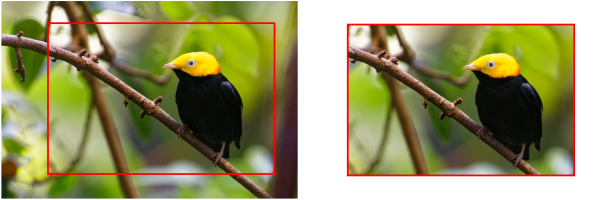
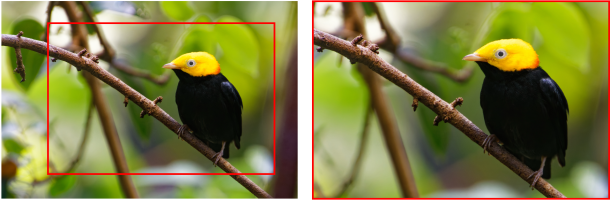
It’s a pleasure to reply to a question from someone who is appreciative.Thank you both for the explanation and the diagrams - very helpful.
It seems to me that there’s a large divide between the popular colloquial language and the formal terminology used in these discussions.
There are 2 aspects to light/exposure/noise that might be important to photographers. And are often confused. Your f-ratio measures the intensity of light in a given area, but his is not the total amount of light gathered. Since exposure is intensity, it does not change if sensor size is different. This is why an exposure of f/2.8 is the same regardless of sensor size. But light gathered is a different measurement and is tied into how much noise (S/N ratio). How much light is gathered depends on the size of the entrance pupil - not the f-ratio. For example:....
Telling folks just getting into photography, and are primarily concerned with whether the lens/camera combination they're looking at can capture enough light in low light situations that the f/2.8 lens they're looking at is really an f/4 lens is totally misleading to the ordinary photographer, and is primarily designed to steer them to buy more expensive full-frame gear.


