What’s next from Canon?

Someone here said that the R8 would never get it as it's canons cheap full frame, but I hope that's not the strategy.
That was me. I once read an article (which unfortunately I can't find anymore) in which a traditional sensor, a BSI sensor and stacked sensor were compared. In one part of the article the author cited prices from the Sony semiconductor sales department and mentioned that a stacked sensor with the same pixel count (it was 20 or 24mp on all sensors) is 300-500 $ more expansive than a traditional design and 200-400 $ more expansive than a BSI sensor. Of course, the author didn't know if Sony semiconductor department just put a higher mark-up on the stacked sensor or not.

Nevertheless, although I don't have exact numbers the production costs of a stacked sensor are higher. I just can´t see Canon putting an expensive sensor in a full-frame entry level camera.

I´ll search for the article later tonight. Hopefully I can find it.
 
Upvote 0
of your 5DIV, but the focusing screen. The stock focus screen in DSLRs is designed to deliver sufficient brightness with slower (f/4-5.6) lenses, but as a consequence of that it cannot show the true DoF of lenses faster than about f/2.5.

On my 5DII, I had the Eg-S focus screen that was able to show the true DoF of fast lenses, and it was great to watch a subject ‘pop’ into focus with the 85/1.2L II. Later DSLRs did not have swappable focus screens so seeing the true DoF wasn’t possible.
I know, but that's the problem with the last generation DSLRs with LCD enhanced focusing screens. In my older DLRS I always swapped the screens, accepting that the focusing screens for fast lenses were a tad darker.

What I just wanted to say (in obviously too many words, I was tired) is that there is no reason to complain about the EVF of the R7. It is quite a smart trade-off between enough resolution and saving battery capacity. I appreciate the latter for birding/wildlife, because here OVFs still have the advantage that one sit can watch a motif for hours w/o draining the battery when nothing interesting happens.
 
Upvote 0
It’s not like they just didn’t make a grip. The camera was designed to not take a grip. To me that suggests intent, not reaction to a shortage.

Or maybe it was a shortage…of grip buyers or of profits from selling grips, for APS-C cameras.
I guess they wanted to make the R7 as compact as possible, so standard additional grips won't fit anymore. With smaller lenses, it is a nice little camera, but with big tele lenses it is a bit small. It is the fist camera I wrapped in a rupper case, just to have a better grip on it when I have a big lens attached. The downside I discovered now is that the space between the grip and the lens gets quite tight for my fingers when I attach the RF 200-800. The form factor of that lens is mainly a straight cylinder of about 10 cm diameter (it takes a 95mm filter) that extends very close to the mount. A big supertele prime has a much smaller diameter at the camera side, so there is much more space between the lens and the camera grip.
 
Upvote 0
That was me. I once read an article (which unfortunately I can't find anymore) in which a traditional sensor, a BSI sensor and stacked sensor were compared. In one part of the article the author cited prices from the Sony semiconductor sales department and mentioned that a stacked sensor with the same pixel count (it was 20 or 24mp on all sensors) is 300-500 $ more expansive than a traditional design and 200-400 $ more expansive than a BSI sensor. Of course, the author didn't know if Sony semiconductor department just put a higher mark-up on the stacked sensor or not.

Nevertheless, although I don't have exact numbers the production costs of a stacked sensor are higher. I just can´t see Canon putting an expensive sensor in a full-frame entry level camera.

I´ll search for the article later tonight. Hopefully I can find it.
I am not convinced that the R8 is supposed to be Canon's "cheap" full frame camera. I think that cheap camera has not been released yet (R9??). From what it looks like now, the R8 is just a compact, scaled down (body wise) version of the R6. Just the same as the A7C is a compact, scaled down (body wise) version of the A7. If I am correct, then the R8II should get the same sensor, autofocus, and continuous shooting ability as not yet released R6III. And I am REALLY HOPING that this includes the stacked sensor from the R3! :-D

24MP is the sweet spot for me. I had an R5 but sold it to get the R3 when it came out. I don't shoot distant wildlife, and I am able to fill the frame with my subjects I found the 45MP R5 images were taking up too much space on my hard drive.

To me the R1 and a stacked sensor R8 will be my perfect combination. Better start saving my pennies! :-D
 
  • Like
Reactions: 2 users
Upvote 0
I am not convinced that the R8 is supposed to be Canon's "cheap" full frame camera. I think that cheap camera has not been released yet (R9??). From what it looks like now, the R8 is just a compact, scaled down (body wise) version of the R6. Just the same as the A7C is a compact, scaled down (body wise) version of the A7. If I am correct, then the R8II should get the same sensor, autofocus, and continuous shooting ability as not yet released R6III. And I am REALLY HOPING that this includes the stacked sensor from the R3! :-D

24MP is the sweet spot for me. I had an R5 but sold it to get the R3 when it came out. I don't shoot distant wildlife, and I am able to fill the frame with my subjects I found the 45MP R5 images were taking up too much space on my hard drive.

To me the R1 and a stacked sensor R8 will be my perfect combination. Better start saving my pennies! :-D
The R5ii is rumoured to be only $100 more than the original R5 and yet as well as many other upgrades it has a stacked sensor so perhaps a stacked sensor isn't much dearer to produce and making many more copies of the existing R3 sensor makes sense I think
 
Upvote 0
How is it not? The electronic shutter is silent, vibration free, shoots faster and reacts quicker when you press the button. As long as the quality is on par with the mechanical, until we have global shutters on everything, I’d say electronic is the way to go.
What I meant was, why is its absence specifically desirable? You can still use electronic shutter mode if the camera has a mechanical one.
 
  • Like
Reactions: 1 users
Upvote 0
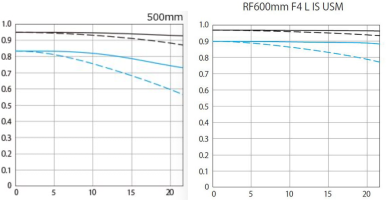
It wouldn't be my personal experience. 300mm 2.8 and 600 F4 out resolve the 100-500mm on an R5..
The 100-500 is great still a joy to use
It's not the experience of Canon's own designers, either. Resolution (blue lines) is clearly better on the RF 600/4 compared to 500mm on the RF 100-500.
MTFs.png

Maybe @FaolainWolf's great white lenses got banged around a little too much, or maybe he got really bad copies. The same thing can happen with a cerebrum.
 
  • Haha
Reactions: 1 user
Upvote 0
Well, one less moving part inside the camera. No more shutter curtains replacement. The camera may pretty much last until IBIS or the shutter button fails. Sounds great to me
This may be a dumb question, but if the shutter fails but you’re really only using electronic shutter, would it likely be important to have it replaced, or would it brick the camera? I wonder if anyone has had the shutter fail on the R3 and just kept on with the electronic shutter or if that’s possible
 
  • Like
Reactions: 1 user
Upvote 0
This may be a dumb question, but if the shutter fails but you’re really only using electronic shutter, would it likely be important to have it replaced, or would it brick the camera? I wonder if anyone has had the shutter fail on the R3 and just kept on with the electronic shutter or if that’s possible
My only concern would be having the ability to close the shutter when powering off the camera. This feature protects the sensor from dirt and dust as well as physical damage.
 
  • Like
Reactions: 2 users
Upvote 0
This may be a dumb question, but if the shutter fails but you’re really only using electronic shutter, would it likely be important to have it replaced, or would it brick the camera? I wonder if anyone has had the shutter fail on the R3 and just kept on with the electronic shutter or if that’s possible
Even if the camera allows it, it’s not guaranteed you will able to use it. For instance, Matt Granger’s Z9 broke the protective curtains and he kept shooting, but the sensor was partially covered, so all the shots he took had a black shadow on top or bottom, and he ended-up having to crop all of them.

DPR's review of the no-mechanical-shutter Nikon Z9 includes "Stepped e-shutter creates banding with fast-flickering displays".
I’m not sure I understood that correctly, but supposedly a mechanical shutter has issues with that as well, right? Unless you’re using a high frequency anti-flicker, if you’re shooting at high shutter speeds, you’ll get an uneven exposure — and I’m not sure the HF anti-flicker can fix that completely.
 
  • Like
Reactions: 1 user
Upvote 0