5DS and 5DS R, the best of both in one body

I have a question about the existence of these two models - 5DS and 5DS R. In theory, it wouldn't be a single body able to activate the Low Pass filter only when necessary, at the choose of the photographer? As I understand, the AA filter cancellation solution does not change the hardware models, but requires limiting choices. I guess it's not that simple, but it couldn't be an alternative way to solve this limitation?
What is your opinion?
 
Pentax has done this in their K-3 DSLR, using the in-body stabilizer. Per DPReview, "allowing users to bracket exposures by AA filter simulation mode. As a reminder, the K-3 lacks a physical anti-aliasing filter, but simulates the blurring effect via minute movement of its sensor, with two intensity levels available (three if you include 'off'). Firmware v1.02 allows you to shoot a burst of sequential images at each AA filter level, to fine-tune the optimal balance between resolution and artifacts like moiré."
 
Upvote 0
neuroanatomist said:
The AA filter is two pieces of lithium niobate crystalline material placed in front of the sensor. How do you propose to 'activate' it?
Neuroanatomist, I have no technical knowledge. I'm actually trying to understand how you can cancel the AA filter effect without changing the camera hardware of 5DS. Only by assumption, hypothetically speaking, I figured if you can cancel the effect without changing the hardware, could also be possible to activate the AA filter. So we would have the best of two cameras in one. But I'm sure there are difficulties for this to be implemented, I just like to understand what are those difficulties.
 
Upvote 0
Lithium niobate crystals have an orientation to them, and in an AA filter the two of them are oriented orthogonally. In the 5DsR, they are oriented at 180°, in effect.

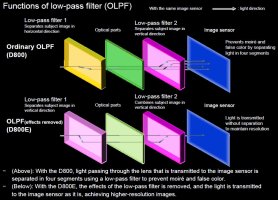
An AA filter basically introduces blur starting at a certain spatial frequency, matched to the pixel pitch. Think of it like this...one layer of the lithium niobate shifts some light waves a small distance in one direction. So in the normal case (5Ds and other cameras), the first layer shifts some light 'up' and the second layer at 90° shifts some light 'left' and thus you have blur. In the 5DsR, the first layer shifts some light 'up', and the second layer at 180° shifts it right back 'down', canceling out the AA effect but maintaining the same thickness of filter stack over the sensor so no manufacturing adjustments (other than the orientation of one filter) are needed.
 
Upvote 0
Should add that there are patents by Canon and others for 'tunable' AA filters, off/on or weak/strong, so what you're suggesting is possible and might be implemented someday. But we're not quite there yet (and the journey from patent to product is perilous and usually fails).
 
Upvote 0
candc said:
I didn't understand how this "cancelling" was achieved until I saw this illustration of how it works on the d800e. I assume the 5dsr is similar?
This really helps to understand, thought the solution adopted by canon was different from the D800 and D800E, but I just checked and it appears that the reasoning is the same. Thanks for your help.
 
Upvote 0
neuroanatomist said:
Should add that there are patents by Canon and others for 'tunable' AA filters, off/on or weak/strong, so what you're suggesting is possible and might be implemented someday. But we're not quite there yet (and the journey from patent to product is perilous and usually fails).
It makes perfect sense. Thanks for the technical explanation too. The patent reasons and trade agreements should weigh heavily in the development of these products.
 
Upvote 0
candc said:
Btw, if the only difference is the orientation of the first olpf then I don't see why it should cost more?

Manufacturing cost is only one factor in setting a retail price, and usually not the most important (particularly for higher end goods). Canon expects to sell less 5DsR units, so the price is higher.

To use an example from my industry, there is a pill to treat cystic fibrosis (CF). It's a rare disease, and this pill works only on a specific mutant form present in only ~5% of the CF patients. It's taken two pills per day and therapy costs $293K/year. So, that's ~$400 a pill...for something that costs about the same as acetaminophen (Tylenol) to manufacture.
 
Upvote 0
neuroanatomist said:
candc said:
Btw, if the only difference is the orientation of the first olpf then I don't see why it should cost more?

Manufacturing cost is only one factor in setting a retail price, and usually not the most important (particularly for higher end goods). Canon expects to sell less 5DsR units, so the price is higher.

To use an example from my industry, there is a pill to treat cystic fibrosis (CF). It's a rare disease, and this pill works only on a specific mutant form present in only ~5% of the CF patients. It's taken two pills per day and therapy costs $293K/year. So, that's ~$400 a pill...for something that costs about the same as acetaminophen (Tylenol) to manufacture.

So the reason the camera cost more is because canon decided they can charge more because people want it. the reason your pharmaceutical product example costs more is because the company producing it decided they can charge more because people need it. I already knew that.
 
Upvote 0
neuroanatomist said:
Manufacturing cost is only one factor in setting a retail price, and usually not the most important (particularly for higher end goods). Canon expects to sell less 5DsR units, so the price is higher.
I asked at the shop where I place my pre-order for the 5dsr, what the ratio was with the pre-orders, and it was mostly SRs of the ~60 they had in. I wonder whether there will be price reversal between S and SR? Just kidding, but I can dream ...
 
Upvote 0
A question for Neuro or another imaging expert: would moire ever be a problem with the repeating patterns in avian feathers? I understand that it is rare in most natural scenes due to the general absence of repetition, but feather structure seems like a potential problem.

I am toying with the idea of the 5DS R mostly for landscape b/c I make very large prints on occasion (and could be inspired to do more). I can achieve very high resolutions with panos, but that technique is limiting for moving subjects (waves, leaves, even clouds etc) and results in a lot of post capture fiddling around (not my strength). However, I could see this body being helpful for more pixels on small subjects (birds) when the light is good and lower ISOs achievable. A dual utility would help me pull the trigger.

Thoughts? (Thanks)
 
Upvote 0