
Food Processing Factory Photography?

Status
Not open for further replies.
First Post, Hey there community.

So he's my thing... I recently purchased a 5D MK III & I've been really pushing myself to do everything I can to advance my Photography as a whole, Getting up early for sunrises & landscapes, Black & Whites on cloudy afternoons, Talking to key locals about my Photography & getting my name around, it's a small town, 2000 odd?

More Recently my Boss approached me about a Project he'd like to do with showing the various stages of Cheese Production, (that's what I do as a day Job, make Cheese, to a certain degree....) So this is great & I'm really all for it, From the Cows to the Milkers to the Tanker, Factory, Pasteurisers, ect, ect, Though I'm hesetant on the Factory Floor Side of things...

What I'm wondering about, is that fact that the images I take concerning the inside of the Dairy Plant itself, In the end I'd like them to come out as appealing, warm & interesting.

This is where I'd like some advice or Tips from Anyone who's perhaps done some Photography like this in the past or just general knowledge about such things on how to take Professional looking Factory Photos. The inside of the Factory is mostly white, you might find a Yellow wall here or there some places. Fluro lights EVERYWHERE, Stainless steel production equipment Everywhere, & the White walls are usually covered on condensation, making a lot of glossy reflective surfaces. The Floors are just,,, I guess It's a brown Colour. & Here I'm thinking how am I going to get Farmhouse style Photographs here... In a Food Production plant.

I don't have a flash right now, I've never really used flash before except on my old 350D & probably hated every minuet of it. I have the 5D, a 16-35mm f/2.8 L & a 70-200mm 2.8 L IS II. No Primes no Flash, I do have a good Tripod & some Lee Filters on back order, (don't we all...) but right now, money wise for the next month or so thats it, There's not a complete rush for the project too & a lot of locations are outside or well lit areas like the Fromage or Grocery Store.

I'm looking at the Speedlite 600EX-RT & a good 50mm next, so there is that... What can you guys/gals suggest method, Artistic wise, for good, indoor-fluro-factory-paint-&-steel Factory Photography?

Thanks everyone for your time & I'm eager to hear back from everyone about this.

Regards, Timothy.
 
First of all; way cool to work in a cheese factory:) Do you make any unpasteurized variants too?
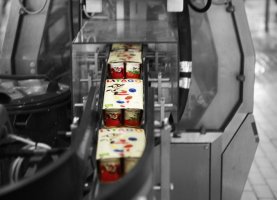
I am enclosing a shot I took in a dairy in Norway. Not the style your going for, but anyway.

I would go for 50mm or wider, and then I would get a macro to take shots of details.

As far as flash goes, it might complicate things unless you are very good at using them, since what you're describing are many different types of reflective surfaces. I would probably go for natural light (shot in Raw of course), then make adjustments in pp.
 

Attachments

  • Dairy shot - Copy.jpg
    Dairy shot - Copy.jpg
    38.1 KB · Views: 553
Upvote 0
.
Timothy:

First, congratulations on your keen interest in photography. Sounds to me like you have a good attitude toward learning and enough confidence to try new things. Don't let negative ninny type comments discourage you. Focus on what is possible! The winners in life take chances.

Second, I've had a lot of experience with such things so I'll throw out a few suggestions:

1. People trump machinery every time. A picture of a human working with a machine has an interest element that a machine-only picture does not. And this does not have to be the whole person. Sometimes a picture of hands interacting with machines/process/products tells a great story in itself. Looks for instances where humans seem to dominate the machine or vice versa. Maybe there's a huge butter churn in there being operated by a person who is dwarfed by the machine. That can be a great point of contrast.

2. All the standard photography rules are in effect -- numbers, lines, symmetry, etc. Those sorts of things are all over factories.

3. Look for what makes this unique from other "factory" environments. You mentioned condensation on the walls -- that's great, and I'd try to incorporate it into the images if possible. A focus on the condensation with something factory/cheese related in the background may work. Or it might be taken further with some post-process. That focused condensation/factory shot layered over a cows-in-pature image may be possible.

4. Movement is an element of factories and machinery. Don't let pictures be static. Show motion and movement -- in all the many ways photography can do this.

5. Look for the little details. A closeup of a big start/stop button smeared with cheese layered over weeks/years of use. Worn spots on a floor where people have stood for hours and days and years. Clothing/equipment that workers use -- coveralls on a hooks, boots, gloves, safety eyeglasses, etc. Safety notices on machinery. Stacked boxes or other supplies. You may want to walk the factory floor sometime when it's shut down to really look and get ideas.

That should give you something to think about. Again, stay positive and enjoy the challenge.
 
Upvote 0
distant.star said:
.
Timothy:

First, congratulations on your keen interest in photography. Sounds to me like you have a good attitude toward learning and enough confidence to try new things. Don't let negative ninny type comments discourage you. Focus on what is possible! The winners in life take chances.

Second, I've had a lot of experience with such things so I'll throw out a few suggestions:

1. People trump machinery every time. A picture of a human working with a machine has an interest element that a machine-only picture does not. And this does not have to be the whole person. Sometimes a picture of hands interacting with machines/process/products tells a great story in itself. Looks for instances where humans seem to dominate the machine or vice versa. Maybe there's a huge butter churn in there being operated by a person who is dwarfed by the machine. That can be a great point of contrast.

2. All the standard photography rules are in effect -- numbers, lines, symmetry, etc. Those sorts of things are all over factories.

3. Look for what makes this unique from other "factory" environments. You mentioned condensation on the walls -- that's great, and I'd try to incorporate it into the images if possible. A focus on the condensation with something factory/cheese related in the background may work. Or it might be taken further with some post-process. That focused condensation/factory shot layered over a cows-in-pature image may be possible.

4. Movement is an element of factories and machinery. Don't let pictures be static. Show motion and movement -- in all the many ways photography can do this.

5. Look for the little details. A closeup of a big start/stop button smeared with cheese layered over weeks/years of use. Worn spots on a floor where people have stood for hours and days and years. Clothing/equipment that workers use -- coveralls on a hooks, boots, gloves, safety eyeglasses, etc. Safety notices on machinery. Stacked boxes or other supplies. You may want to walk the factory floor sometime when it's shut down to really look and get ideas.

That should give you something to think about. Again, stay positive and enjoy the challenge.

+5

It was not me who posed the initial question, but I must say I enjoyed the positive, practical and constructive response you gave in this answer, that other, myself included can benefit from!

I envy you Samurai for your opportunity to shoot pictures in these surroundings (given that most people will not get in these plants, because of secrecy surrounding manufactoring procedures and such). I have two boys, and with the rapidly changing cityscapes (where factories and production is replaced by service economy and various forms of entertainment) my sons will grow up with hardly any sense of the true nature of goods and where they come from. In this sense I think your project is an essentialistic one. Hope that you will share some of the shots as they are made.
G.
 
Upvote 0
distant.star said:
.
Timothy:

First, congratulations on your keen interest in photography. Sounds to me like you have a good attitude toward learning and enough confidence to try new things. Don't let negative ninny type comments discourage you. Focus on what is possible! The winners in life take chances.

I think you are referring to my comment as a "Ninny Comment".

While learning is a great thing, not having even basic knowledge of lighting or the equipment involved is putting a new photographer at risk of disappointing his boss and looking bad. This could discourage him as well as perhaps make his boss lower his opinion of him.

There is nothing wrong from learning by hiring someone who knows the business, perhaps even workiing with the photographer. He has everything to gain by showing his good judgement in knowing his limitations, and everything to lose by showing poor judgement such that the result is poor and the boss has to embarass him by hiring a pro.

If he recommends hiring a pro, the boss may very well be willing to have him give it a try first, but he should let the boss know that he has no knowledge or experience of where to start and that he would be learning on the companies dime.
 
Upvote 0
Thanks everyone for getting back to me & the PM's I got too, Everybody's been extremely helpful, even you Mt Spokane, I understand from previous experience about people having higher expectations of me for projects in the past & personally thinking that I did not meet them. Photography however I love & don't mind perhaps if I fall here or there, it's all part of the wonder for me.

Luckily also that, while the end photos I produce will have to be cleared first by Company-heads, it's a small project that doesn't look to be a big money driven campaign. Perhaps the Company Facebook page, maybe some Postcards produced for Tourists who visit the place. The overall Idea I was lead to believe was to get some of the local employs involved in local projects & the sort. Nothing to Fire anyone over. Though I'd still like to be going in with some knowhow under my belt.

@Quasimodo, No all our milk is pasteurised when it arrives, We couldn't sell our Product if it wasn't. Legally I think that's the case for everyone. Thank you for your other comment Quasimodo, You have in-fact made me realise that It might be a good Idea to have multiple aspects of a particular area whilst inside the Dairy, some unique procedures the Bosses might not like being revealed, so showing the actual Cheese making from a variety of views/aspects would be a good fallback.

@distant.star Your advice will be greatly emphasised in my project I think, So much I had't figured into what I might shoot. Thinking about movement, I could visually see that working here. I also hadn't though about focusing on people specifically, initially. This should also work with what I'd gather the Higher-ups would agree with, I think the mentality here is going to be People & Product, though the overall theme of-cause is still "how it's all made."

Again at Mt Spokane, I like your view about all this, you're right in thinking that of-cause, & from past experience as mentioned before, I know now when to back away from something that's too big for me. I'll be sure to take my own notes from all this as the experience is my no drive for all this, I'm confident enough to know I can take decent photos, though it's going to be nice to have some fielded knowledge with me as I go in looking for some winning photos.

So thanks to everyone for your input. & please if anyone has their own ideas or experiences about all this, please add to the conversation.
 
Upvote 0
Status
Not open for further replies.