Mirror-less and EF Lenses

Status
Not open for further replies.

Cgdillan

HDSLR Cinematographer/Photograper
Mar 20, 2012
288
0
6,976
1992-06-25
www.stockhammedia.com
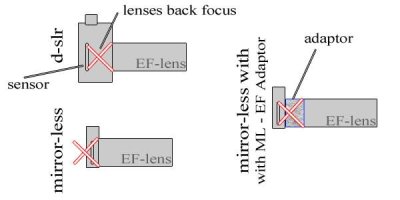
A mirror-less camera is generally a thinner camera than d-slr which may mean the lens mount would put the rear element of a lens much closer to the sensor than on d-slr bodies. this means new lenses are need that are able to focus properly on the sensor. and if an EF lens was mounted to it, it would be trying to focus on a sensor that is further back than on the mirror-less sensor. so what are the chances of a new mount system, new lenses, but with the same EF technology. This would allow for an adaptor to be released that would simply pull the ef lenses further from the sensor, to be able to focus correctly, and still be able to AF and control F-stop.

made a little picture of my thought
 

Attachments

  • idea.jpg
    idea.jpg
    18.9 KB · Views: 602
Cgdillan said:
A mirror-less camera is generally a thinner camera than d-slr which may mean the lens mount would put the rear element of a lens much closer to the sensor than on d-slr bodies. this means new lenses are need that are able to focus properly on the sensor. and if an EF lens was mounted to it, it would be trying to focus on a sensor that is further back than on the mirror-less sensor. so what are the chances of a new mount system, new lenses, but with the same EF technology. This would allow for an adaptor to be released that would simply pull the ef lenses further from the sensor, to be able to focus correctly, and still be able to AF and control F-stop.

made a little picture of my thought

It can be done. My understanding is that Sony A-Mount lenses and standard 4/3 lenses will autofocus on NEX and micro 4/3 cameras respectively when the right adapter is attached. However, they don't autofocus as well on the mirrorless cameras as they do on the DSLRs, because the mirrorless uses contrast detect AF. Also, the adapter negates the compactness advantage otherwise enjoyed by mirrorless cameras, which is why adapted rangefinder and c-mount lenses have become popular with mirrorless enthusiasts (the flange distances are smaller so the package stays small).

So this would be more of a stop gap solution for those who already have a large investment in EF lenses than a replacement for a strong system of native lenses for the new mount. With EF lenses, they would need some kind of electronic coupling because this is required to adjust the aperture.
 
Upvote 0
elflord said:
So this would be more of a stop gap solution for those who already have a large investment in EF lenses than a replacement for a strong system of native lenses for the new mount. With EF lenses, they would need some kind of electronic coupling because this is required to adjust the aperture.

Its also of course a potential option to allow specialist lenses to be used that might not sell enough to justify mirrorless specific versions. Many such speicalist lenses(macro's, long/fast tele's) are likely to be used on a tripod aswell which means size and balance become lesser issues aswell.

If Canon are looking to put out more high end mirrorless bodies(espeically ASPH or FF ones) then access to such lenses is obviously going to be a big advanatge.
 
Upvote 0
Status
Not open for further replies.