Patent: Improved Sensor Based AF

Canon Rumors

Who Dey
Canon Rumors Premium
Jul 20, 2010
12,753
5,577
279,596
Canada
www.canonrumors.com
HTML:
A patent showing what appears to be improved sensor based AF has appeared, this one uses some kind of “light field” processing.</p>
<p>Patent Publication No. 2015-161785 (Google Translated)</p>
<ul>
<li>Published 2015.9.7</li>
<li>Filing date 2014.2.27</li>
<li>The image plane phase difference AF, the light field I comprises a</li>
<li>First, it is focusing on the image plane phase difference AF</li>
<li>Then, detect the focus from refocus image</li>
<li>To determine the driving range from the re-focus information in the case of out-of-focus</li>
</ul>
 
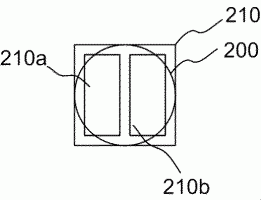
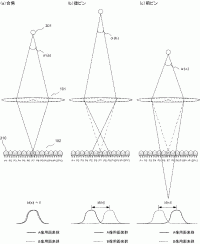
The patent is for a Dual Pixel Sensor, at least it seems that way from looking at the drawings.A look at the Figures show a dual pixel sensor.


Here is a different translation. This one is also very confusing, but I think the meaning comes thru.

However, in an imaging plane phase difference system, since the light flux in which the focus detection pixel which performs focus detection carries out light reception differs from the light flux in which the imaging pixel which acquires a captured image carries out light reception, the influences of each aberration (a spherical aberration, astigmatism, a coma aberration, etc.) of a taking lens differ with a focus detection signal and an imaging signal. Therefore, the problem that a difference arises occurs between the focusing position computed from a focus detection signal, and the best focusing position of an imaging signal.
[0009]
On the other hand, in the technology of the description to a Patent document 4, since the depth of field in which refocusing is possible is not taken into consideration, when a focus surface exists out of the refocusing possible range, refocusing processing cannot be performed correctly. In such a case, it is difficult to start what is called scan operation that looks for the minimal value of contrast evaluation value, and to accelerate processing.
[0010]
In light of the above-mentioned problems, the present invention aims at offer of the focus detecting device which can perform highly precise focus detection at high speed.


Now, the simplified translation of how it works - Clear as Mud! My guess is that the lens is moved to a position based on the first calculation, and then another focus try is done with the lens being already very close to perfect focus. Just a guess.


In order to attain the above-mentioned the object of this invention, according to the present invention, a focus detecting device, The pixel signal acquisition means which acquires the pixel signal which can generate a refocusing image, The first focus detection means that generates a refocusing image from the acquired pixel signal, and detects a focusing position from the generated refocusing image, Based on the result of detection of a first focus detection means, have a drive amount determination means to determine the drive amount of a focus lens, and a drive amount determination means, When a focusing position is not detected from the refocusing image generated by the first focus detection means, the aforementioned drive amount is determined according to the refocusing possible range of the generated refocusing image.

 

Attachments

  • drawing2.gif
    drawing2.gif
    4.4 KB · Views: 1,262
  • drawing3.gif
    drawing3.gif
    9.4 KB · Views: 1,303
  • drawing7.gif
    drawing7.gif
    15.8 KB · Views: 1,218
Upvote 0
Mumbo-jumbo.
Don't care, how they do it. Just do it.
All i want is a kick-butt FF mirrorless system with Canon user Interface, class-leading IQ and class-leading AF. No mirrorflapping, no mechanical crap. Fully electronic and digital. All the way.
 
Upvote 0
AvTvM said:
Mumbo-jumbo.
Don't care, how they do it. Just do it.
All i want is a kick-butt FF mirrorless system with Canon user Interface, class-leading IQ and class-leading AF. No mirrorflapping, no mechanical crap. Fully electronic and digital. All the way.

This has nothing specifically to do with mirrorless, so far Dual Pixel has been DSLR. DSLR is still much superior to mirrorless at this point.

Samsung is giving their Mirrorless cameras away, I guess that's one way to reduce inventory.
"Visitors to PIX 2015 can #DitchTheDSLR to Receive a New NX500 SMART Camera (on Wednesday Oct 7th)

Samsung Electronics America, Inc. is bringing the highly successful #DitchTheDSLR movement to Seattle at the inaugural PIX Photo Expo and Conference hosted by DPReview and Amazon on Wednesday, October 7 starting 11 a.m. and lasting until supplies run out. Samsung will offer PIX show attendees the chance to receive the award-winning Samsung NX500 camera (valued at $799) by simply trading in their DSLRs*. This program has previously seen nearly 1,000 DSLRs traded in at events in New York and Los Angeles.

The NX500 is the latest addition to Samsung’s NX line of mirrorless cameras and is packed with advanced technology and features. Built around the same technology architecture featured in the flagship NX1, including a high resolution 28MP BSI APS-C sensor, 4K and UHD video recording, and Samsung Auto Shot, the NX500 places powerful performance in a portable and convenient size. This award-winning camera comes with updated connectivity options via Bluetooth and Wi-Fi, which provide users with an advanced wireless experience and the ability to effortlessly shoot and share their captured moments with family and friends.

Show attendees can visit the Samsung booth and trade in a fully operational Digital Single Lens Reflex (DSLR) camera including battery, power supply and lens and walk away with the cutting-edge NX500, while supplies last. While in the booth, attendees can see and experience the entire Samsung NX system, including the pro-focused NX1 and S-Lens collection, the ever-portable NX Mini and GALAXY Camera 2, as well as a variety of accessories. "
 
Upvote 0
"Dual Pixel is DSLR."
Because Canon did not put it where it would make most sense: mirrorless / EOS M2 or M3. For no apparent (technical) reason. "Marketing differentiation" probably. Or plain stupidity. Who nnows ... After all it's Canon, stupid.
 
Upvote 0
Does this mean we could potentially change the focus slightly in post-processing (when you shoot RAW)?

Light-field tech seems to be very interesting for me (since I heard from it years ago). That'd be a whole new revolution in photography, if someone like Canon would "polish" it and provide well-made software for this kind of thing. Lytro did a first step in this direction, but it seems to be very very raw and unfinished for me.

What do you guys think about this... I think we're far away right now. But i.m.o. someday, finally, we'll be there - and I'm thinking 2020+. Is that even realistic or do you think this has not enough potential to revolutionize photography?
 
Upvote 0
No. There won't be any re-fosusong in post processing with Canon cameras. As opposed to lightfield photography (eg Lytro) canon does not even think about that. They are just trying to attach the catchword "lightfield" to one of their patents. It is nothing more than another theoretical twitch to their over-hyped dual pixel Af system, which has failed to deliver any tangible value in real life so far. Matching up 2 sligjtly different images is the very core of any phade detect af system. Ever since minolta invented and marketed it in the 1980s.
 
Upvote 0
AvTvM said:
No. There won't be any re-fosusong in post processing with Canon cameras. As opposed to lightfield photography (eg Lytro) canon does not even think about that. They are just trying to attach the catchword "lightfield" to one of their patents. It is nothing more than another theoretical twitch to their over-hyped dual pixel Af system, which has failed to deliver any tangible value in real life so far. Matching up 2 sligjtly different images is the very core of any phade detect af system. Ever since minolta invented and marketed it in the 1980s.

Just for reference, phase detect AF was invented by Honeywell, not Minolta.
 
Upvote 0
AvTvM said:
No. There won't be any re-fosusong in post processing with Canon cameras. As opposed to lightfield photography (eg Lytro) canon does not even think about that. They are just trying to attach the catchword "lightfield" to one of their patents. It is nothing more than another theoretical twitch to their over-hyped dual pixel Af system, which has failed to deliver any tangible value in real life so far. Matching up 2 sligjtly different images is the very core of any phade detect af system. Ever since minolta invented and marketed it in the 1980s.

Actually, Canon patented a lightfield camera similar to the Lytro recently. As far as the word lightfield appearing in a translation of a patent, that a a computer translation, and making it to be anything else is because of the translation.
 
Upvote 0
raptor3x said:
AvTvM said:
No. There won't be any re-fosusong in post processing with Canon cameras. As opposed to lightfield photography (eg Lytro) canon does not even think about that. They are just trying to attach the catchword "lightfield" to one of their patents. It is nothing more than another theoretical twitch to their over-hyped dual pixel Af system, which has failed to deliver any tangible value in real life so far. Matching up 2 sligjtly different images is the very core of any phade detect af system. Ever since minolta invented and marketed it in the 1980s.

Just for reference, phase detect AF was invented by Honeywell, not Minolta.
Ah yes. At least thats what honeywell cöaimed and how they killed minolta's success in the marketplace. ;)
 
Upvote 0