

You are using an out of date browser. It may not display this or other websites correctly.
You should upgrade or use an alternative browser.
You should upgrade or use an alternative browser.
Which is better for wide angle astro - the 6D or the 80D?
- Thread starter chrysoberyl
- Start date
in order
6D, 6D, 6D and finally the 6D.
If you get REALLY serious I might suggest something like the Atik 383L+ or even the Atik 11000
But fitting it to your lenses will be more of a challenge!.. I made use of a local machine shop to connect my 383 setup to my scope
Take a look at lenses like the Samyang 14mm f2.8 for astro.. I haven't yet bought one, but I've found images with the 6D and this lens on pixel-peeper and there's little to complain about.
6D, 6D, 6D and finally the 6D.
If you get REALLY serious I might suggest something like the Atik 383L+ or even the Atik 11000
But fitting it to your lenses will be more of a challenge!.. I made use of a local machine shop to connect my 383 setup to my scope
Take a look at lenses like the Samyang 14mm f2.8 for astro.. I haven't yet bought one, but I've found images with the 6D and this lens on pixel-peeper and there's little to complain about.
Upvote
0
Thanks, all. Do all of you use a tracking mechanism? And doesn’t that mess up the foreground?
I’ve taken a few shots (I live near Atlanta, GA, so I must travel far for good sky) with the 6D + Sigma 35 and was quite pleased. From what I’ve read (thanks to some Nancy P advice in one of these threads) the light gathering is superior to the 24 and the 24’s coma is horrendous.
The 16-28 light gathering concerns me, but of course I will try it; I do want wider than 35mm. The Samyang 14 2.4 is intriguing, if Samyang ever releases it. So I will go that route rather than the Samyang 14 2.8.
John
I’ve taken a few shots (I live near Atlanta, GA, so I must travel far for good sky) with the 6D + Sigma 35 and was quite pleased. From what I’ve read (thanks to some Nancy P advice in one of these threads) the light gathering is superior to the 24 and the 24’s coma is horrendous.
The 16-28 light gathering concerns me, but of course I will try it; I do want wider than 35mm. The Samyang 14 2.4 is intriguing, if Samyang ever releases it. So I will go that route rather than the Samyang 14 2.8.
John
Upvote
0
j-nord said:IMO Lonelyspeck is the best resource for learning astro. Several very useful guides on equipment and shooting technique.
http://www.lonelyspeck.com
Thank you. Mostly I have studied http://clarkvision.com/index.html.
Upvote
0
Chrysoberyl the 6D would be the best.
Some astro thoughts the rule of exposure of 500 over lens length in your case 500/24mm would give you a 20 second star streak free exposure, so at 20 seconds using a 24mm lens no tracking mount is needed. To get a good bright exposure to work with that probably means an iso of 6400, and to take advantage of the sharpness of the lens an f stop of 2.4- 2.8.
With a 14 mm lens (samyang/rokinon) you could keep shutter open for 35 seconds and at f 2.8 you may need to.
Like you I'd want the rokinon 14mm f 2.4 just to be able to get a nice bright 30 second exposure. Even with a mount the foreground moves so long or multiple exposures increase the degree of difficulty of matching sky and landscape.
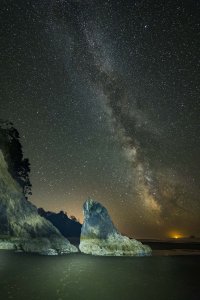
Below is one with a little foreground painting iso 6400, 30 second, rokinon 14mm.
Some astro thoughts the rule of exposure of 500 over lens length in your case 500/24mm would give you a 20 second star streak free exposure, so at 20 seconds using a 24mm lens no tracking mount is needed. To get a good bright exposure to work with that probably means an iso of 6400, and to take advantage of the sharpness of the lens an f stop of 2.4- 2.8.
With a 14 mm lens (samyang/rokinon) you could keep shutter open for 35 seconds and at f 2.8 you may need to.
Like you I'd want the rokinon 14mm f 2.4 just to be able to get a nice bright 30 second exposure. Even with a mount the foreground moves so long or multiple exposures increase the degree of difficulty of matching sky and landscape.
Below is one with a little foreground painting iso 6400, 30 second, rokinon 14mm.
Attachments
Upvote
0

chrysoberyl said:j-nord said:IMO Lonelyspeck is the best resource for learning astro. Several very useful guides on equipment and shooting technique.
http://www.lonelyspeck.com
Thank you. Mostly I have studied http://clarkvision.com/index.html.
Seek out jrista on these forums. He is a fantastic astrophotographer and can point you in the right direction.
Upvote
0
applecider said:Chrysoberyl the 6D would be the best.
Some astro thoughts the rule of exposure of 500 over lens length in your case 500/24mm would give you a 20 second star streak free exposure, so at 20 seconds using a 24mm lens no tracking mount is needed. To get a good bright exposure to work with that probably means an iso of 6400, and to take advantage of the sharpness of the lens an f stop of 2.4- 2.8.
With a 14 mm lens (samyang/rokinon) you could keep shutter open for 35 seconds and at f 2.8 you may need to.
Like you I'd want the rokinon 14mm f 2.4 just to be able to get a nice bright 30 second exposure. Even with a mount the foreground moves so long or multiple exposures increase the degree of difficulty of matching sky and landscape.
Below is one with a little foreground painting iso 6400, 30 second, rokinon 14mm.
Thanks, I admit I am a little confused by the varying shutter speeds. Some sources state that much shorter speeds are needed to avoid trailing. So thanks for including the specifics.
Upvote
0
wsmith96 said:Seek out jrista on these forums. He is a fantastic astrophotographer and can point you in the right direction.
I have seen some of his posts. But I thought he did deep instead of wide. And I don't have his budget!
Upvote
0
chrysoberyl said:wsmith96 said:Seek out jrista on these forums. He is a fantastic astrophotographer and can point you in the right direction.
I have seen some of his posts. But I thought he did deep instead of wide. And I don't have his budget!
if I may I will point out the most important bit
Give it a go.
it's like going round a spiral, you make one improvement, have another go, make another and so on until you get back to the point that the first improvement is no longer good enough, so you improve that further and so on.
but you'll never get there without having a go... and it is a VERY hands on branch of photography, sometimes it is kit that makes the difference, mostly it's technique.
Upvote
0

The longer the focal length, the faster your shutter speed has to be to avoid trailing.....chrysoberyl said:applecider said:Chrysoberyl the 6D would be the best.
Some astro thoughts the rule of exposure of 500 over lens length in your case 500/24mm would give you a 20 second star streak free exposure, so at 20 seconds using a 24mm lens no tracking mount is needed. To get a good bright exposure to work with that probably means an iso of 6400, and to take advantage of the sharpness of the lens an f stop of 2.4- 2.8.
With a 14 mm lens (samyang/rokinon) you could keep shutter open for 35 seconds and at f 2.8 you may need to.
Like you I'd want the rokinon 14mm f 2.4 just to be able to get a nice bright 30 second exposure. Even with a mount the foreground moves so long or multiple exposures increase the degree of difficulty of matching sky and landscape.
Below is one with a little foreground painting iso 6400, 30 second, rokinon 14mm.
Thanks, I admit I am a little confused by the varying shutter speeds. Some sources state that much shorter speeds are needed to avoid trailing. So thanks for including the specifics.
The smaller your pixels are, the faster your shutter speed has to be to avoid trailing.....
Tracking mounts allow you the luxury of long exposures without star trails....
http://ca.skywatcher.com/_english/02_mounts/02_detail.php?sid=68
Upvote
0
Don Haines said:The smaller your pixels are, the faster your shutter speed has to be to avoid trailing.....
Tracking mounts allow you the luxury of long exposures without star trails....
http://ca.skywatcher.com/_english/02_mounts/02_detail.php?sid=68
And yet more good advice! I am always impressed with the sharing that takes place in this forum.
Thanks, all.
Upvote
0

Similar threads


- Replies
- 23
- Views
- 1K


- Replies
- 0
- Views
- 994
- Replies
- 13
- Views
- 2K

