


When you purchase through links on our site, we may earn an affiliate commission. Here’s how it works. |
Rediscovering and reinventing the charm of film photography in a digital format. Evolving from the concept of classic half-frame cameras. Compact, lightweight design at just 240g offering a film-like photography experience.
TOKYO, May 22, 2025 – FUJIFILM Corporation (President and CEO, Representative Director: Teiichi Goto) announces the global launch of the “X half” (FUJIFILM X-HF1) from June 2025. The X half will be the latest model in the X Series, rediscovering and reinventing the charm of film photography in a digital format. It allows users to enjoy film-like photography with a lightweight body weighing only 240g1.
The “X half” is a digital camera evolving from the concept of classic half-frame cameras2, film cameras capable of shooting at half the size of 35mm film. In the past, Fujifilm introduced various film cameras, including the “FUJICA Half3” released in 1963, sparking a timeless passion for photography.
Preorder

- 18MP 1" Vertical 3:4 CMOS Sensor
- FUJINON 10.8mm f/2.8 Lens (32mm Equiv.)
- Rear Vertical LCD & Sub LCD Screens
- Optical Window Viewfinder
- Film Camera Mode & 2-in-1 Mode
- 13 Film Simulation Modes and 26 Filters
- Frame Advance Lever & Exposure Comp Dial
- 1080 x 1440 Vertical Video Recording
FUJIFILM X half Features
- 18MP 1″ Vertical 3:4 CMOS Sensor
- FUJINON 10.8mm f/2.8 Lens (32mm Equiv.)
- Rear Vertical LCD & Sub LCD Screens
- Optical Window Viewfinder
- Film Camera Mode & 2-in-1 Mode
- 13 Film Simulation Modes and 26 Filters
- Frame Advance Lever & Exposure Comp Dial
- 1080 x 1440 Vertical Video Recording
- X half App for Image Development
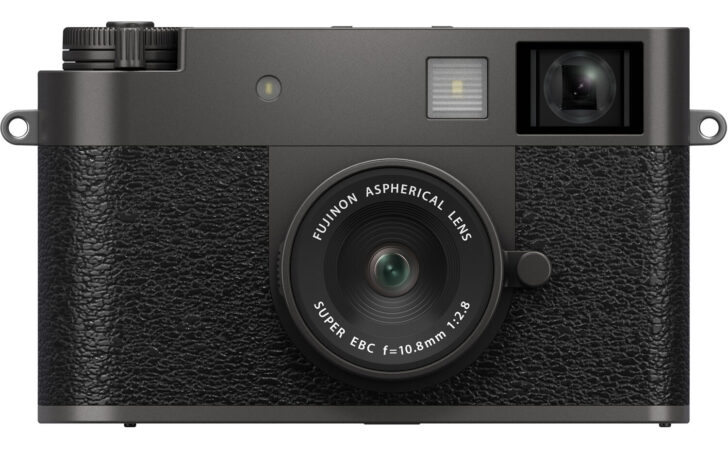
The “X half” is a digital camera that recreates and evolves the analog photography experience with a Frame Advance Lever and film-like photographic expression in a digital format. Fujifilm named this product “X half”, envisioning it as a perfect companion for both photography enthusiasts and newcomers exploring the world of digital cameras for the first time.
Unique Aspect Ratio
The “X half” is a compact digital camera that uses a 3:4 aspect ratio, different from the 3:2,4:3 and 16:9 aspect ratios commonly used in many digital cameras, enabling the capture of still images and videos in a vertical composition.
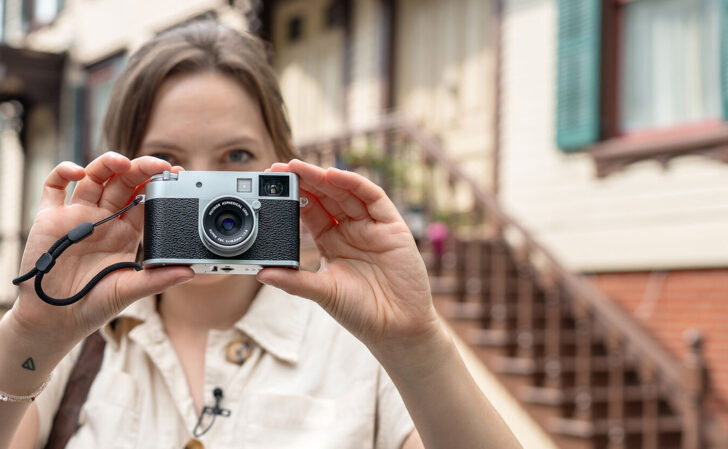
Equipped with a vertical optical viewfinder and LCD monitor optimized for vertical composition photography, the camera also features the “2in14” function, which enables the combination of two vertically composed photos into a single image, allowing for the creation of story-driven works that fully utilize the vertical aspect ratio.
Film Simulations
Furthermore, it includes “Film Simulation” which allows users to enjoy various color tone expressions as if they were changing photographic films, and “Grain Effect5” which reproduces the unique graininess of film photos.
Additionally, new shooting filters such as “LIGHT LEAK6” and “HALATION7” have been adopted, enabling diverse shooting expressions tailored to subjects and scenes. Furthermore, the “Film Camera Mode” revived the shooting experience of a film camera. In this mode, shooting is possible using only the optical viewfinder without the LCD monitor.
After each shot, the Frame Advance Lever is operated to proceed to the next shot. The operation feels similar to advancing the film in a film camera. The images can only be viewed after the specified number of shots have been taken, adding an element of excitement and anticipation for the captured images.
“X half” is designed with a focus on lightness and product design, featuring a compact 240g body that evokes the charm of a classic film camera. It can be carried anywhere and used anytime for casual shooting.
Connected
Additionally, the dedicated “X half8” app allows the transfer of still images and videos to a smartphone, viewing captured images in gallery and album format, and printing them using the smartphone printer instax™ Link series9, greatly expanding the ways to enjoy and express creative work.
The “X half” is a compact camera that digitally recreates and evolves the analog photographic expression and shooting experience unique to half-frame cameras, condensing the joy of photography into one device
Preorder
- 18MP 1" Vertical 3:4 CMOS Sensor
- FUJINON 10.8mm f/2.8 Lens (32mm Equiv.)
- Rear Vertical LCD & Sub LCD Screens
- Optical Window Viewfinder
- Film Camera Mode & 2-in-1 Mode
- 13 Film Simulation Modes and 26 Filters
- Frame Advance Lever & Exposure Comp Dial
- 1080 x 1440 Vertical Video Recording
- A camera that shoots two frames of 35mm film at approximately half size (18 x 24mm). ↩︎
- Including attached battery and memory card ↩︎
- 35mm half-frame camera released by Fujifilm in 1963 ↩︎
- A photo collage composed by dividing the 3:2 aspect ratio screen at the center and arranging still images/videos with a 3:4 vertical composition on the left and right ↩︎
- An effect that reproduces the unique graininess of film photography ↩︎
- An effect that realistically recreates the light leaks characteristic of film cameras ↩︎
- An effect that replicates the phenomenon where part of the image becomes blurred due to strong light entering the lens ↩︎
- A free app for Android and iOS devices. It is available for download from Google Play for Android devices and from App Store for iOS devices. Android and Google Play are trademarks or registered trademarks of Google Inc. iPhone and App Store are trademarks of Apple Inc. The iPhone trademark is used in Japan under license from Aiphone Co., Ltd. The iOS trademark is used under license from Cisco in the United States and other countries. ↩︎
- Compatible models: instax mini Link 2™, instax mini Link 3™, instax SQUARE Link™, instax Link WIDE™ ↩︎






Generally, I like that Fuji is doing some fresh stuff, even though I wouldn't buy it.
I have nothing against the concept, in fact I find it quite interesting (looks fun), but this camera sounds like a 299 toy for a child, how on earth are they asking €799 for this?
It has a small sensor, a fixed and darker than a smartphone lens (yes, I know it’s a larger sensor), no EVF, just 1080p video (I kind of think that’s a missed opportunity for social media, but I understand there’s limitation on the sensor) and, according to the newsletter I received from a retailer, it doesn’t shoot RAW.
There are much more powerful compact cameras for the same price or a lot less.
At least they could have put an APS-C sensor in it, but they didn’t even do that.
€299 or €399 would be adequate, in my opinion. There’s just no technology in this for 800 euros.
Any Mft would be a much better choice.
"My main issue with the control scheme of the X half has to do with the cumbersome nature of the touch interface. If you swipe too quickly, the screen won’t register the movement, and often tapping the screen takes a couple of tries to get things going."
PetaPixel/Chris Niccolls