


When you purchase through links on our site, we may earn an affiliate commission. Here's how it works. |
The Canon EOS 300D is now old enough to drink in the United States.
On this day 21 years ago, Canon announced the Canon Digital Rebel. It was known as the EOS Kiss Digital in Japan and EOS 300D in other regions. Canon kept this camera at $899 and the kit with the EF-S 18-55 under $1000, drove one of the largest nails into the coffin of film cameras.
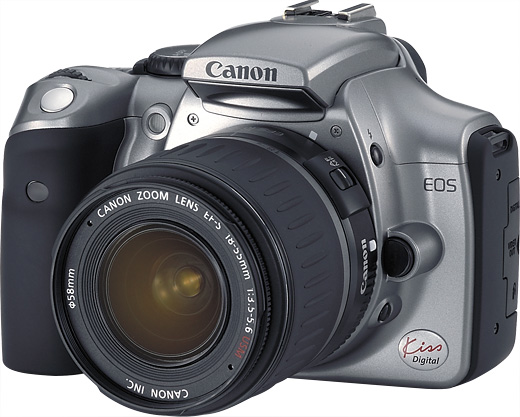
Before its release, DSLRs were primarily the domain of professional photographers due to their high cost and complex operation. The Digital Rebel 300D, however, offered a more accessible and affordable option, making photography a viable hobby for millions
The Digital Rebel 300D was built to be compact lightweight, and low-cost. The use of engineering plastics and pentamirror helped keep the cost and weight down. The camera boasted a 6.3-megapixel sensor and a basic autofocus system. These features and its user-friendly LCD interface made the Digital Rebel 300D a popular choice for amateur photographers.
The EOS 300D is a formidable camera, not from a feature set point of view. Not from a body finish point of view (which is actually better than I'm sure you're thinking). Not from how its feature set compares to other digital SLR's (although it can certainly hold its own), but rather for what it offers, for its value for money. And for what this camera could mean for the future of digital SLR's and the entire prosumer digital camera market.
https://www.dpreview.com/reviews/canoneos300d/22The impact of the Digital Rebel 300D on the photography industry cannot be overstated. Its success paved the way for the widespread adoption of digital SLR cameras and spurred further innovation from Canon and other manufacturers. The camera's affordability and ease of use allowed people from all walks of life to capture and share their experiences – for some, the first time in the digital era.
At the end of the day, image quality is probably the single most important thing about any digital camera, and the EOS Digital Rebel has it in spades – as you'd expect for a camera so closely based on the EOS 10D. Considering how little time I had to get accustomed to the camera, I felt that a good proportion of my images were pleasing, and I'm sure with more time I could have increased that ratio. Long exposures on the Digital Rebel can make your jaw drop, and low-ISO images have that almost indescribably “buttery-smooth” feeling that has come to be associated with Canon's CMOS-sensor based SLRs.
https://www.imaging-resource.com/PRODS/EDR/EDRAREPORT.HTMAs we celebrate the 21st anniversary of the Digital Rebel 300D, it is important to remember its impact on photography. This little camera changed how we capture images and inspired a new generation of photographers to explore their creativity and share their stories with the world. Much of our modern cameras is because of the success of this little camera.
Happy Birthday!




From that day, a long run passing from (main bodies) 20D, 5D classic, 5D II, 6D, arriving today at the R6 (actually two R6's, as I just recently swapped the backup R for a second R6, 250k shots, pretty beaten up, but works good and costed me less then the reselling price of the R).
I decided to buy the EOS 20D with the great EF-S 2.8 60 Macro which performs very well on the M50 despite its 3 times larger pixel count (or 1.7x greater linear resolution, or 2 times in comparison with the 300D).
I have a 13x19" print of a waterfall in Yosemite I took with that camera, framed and hanging still in my house today. Amazing, considering 45mp is still not enough to print that size. 😉
Brian
It is a very honourable camera, indeed.
Last year I disassembled myself a 6D following an online tutorial (I have manual skills, but definitely I'm not trained, especially with small and dense apparatus like a DSLR) to swap the shutter button + front dial ensemble, as the front dial lost the rubber wheel and was unusable, and the thing was working pretty well after the servicing. Now, I don't know the different level of complexity of a 300D, but if you have basic skills and the right tools, I'm pretty sure you can do it without damaging it 🙂