


When you purchase through links on our site, we may earn an affiliate commission. Here's how it works. |
Over the last few days there have been all sorts of new claims about an upcoming Canon EOS R3 Mark II. All of this started with images that Olympic photographer Jeff Cable posted from inside the Canon CPS room. People do like seeing hundreds of thousands of dollars in lenses and cameras stacked together.
There was one image in that article that was sent to me nearly a dozen times focusing on the shelf labels.
The Image
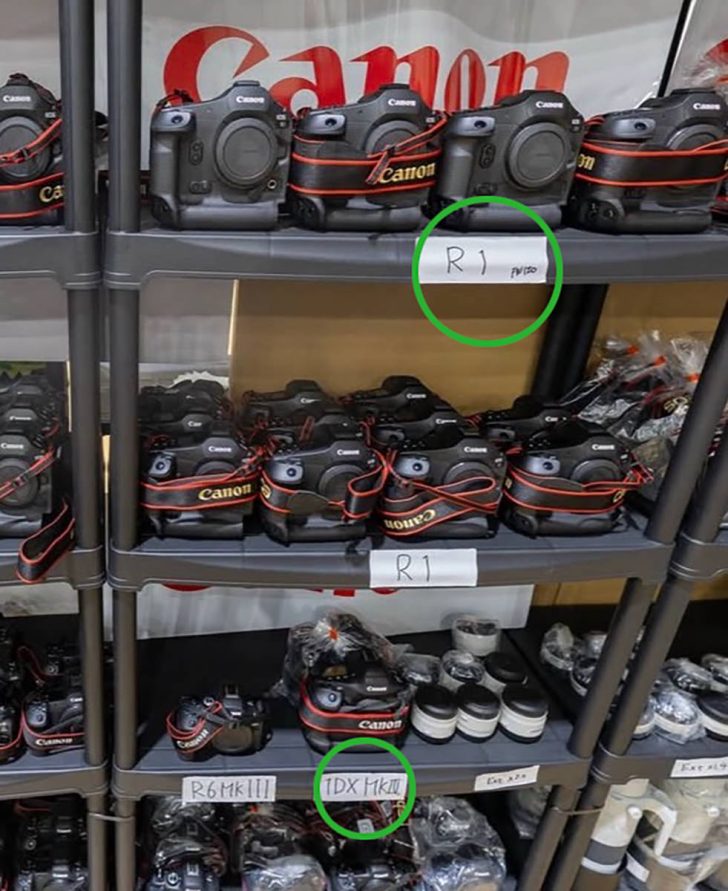
“EOS-1D X Mark IV”
We'll get that one out of the way first. There is no EOS-1D X Mark IV and there never will be. Someone had an issue doing a straight line on the second “I”.
EOS R3 Mark II
The top shelf has some EOS R1 cameras that have a different label than the ones below it. You can see the “FV120”. There have been a couple of claims that it's the EOS R3 Mark II in an EOS R1 body. That in itself is not unusual during product development.
I asked a couple of people that are in Milan shooting the The Games in a way that skirts NDAs, and no, there is no EOS R3 Mark II hidden in those EOS R1 bodies that they know about. If there was and they weren't privy to the information, they wouldn't be on the shelf in the CPS room.
What is “FV120”?
I have no idea, but if I had to make a guess. Maybe those R1s have the software required to use the Content Authentication Technology that Canon has been developing in partnership with Reuters, USC and Stanford University.
Edit: As suggested on the forum, it's more likely Firmware Version 1.2.0. I hadn't thought of that.
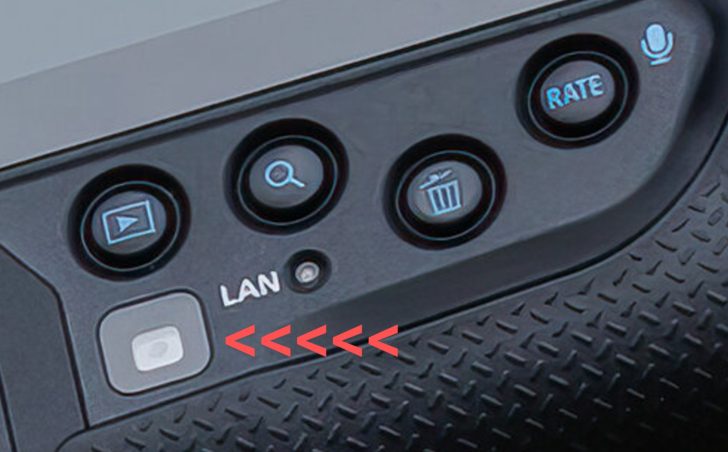
We all suspect that the little window on the back of the EOS R1 has something to do with this unreleased technology. The Olympics seem like a good place to test that out, but that's just a guess.
Maybe the “FV120” means nothing, and someone was trying to save paper and just reused it for the label.
Now onto the latest claims about a follow-up to the EOS R3.
Claimed Canon EOS R3 Mark II Features
Soon after this stuff started to brew, claimed features of an EOS R3 Mark II at the Olympics begain to circulate. They are pretty impressive on the surface.
The claims come from a Weibo account called Camera Beta. (Google Translated)
EOS R3 Mark II may support dual resolution .There is news that Canon EOS The R3 Mark II camera was recently unveiled in the test of the Milan Winter Olympics. It is not as high-resolution as EOS R1 The version is launched, but a more experimental product. The core innovation lies in the industry's first dual native resolution. Back-illuminated stackable CMOS sensor.
The new machine supports switching between the two native resolutions of 54 million pixels and 24 million pixels, respectively, to achieve 40 shots per second And high-speed continuous shooting of 90 shots per second. It uses an enhanced Bayer array to pass through adjacent images in 24 million pixel mode! The combination of elements increases the sensitivity by about 80% compared to EOS R3, and combines the three original ISO technologies to achieve a top-notch high Perceptual performance
thenewcamera.com
In terms of focusing, the four-pixel CMOS AF system has four photodiodes in each pixel, which are all 54 million Dual cross-shaped autofocus is realized on each pixel, and multi-directional phase detection can be performed horizontally, vertically, and diagonally.
In terms of video capabilities, it supports in-camera recording of 9K 60p and 6K 120p RAW video, and maintains full pixel self- Dynamic focus.
Leica uses some version of this in their current line of cameras. The Q3, M11 and SL3 can shoot native 18MP, 36MP and 60MP images. It's a cool feature for sure.
In Closing
Rumors about the EOS R3 Mark II began a year or so ago on some YouTube channels and died off for some time. I reported a claim that there would be a “development announcement” in early February, I think I was clear that I didn't think much of the claim. People aren't NDA'd for development announcements.
This is the second wave of rumors about a camera that I don't think will ever exist. If Canon ever does another 3 series, it won't be a gripped body and it will be something completely different than anything else in the lineup. I haven't talked to anyone that thinks there will ever be a Mark II of the R3.







Labelling a specific FW version (especially new) would make sense in this environment.
I hadn't thought of that! Nice. Edit incoming.
It doesn't seem to be quad-Bayer like a smartphone. 54MP -> 24MP is a conspicuous 2.25X reduction, not 4X.
They could be doing it in software... there's actually a lot of unpicked "low hanging fruit" in software downscaling, like the dpid algorithm that I absolutely adore for keeping sharpness: https://github.com/mergian/dpid
But they're wording it like it's done on the sensor level? Especially with the sensitivity claims?
I can't wait for some more analysis on this.
AFAIK, IMHO, etc. 😉
as for 6k120 - that is technically a very similar data rate to 8k60, so should be possible on the current CFexpress implementation.
So if it was not Canon, I'd be pretty sure that someone saw a cropped version of the image.
I don't think dual resolution makes much sense. It would have to be pixel-binned (something like 80/20 MP, four neighboring pixels would share the same color in the Bayer mask). In that case, I don't think it would bring much of an increase in detail in the 80 MP image.
If the binned pixels don't share the same microlens, then you'd still have to store data from all the pixels to recreate the color information.
The simplest scheme that fits the rumor would be some kind of 3x3 pixel array that could be sampled as either 9 pixels or 4 pixels, lightly software corrected for the full 9-pixel resolution. But I'm not qualified to even guess what they would look like.
If that's the case, all our existing editing software will need updates to process RAWs. We might be able to get hints by peeking at changelogs.
Reading that as an array of 3x3 pixels would be normal: RGGB.
Reading it as a 2x2, would only be slightly uneven: 2R 5G 2B, 3R 4G 2B, 3B 2R 4G, and 2R 5G 2B. Still more green in every pixel, as it should be. This would be similar:
Those big blocks of 2 green, in particular, could be binned as one more sensitive pixel each.
Alternatively, it's possible that Canon is doing something funky like sampling adjacent pixels or using the autofocus individually diodes in "low resolution" mode, to hit that massive ISO gain figure.
...I don't really know about this stuff, I'm just spitballing. But it's an interesting idea.
In a nutshell.
Actually, in one way they can agree on what it will be...the camera they personally want. It's just that they all want something different.
It's an interesting idea, but heterogenous color layouts like this will almost certainly lead to color aliasing and moire effects. This would be a pretty bad solution, while admittedly academically interesting. I think whoever is claiming multiple "native" resolutions just doesn't understand what they are saying. We have had downscaled Raws and crops for decades now. That's likely all this was.
As for the R3 II - my #1 gripe about the R1 is that the sensor has less latitude at high ISOs than my 1DX Mark II from ten years ago, so I'm still pulling out the EF body in low light situations where I know I'll be at 12800 and need to make ANY adjustments to exposure or shadows (including vignetting correction). I preordered the R1, assuming I'd get the same results as the R3 I evaluated from Canon, and was bitterly disappointed when I got my shots home and couldn't get the results I was able to get with the R3.
So I'll absolutely jump on the R3 II if I can get an improvement in low light performance that's equal to that of the R3 with the AF performance of the R1. Don't need to change anything else; just shut up and take my money. If it had a high resolution mode, then I get to sell my R5 which makes me even happier.
Cautiously optimistic that I may have a solution moving forward.
I was curious about the average # of days from a Mark I announcement to a Mark II announcement for a variety of Canon cameras. This is based on the announcement dates of each camera...culled from putting the squeeze on cgpt.
EOS 5D — 1,122 days
EOS 6D — 1,746 days
EOS 7D — 1,840 days
EOS R5 — 1,469 days
EOS R3 Mark I (days since announcement) — 1,621 days to 2/23/26.
There seems to be modest time left, yet, at this point, the strongest evidence for an R3 Mark II is a blank cell in my complex spreadsheet and my optimism — and those are each questionable.
Anyway, just a fun idea and that's it.