

When you purchase through links on our site, we may earn an affiliate commission. Here’s how it works. |
This patent application (2025-159215) is a divisional patent application from a prior parent patent application, but this indicates that Canon is still legging it out and researching this. I find this interesting because it shows that Canon is thinking of novel ways to reduce costs or production time for some of the big white lenses.
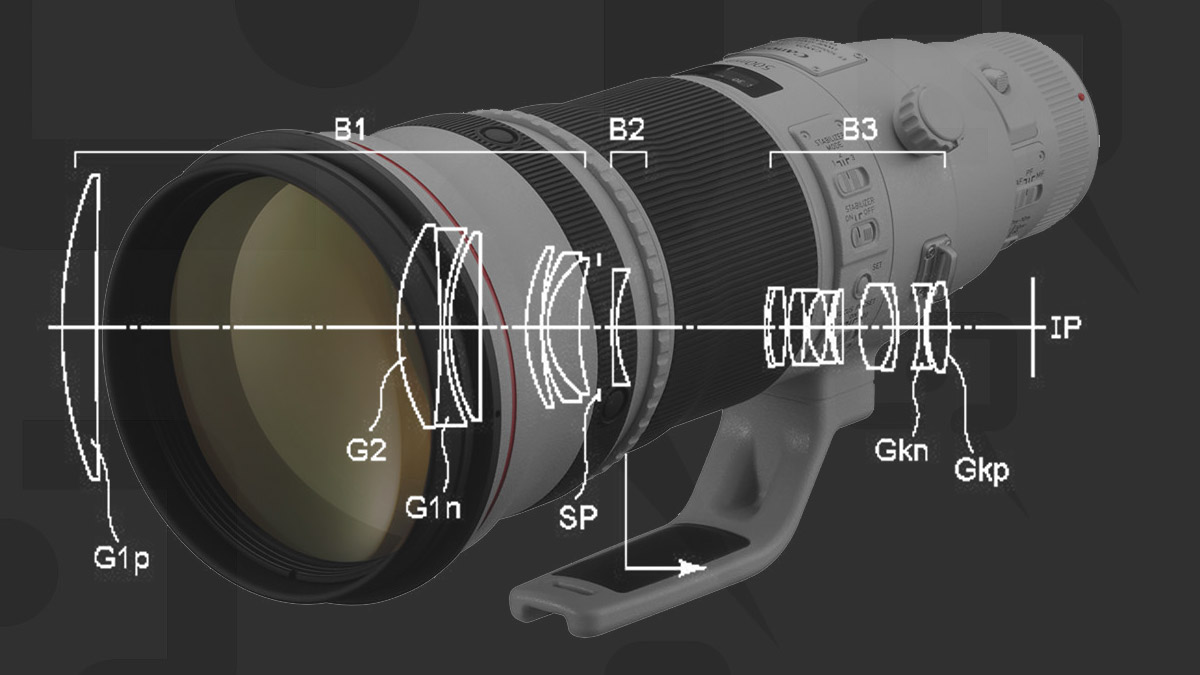
These embodiments share b1 and b2 element layouts, and only b3 differs. However, if I’m reading the embodiment examples correctly, the elements have different diameters. Doing so could help Canon reduce costs and even the time and effort it takes to make the lens bodies for both lenses, as the 500mm is simply a scaled-up version of the 400mm.
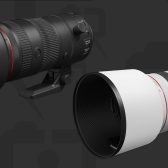
This is an interesting technique and it really didn’t dawn on me but even the latest rendition of Canon’s RF super telephotos share the same design. If you notice, the b1 and b2 groups are the same between the RF 400mm F2.8L IS USM and the embodiment for the 400mm F2.8, but the rear (b3) element groups differ.

If we look at the Canon RF 600mm F4L IS USM, we see the same first two groups of elements, but the rear elements are modified to give the lens the full 600mm focal length. The individual components may have different characteristics, but fundamentally, they have the same optical design.

This is curious, as Canon doesn’t have to reinvent the wheel whenever Canon introduces a new lens version. The “big elements” in the front and middle, which are also expensive and have specialized coatings and glass elements, are common across the variants, so the assemblies, mounting, and other mechanical bits could just be kept the same as long as no mechanical or engineering problem existed.
Canon RF 400mm F2.8L
This embodiment shows a Canon RF 400mm super telephoto prime with a slightly different element configuration than the existing RF version. The 31 mm backfocus is relaxed enough for Canon’s teleextenders, and the lens length is around 27mm shorter than the existing production version.
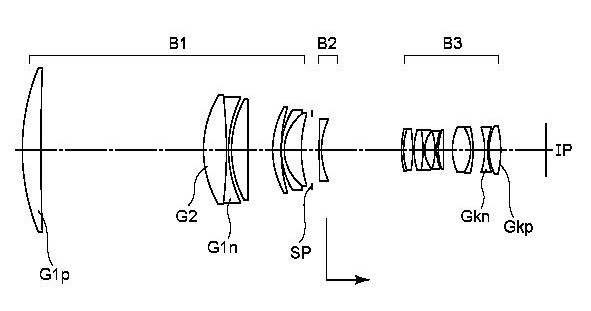
| Focal length | 392.00 |
| F-number | 2.90 |
| Angle of view | 3.16 |
| Image height | 21.64 |
| Total lens length | 360.03 |
| Back Focus Distance | 31.01 |
Canon 500mm F4L
The Canon RF 500mm F4L does not exist yet, so this would be a welcome addition to the supertelephoto family, and for the RF mount being 7 years old now seems like a strange omission. A back focus distance of 33.09mm offers enough room for the teleextenders, as as with others in this design, with the majority of the elements to the rear of B1, it should be well balanced for a mirrorless camera body.
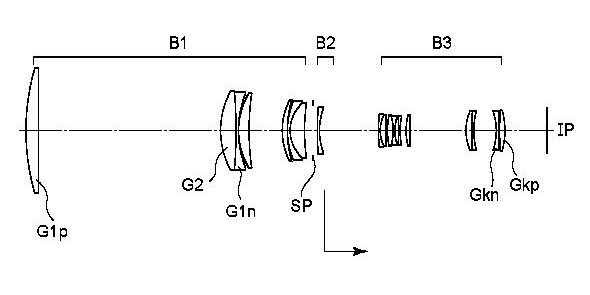
| Focal length | 490.00 |
| F-number | 4.12 |
| Angle of view | 2.53 |
| Image height | 21.64 |
| Total lens length | 412.08 |
| Back Focus Distance | 33.39 |
Canon 600mm F4L
This Canon 600mm F4L embodiment is similar to the existing Canon RF 600mm F4L IS USM; however, it’s slightly shorter at 456mm versus 472mm. This should lead to reduced weight and perhaps a little better balance than the Canon RF 600mm F4L IS USM original version.
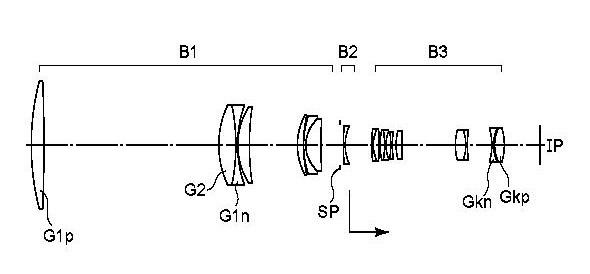
| Focal length | 588.00 |
| F-number | 4.12 |
| Angle of view | 2.11 |
| Image height | 21.64 |
| Total lens length | 476.08 |
| Back Focus Distance | 33.21 |
Closing Thoughts
I find the engineering around these supertelephotos to be interesting. While we won’t know if this patent application will be used in the next releases, given the current RF super telephotos and their commonality, it would not surprise me if they are similar.
Just a Reminder!
With all patents and patent applications, I have to stress constantly – this is simply a look into Canon’s research; the only thing we can quantify accurately is that Canon is researching this. A patent application doesn’t mean they are going to release this in the next month, or even year, or even at all.








And then the disclaimer: A patent application doesn’t mean they are going to release this in the next month, or even year, or even at all.
So which is it?