
When you purchase through links on our site, we may earn an affiliate commission. Here’s how it works. |
Through astrophotography, we can combine scientific, mathematical, and celestial knowledge with artistic skills to record the night sky’s beauty, which can include both the Milky Way and distant galaxies. For this guide, we are going to limit our discussion to landscape astrophotography, which takes wide-field images, usually containing dramatic pictures of the Milky Way.
Modern mirrorless camera systems enable photographers to participate in this genre of photography easily, and more importantly to us, the Canon RF system can deliver outstanding low-light capabilities, and paired with the right lens, you can get excellent results.
The following guide provides a guide for starting landscape astrophotography with your Canon mirrorless camera, including essential equipment, techniques, and key factors to consider.
Be sure to check out our companion shutter speed calculator for astrophotography.
Astrophotography Calculator

Be warned, astrophotography is a rabbit hole that you may never escape from, Alice.
Location, Location
Selecting your location is the first thing you need to do. Unless you are blessed with an amazing backyard, you are going to have to travel to find a suitable location to shoot astrophotography landscapes.
Minimizing Light Pollution
The priority should be to reduce all forms of light pollution. City artificial lighting systems make it very difficult to see the faint stars and the complete details of the Milky Way. The light pollution maps available at lightpollutionmap.info and darksitefinder.com help users locate dark areas, which show the galactic core in its most vibrant state through Bortle Class 1-4 zones (dark gray to blue on maps).

The goal should be to find International Dark Sky Parks or Reserves, which include Death Valley and more distant locations beyond urban areas.
The camera should focus on interesting foreground elements, which include rugged mountains, arches, lakes, trees, and rock formations that create dramatic frames for the sky. Scout the location during daylight hours while using Google Earth to find suitable composition spots that provide clear views of the sky to capture the Milky Way core.
Time for New Moon and Clear Weather
The observation of new moon phases needs to occur during specific times because moonlight should not dominate the stars and wash out your scene. The atmosphere should remain clear and dry for better visibility, or what is called “seeing”.
Ensure Safety and Accessibility
This is very important. Keep in mind that you are going to be walking around in the dark. Choose a safe location with minimal things around your location to trip over, or worse, to fall from.
Consider as well, wildlife dangers as well. and try to find a spot that has working cell coverage in case of any emergencies. You should inform someone about your plans as well, and what your location is. This way, if something does happen, they can alert rescue.
The 1/500 Rule
The Earth’s rotation creates a movement of stars that appears in the camera frame during night sky photography. The stars will show up as streaks instead of points when your camera exposure time becomes too long. Photographers prevent this issue through a standard method that helps them determine the longest exposure duration that will produce star trails. The 1/500 Rule stands as the most basic method for measurement.
The rule provides a simple method to calculate maximum exposure time in seconds by dividing 500 by your lens’s effective focal length. So, for instance, the maximum exposure time for your full-frame camera with a 20mm lens would be 25 seconds according to the formula 500 / 20 = 25 seconds. The 14mm lens would require a shutter speed of 500 / 14 or approximately 35.7 seconds.
Users who operate APS-C crop sensor cameras will need to multiply their lens focal length by the crop factor (1.6x on Canon cameras) to determine the effective focal length. The calculation for a 16mm lens on a crop body camera would then be 500 divided by (16 * 1.6), which equals 19.5 seconds.
The basic rule provides a dependable beginning point, but it represents an estimate rather than an exact solution. The NPF rule provides advanced calculation methods that use pixel pitch and declination values to generate more accurate results. We actually have that calculator here now, and you can check it out here.
Astrophotography Calculator
Cameras for Astrophotography
When I first did this article, I didn’t put in any cameras that I would recommend, because well, they all can work for astrophotography from the lowly R100 to the flagship R1. A few in my mind stand out in terms of performance, portability, and price, so I’ll include them here, even though any modern RF mount camera will do for this article. I prefer a mirrorless camera, because its autofocus is better, which is still important for astro photography, and you don’t have a mirror and shutter vibrations, as you can use an electronic shutter.
I realize you can use mirror lockup with DSLRs and also electronic shutter, but the entire process is simply much easier with mirrorless cameras (including filters).
Full-Frame vs. Crop Sensor
The current mirrorless lineup from Canon consists of two sensor types, which include Full-Frame (RF mount cameras such as EOS R, R6, and R8, and R5) and APS-C Crop Sensor (RF-S cameras including EOS R10, R50, R50V, and R7). The identification of these two sensors stands as a primary requirement because it determines all aspects of lens selection and reasonable expectations of image quality.
Full-frame sensors are called this because they have the same dimensions as traditional 35mm film, while the APS-C crop sensors are smaller (around 2.6x smaller in area). The larger surface area of full-frame sensors enables them to collect more light to create images with a better signal-to-noise ratio during high ISO astrophotography.
Another distinction between these two systems exists in their crop factor, and the lens focal length becomes larger because of this factor. A 16mm lens used with a crop sensor camera will produce an effective field of view that matches a 25.6mm lens when used on a full-frame camera. The effective focal length is part of the calculation to determine how long a shutter speed you can use to get good results.
A full-frame Canon body that fits within budget will produce better low-light results for deep-sky and wide-field astrophotography, but an APS-C camera with a suitable lens can also deliver good results and is generally less expensive to purchase.
The camera’s crop factor creates difficulties when photographers want to take wide-field shots. The APS-C camera format provides users with entry-level photography access because it offers affordable prices, a lightweight design, and a compact size.
The selection between these two sensor sizes is really personal and depends on your financial constraints and portability. But they both can produce excellent images.
Canon EOS RP

If you want to get into this hobby and you don’t have a full-frame camera and not a lot of money, then this would be the ideal starting point. For landscape astrophotography, you don’t necessarily care as much for dynamic range, and the EOS RP is adequate for functionality and high ISO noise. Its 26.2MP full-frame sensor will capture a lot of detail and take great images. It’s also a camera that you can find used fairly easily on marketplaces and eBay to save even more money.
Key Features
- 26.2MP Full-Frame CMOS Sensor
- DIGIC 8 Image Processor
- UHD 4K and Full HD 1080 Video
- 2.36m-Dot OLED Electronic Viewfinder
- 3″ 1.04m-Dot Vari-Angle Touchscreen LCD
- Dual Pixel CMOS AF, 4779 AF Points
- ISO 100-40000, Up to 5 fps Shooting
- Wi-Fi and Bluetooth Connectivity

- 26.2MP Full-Frame CMOS Sensor
- DIGIC 8 Image Processor
- UHD 4K and Full HD 1080 Video
- 2.36m-Dot OLED Electronic Viewfinder
- 3" 1.04m-Dot Vari-Angle Touchscreen LCD
- Dual Pixel CMOS AF, 4779 AF Points
- ISO 100-40000, Up to 5 fps Shooting
- Wi-Fi and Bluetooth Connectivity
Canon EOS R10
Canon makes a variety of APS-C Cameras, and all of them, even the EOS R100, would do an equally competent job at astrophotography, as all of them have very similar sensors with around the same amount of high ISO noise.

For this, I’m going to choose the EOS R10, as it’s a good all-around camera for a moderate price, for stills and video, so it can complement your shooting style even when you are not taking pictures of the night sky.
Key Features
- 24.2MP APS-C CMOS Sensor
- Dual Pixel CMOS AF II
- 4K30 Video, 4K60 with Crop; HDR-PQ
- 23 fps E. Shutter, 15 fps Mech. Shutter
- 2.36m-Dot OLED EVF
- 1.04m-Dot Vari-Angle Touchscreen LCD
- Multi-Function Shoe, Wi-Fi and Bluetooth

- 24.2MP APS-C CMOS Sensor
- Dual Pixel CMOS AF II
- 4K30 Video, 4K60 with Crop; HDR-PQ
- 23 fps E. Shutter, 15 fps Mech. Shutter
- 2.36m-Dot OLED EVF
- 1.04m-Dot Vari-Angle Touchscreen LCD
- Multi-Function Shoe, Wi-Fi and Bluetooth
Lenses for Astrophotography
The lens you choose follows the camera body as the most important piece of your gear. The practice of astrophotography requires photographers to use a very fast (wide aperture) lens and usually a very wide-angle lens, because these lenses help them collect the most light possible while showing a large section of the nighttime sky.
The best results will come from using lenses that have a maximum aperture of f/2.8 or faster (including f/1.8 and f/1.4) and operate between 12mm and 24mm focal lengths.
Coma
The process of selecting lenses for astrophotography requires photographers to handle the optical aberrations, which will appear as coma. Coma produces star images that extend into comet-like or winged shapes that have a bright central section and a faint extended portion.
The effect becomes most apparent when photographers use their lenses at their widest aperture setting because light rays entering the lens elements must travel at steeper angles. Some lenses have these aberrations more controlled. But regardless, if you stop down any lens from its maximum aperture, the coma is often far less, but at the expense of your maximum amount of light you can collect during your exposure.

If we look at this lens sample from Lenstip’s review of the Canon EF 35mm f/2, we see that the effect of coma is most apparent in the corners and at f/2.0. Once the lens is stopped down to f/2.8, coma is minimal.
Canon Full-Frame Lenses
Canon has a wide variety of full-frame lenses that you can use and as well, and you have a wealth of lenses from the EF mount that you can adapt to the Canon RF mount. This allows you to use almost any lens made in the DSLR era on your RF mount camera.
You can even go fully old school and use a manual focus lens, but more care is required because you need to manually adjust focus to exact infinity to get stars into the smallest dots possible.
Canon RF 16mm f/2.8 STM

The Canon RF 16mm f/2.8 STM is an affordable compact prime lens that serves as an excellent starting point for astrophotography. The f/2.8 aperture and 16mm focal length make this lens good for capturing the Milky Way. This lens does, however, exhibit strong coma in the corners and requires distortion correction. If you are willing to crop out the worst of the corners and use this lens as more of an 18mm, then this lens, for the price, is a decent starting lens. This lens is also very good on an APS-C camera as a 25.6mm effective focal length prime, and when using it on a crop camera, it will not exhibit much in the way of coma.
Features
- RF-Mount Lens/Full-Frame Format
- Aperture Range: f/2.8 to f/22
- One Aspherical Element
- Super Spectra Coating
- STM Stepping AF Motor
- Customizable Control Ring
- Rounded 7-Blade Diaphragm

- Full-Frame
- Super Spectra Coating
- STM Stepping AF Motor
- Customizable Control Ring
- Rounded 7-Blade Diaphragm
Canon RF 15-35mm f/2.8L IS USM

The Canon RF 15-35mm f/2.8 L IS USM functions as a professional-grade zoom lens that provides exceptional optical performance and zoom functionality. The lens features a constant f/2.8 aperture, which positions it as a leading option for wide-field nightscapes. This lens also has minimal coma at the business end of 15mm, making it suitable for astrophotography. Just keep in mind that as you zoom to longer focal lengths, coma does make an appearance and may require you to stop down.
Features
- Full-Frame | f/2.8 to f/22
- Fast Wide-Angle Zoom
- Nano USM AF System
- Optical Image Stabilizer
- Aspherical and Low Dispersion Elements
- Air-Sphere and Fluorine Coatings
- Customizable Control Ring
- Weather-Resistant Design

- Fast Wide-Angle Zoom
- Nano USM AF System
- Optical Image Stabilizer
- Customizable Control Ring
- Weather-Resistant Design
Samyang/Rokinon 14mm f/2.8

The budget-friendly Samyang/Rokinon 14mm f/2.8 lens operates with manual focus and is basically an EF lens with a built-in RF to EF adapter. The lens offers an extremely wide 14mm focal length together with a quick f/2.8 aperture. This lens is also renowned for its excellent lack of coma distortion. This lens is manual focus and manual aperture, which may be more frustrating for users working in the dark.
Key Features
- RF-Mount Lens/Full-Frame Format
- Aperture Range: f/2.8 to f/22
- Two Aspherical Elements
- Two ED Elements, Three HR Elements
- Ultra Multicoating
- Manual Focus Design
- Weather-Sealed Construction
- 6-Blade Diaphragm
- Rear Gel Filter Holder
- Built-In Petal-Shaped Lens Hood
- RF-Mount Lens/Full-Frame Format
- Aperture Range: f/2.8 to f/22
- Two Aspherical Elements
- Two ED Elements, Three HR Elements
- Ultra Multicoating
- Manual Focus Design
- Weather-Sealed Construction
- 6-Blade Diaphragm
- Rear Gel Filter Holder
- Built-In Petal-Shaped Lens Hood
Canon Crop Sensor (RF-S Mount) Lens Recommendations
Any of the recommendations for full-frame lenses would work just fine for crop sensor cameras, and in terms of coma aberrations, probably even better, as lenses usually have less apparent coma when you crop out the extreme corners. However, there are some great lenses available for RF-S lenses that are suitable for astrophotography work.
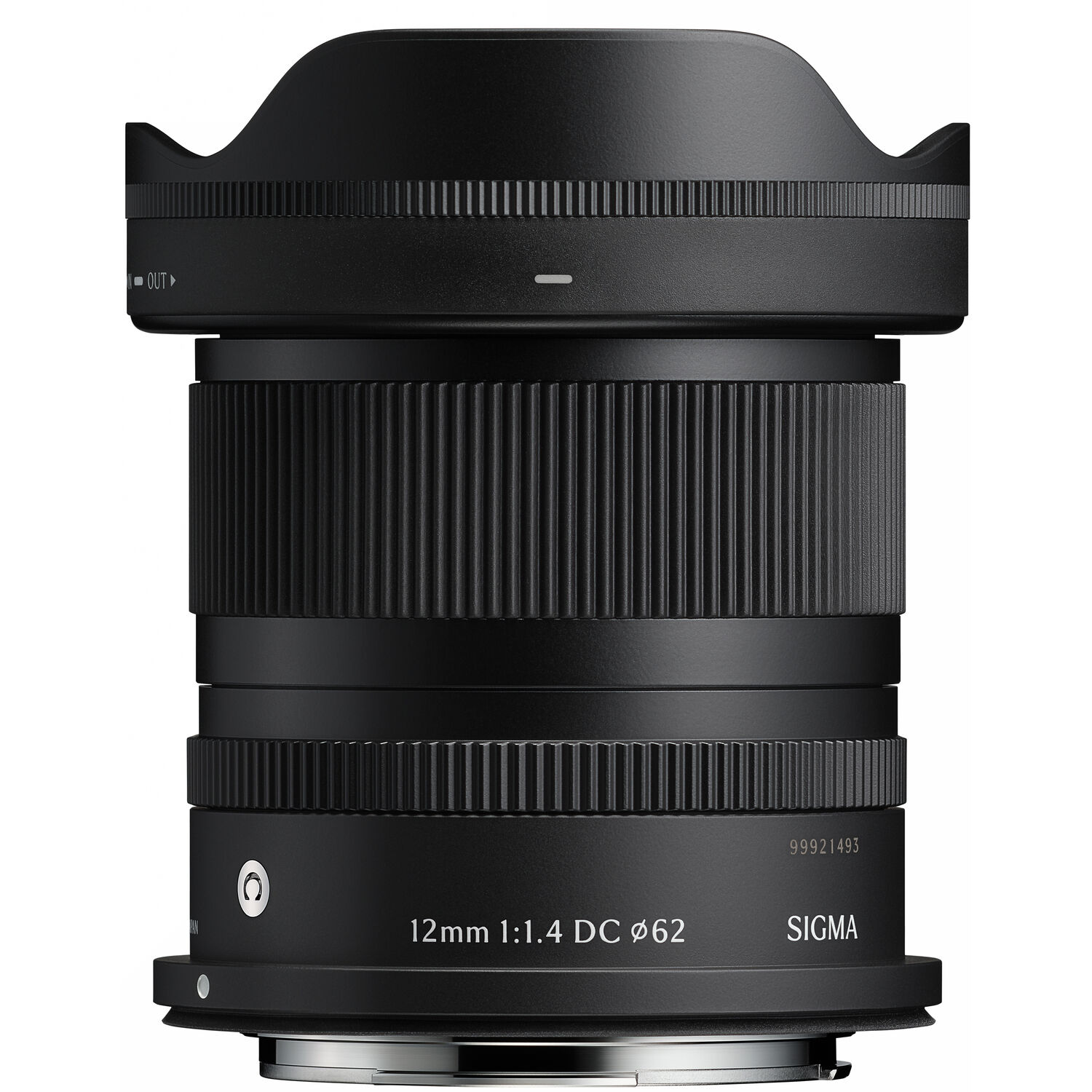
Sigma 12mm f/1.4 DC Contemporary Lens

The Sigma 12mm f/1.4 DC Contemporary Lens (Canon RF) would be my go-to lens for APS-C crop cameras if cost were not an issue. The lens exhibits good coma correction with stars being pinpoint dots into the extreme corners, and is impressively fast with a maximum aperture of f/1.4.
Key Features
- APS-C | f/1.4 to f/16
- 19.2mm (Full-Frame Equivalent)
- Fast & Lightweight Wide-Angle Prime
- Stepping Motor AF System
- Rounded 9-Blade Diaphragm
- Control Ring
- 3 Aspherical Elements, 2 SLD Elements
- Minimum Focusing Distance: 6.8″
- Water- and Oil-Repellent Coating
- Dust- and Splash-Resistant Construction
- APS-C | f/1.4 to f/16
- 19.2mm (Full-Frame Equivalent)
- Fast & Lightweight Wide-Angle Prime
- Stepping Motor AF System
- Rounded 9-Blade Diaphragm
- Control Ring
- 3 Aspherical Elements, 2 SLD Elements
- Minimum Focusing Distance: 6.8"
- Water- and Oil-Repellent Coating
- Dust- and Splash-Resistant Construction
Sigma 10-18mm f/2.8 DC DN Contemporary Lens

If prime lenses are not your thing, then Sigma makes another fantastic lens for the RF-S mount, and that is the Sigma 10-18mm zoom lens. While it’s not as fast as the Sigma 12mm f/1.4 DC Contemporary Lens, it’s fast enough and a bit wider. Having a zoom from 10mm to 18mm also allows you to frame your landscape image a bit more optimally as well.
Key Features
- APS-C Format | f/2.8 to f/22
- 16-29mm (Full-Frame Equivalent)
- Ultra Wide-Angle Zoom
- Fast Internal Focus System
- Rounded 7-Blade Diaphragm
- Dust & Splash-Resistant Design

- APS-C Format | f/2.8 to f/22
- 16-29mm (Full-Frame Equivalent)
- Ultra Wide-Angle Zoom
- Fast Internal Focus System
- Dust & Splash-Resistant Design
Samyang 12mm F2.0 RF-S

Another fantastic prime for the Canon RF-S mount is the Samyang 12mm F2.0 AF, which gives a fast 12mm prime that is less expensive than the Sigma 12mm f/1.4 DC. Samyang ultra wide primes are renowned for the lack of coma distortion, and this prime is no different, having very little coma aberrations.
Key Features
- APS-C | f/2 to f/22
- Linear STM Autofocus Motor
- 2 ASPH and 3 ED Elements
- UMC Ultra Multicoating
- Minimum Focus Distance: 7.9″
- 7-Blade Diaphragm
- APS-C | f/2 to f/22
- Linear STM Autofocus Motor
- 2 ASPH and 3 ED Elements
- UMC Ultra Multicoating
- Minimum Focus Distance: 7.9"
- 7-Blade Diaphragm
Light Pollution Filters
One of the main annoyances that astrophotographers face stems from the city light pollution which affects both the contrast of the night sky and faint starlight. Light pollution renders your images more muddy without details. A lot of the dramatic nature of astrophotography images gets lost because of light pollution. Light pollution filters (LPFs) function to solve this problem through their ability to block particular wavelengths which streetlights produce while allowing celestial object wavelengths, including Hydrogen-alpha and Oxygen-III, and Sulfur-II to pass through.
| Before | LPF LPS-D3 FIlter |
|---|---|
 |  |
The LPF system for Canon mirrorless cameras exists in two different formats, which include clip-in filters that insert into the camera body near the sensor and screw-on filters that mount onto lens fronts. Clip-in filters remain the preferred choice because they provide easy use, and they can attach to almost any lens.
Kolari Light Pollution Clip-In Filter

The Kolari Clip in Light Pollution filter operates as a broad-spectrum (broadband) filter that blocks multiple city light wavelengths.
Our Light Pollution Filter is designed to enhance night sky photography by selectively blocking the most common wavelengths emitted by artificial lighting, such as streetlights, mercury vapor, and sodium lamps. By reducing this unwanted glow, the filter helps restore natural contrast to the night sky, making stars, nebulae, and other celestial objects stand out with greater clarity.
These filters work best for Milky Way and wide-field nightscape photography because they maintain the most natural color accuracy. They may add a small color shift, which photographers can fix during editing.
Remote Shutter Release
Physical contact with your camera during long exposure sessions will produce camera vibrations, which lead to star image blurriness. A remote shutter release is an essential device for all photographers who need to use their camera for long exposures. Canon mirrorless camera users have multiple choices available to them.
Canon Camera Connect
The free Canon Camera Connect application enables you to link your smartphone to your camera, which provides complete control over camera settings and focus, and shutter release functions. This method provides free remote access to control your camera for free.

Download From the Apple App Store
Download From the Google App Store
Canon BR-E1
The Canon BR-E1 wireless Bluetooth remote functions as an official Canon remote, which users can also use third-party Bluetooth remotes that provide a basic method to activate the shutter through wireless operation.

The system enables single-shot remote triggering but lacks the advanced intervalometer functions that most modern cameras integrate into their menu systems. Users should consult their camera model manual because the EOS R6 Mark II and other Canon mirrorless cameras include an integrated intervalometer, which eliminates the need for a wired programmable remote.
Sturdy Tripod
A tripod functions as the essential base that every astrophotography operation needs to succeed. A tripod that wobbles and has a weak structure will destroy all your long exposure photographs, regardless of your other camera settings being correct. Your tripod for night sky work requires stability and both sufficient load capacity and user-friendly operation.
Tripods that include a center hook are also recommended, as you can use the center column hook of your tripod to hang your camera bag or a sandbag, which will increase the supporting weight and help to reduce camera shake and assist in dampening any vibrations.
A few other tips for choosing the right tripod are
- The tripod needs to support the total weight of your heaviest camera equipment, along with your lens and any additional accessories. The selection of a tripod should focus on finding a model that handles loads that exceed the weight of your equipment by at least 1.5 to 2 times the actual weight.
- The camera rests on your tripod head, which enables you to accurately aim the camera and frame your image. A ball head serves as the most adaptable and user-friendly choice for capturing wide-field astrophotography images. The ball head needs a secure, non-slip locking system that should withstand the vertical forces that occur when using a heavy lens to point straight up. Another excellent choice would be a geared head.
The purchase of a high-quality tripod from Manfrotto or, more economically, a Benro tripod and head represents an excellent investment for astrophotography practice.
Closing Thoughts
We could go on and on about the subject, but WordPress is already telling me it’s over 20 minutes to read it all. One especially absent subject is image processing software, which I know some of you will suggest (and rightly so, as it is the most important aspect of astrophotography). It is very important, but it’s a subject all on its own and beyond our scope here.
I also feel that landscape astrophotography is the start of a journey to the vast universe of wonders around us, and not the end journey. For those that just starting, I hope this guide has been helpful, and remember to check out our new calculator.