
|
When you purchase through links on our site, we may earn an affiliate commission. Here’s how it works. |
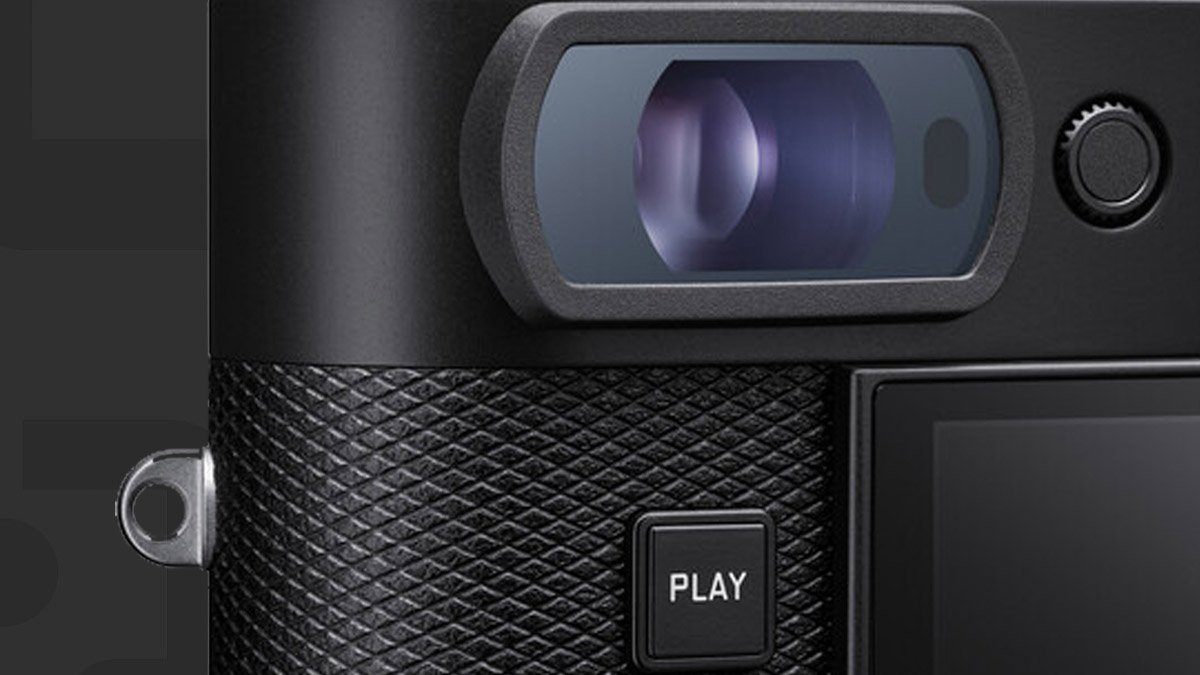
Leica has officially gone EVF with the rangefinder M series lineup with the EV1. Let the debate reign if this is now considered a rangefinder or just another mirrorless camera body.
I can appreciate that the rangefinder enthusiasts will be hissing at this release. Still, the EVF does offer many advantages for framing that weren’t that convenient for a wide variety of lenses, which you couldn’t easily use on a typical rangefinder camera. So this opens up far more creative possibilities for those willing to fork out the eyewatering amount to get the camera.
As well, because of the EVF, the M now gets a full range of focus assist tools, such as focus peaking and focus magnification, to zoom into the image up to 2x to get a better view of critical details.
The camera also has Leica Content Credentials. Leica states that the camera will use a secure processing chip to encrypt the image metadata at the point of capture. This will allow the image to be independently verified and appended to by tools such as Adobe Photoshop so that users can verify the authenticity of the image and what changes were made to it.
Because Leica removed the viewfinder, the camera is actually a little lighter than the M11-P, its predecessor, weighing in at 413g.
Will this camera do well in the market? It’s really hard to say. Richard Butler of Dpreview had an early look at the camera and had this to say, which I thought was blunt and to the point.
Based on using the camera for a week, I can’t see the point in paying 91% of the cost of a Leica rangefinder, only to get something that isn’t a rangefinder and that’s no more elegant to shoot with than any other mirrorless camera trying to manual focus. Yes it’s beautifully made and it has a red dot, but I’m not sure you gain much over, say, a Sony a7CR, with which it shares a sensor.
After a few minutes of shooting with an M9, I understood why someone might buy a rangefinder. After a few days with the M-EV1, I’m at a loss to why anyone would buy this instead.
https://www.dpreview.com/reviews/leica-m-ev1
There are certainly some benefits to using an EVF over the rangefinder OVF, but it remains to be seen if the users who would want this would inherently find it a more frustrating experience.
Key Features
- First M Camera with Integrated EVF
- 60MP Full-Frame BSI CMOS Sensor
- Leica Content Credentials Technology
- FN Button & Focus Assist Settings
- 5.76m-Dot 0.76x-Mag. OLED Viewfinder
- 2.95″ Touchscreen with Gorilla Glass
- 64GB Internal Memory and SD UHS-II Slot
- ISO 64-50,000, up to 4.5 fps Shooting
- Wi-Fi & USB-C, Dedicated FOTOS App
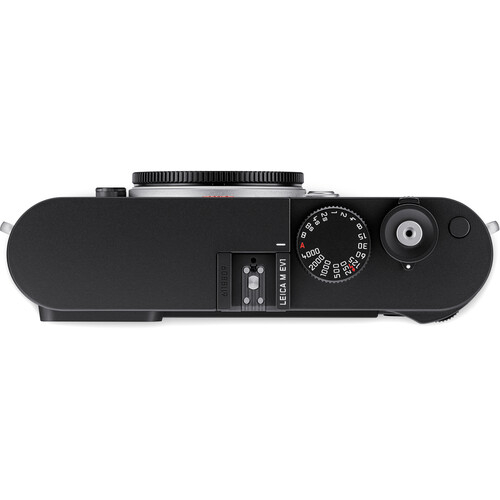
- Lightweight Aluminum Top Plate
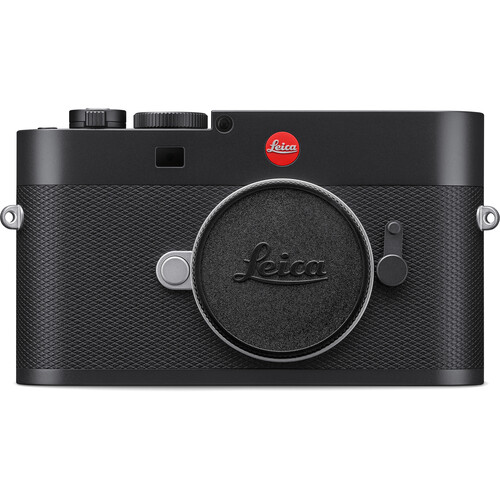
Leica M EV1
Press Release
Next Milestone for the Leica M-System
Leica M EV1 – the first M-Camera with an integrated electronic viewfinder
Teaneck, October 23, 2025 –With the launch of the new Leica M EV1, Leica Camera AG marks a significant milestone in its history, introducing an entirely new segment within the Leica M-System. In addition to the digital and analog M-Camera with an optical rangefinder, the company is welcoming a new member to the M family in the form of a Leica M-Camera with an integrated electronic viewfinder (EVF). The Leica M EV1 combines the benefits of an EVF with the traditional values of the M-System, making it easier to enter the world of M photography. It ensures reliable, comfortable focusing—especially with fast Summilux and Noctilux lenses at shallow depths of field, as well as with ultra wide-angle, telephoto, and macro lenses
As a photography pioneer, Leica Camera AG has been boldly forging new paths for 100 years. In 1925, the Leica 1 – the first mass produced 35mm camera, revolutionized photography. The Leica M is considered its successor and exemplifies the essence of the Leica philosophy like no other. With iconic design, precision craftsmanship “Made in Germany”, and uncompromising quality, it has embodied the values and legacy of the brand for over 70 years by harnessing innovation and forward-looking technology. Since its introduction, the Leica M has been systematically refined with each new generation. In 2006, Leica transported the soul of the analog M-Camera to the digital age with the M8. The currents models – such as the M11 Monochrom with its black-and-white sensor, the M11-D with no display, the M11-P with Content Credentials Technology, and the analog M6, MP and M-A – all demonstrate the ingenuity and individuality of the M-System.
By introducing an EVF to the M-Camera, Leica is fulfilling a frequent customer request and expanding the range of applications for seasoned M users. Thanks to its intuitive operation, new customers will also find it easier to explore the world of the M-System.
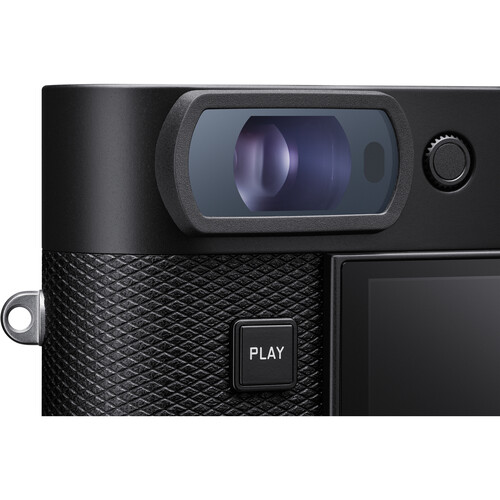
The image displayed in the Leica M EV1’s viewfinder appears exactly as it will be captured when the shutter is released, accurately reflecting the lens used, focal length, and aperture settings. The direct preview of the field of view and plane of focus is very advantageous, especially when it comes to composing images with ultra wide-angle and telephoto lenses. The precise real-time exposure preview provides additional certainty and unleashes new creative possibilities though targeted under- and overexposure. With the integrated diopter compensation, the viewfinder can be adapted to the user’s own visual acuity. A setting wheel allows an adjustment between -4 and +2 diopters.
The high-resolution 5.76 megapixel EVF provides brilliant image quality with exceptional clarity and natural color rendering. If desired, relevant exposure data – such as shutter speed, ISO, and exposure value – can be shown around the image, which remains completely uncovered. The automatic switch between viewfinder and touch panel is supported by an eye sensor.
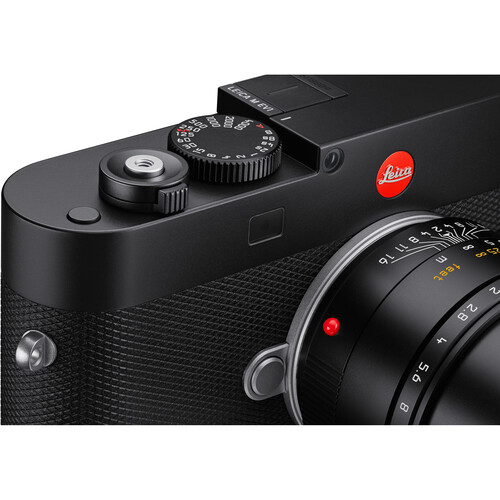
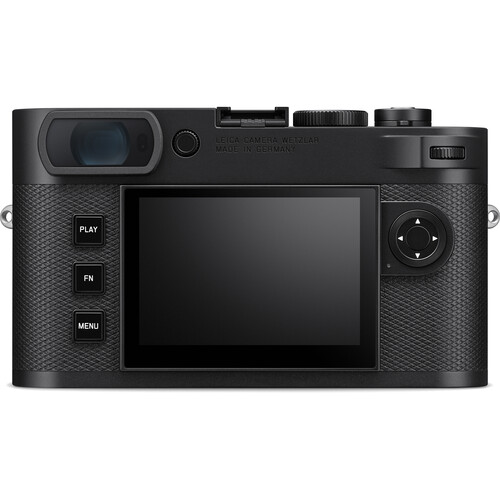
The integrated focus assist, already familiar from other Leica cameras, is especially user-friendly. Focus peaking highlights the active plane of focus with a colored overlay, allowing precise real-time adjustment of the desired focus area. In addition, focus zoom simplifies manual focusing by offering two freely selectable magnification levels, activated either automatically when turning the focus ring or manually via a function button. This feature is particularly useful for achieving precise focus when using fast lenses with a shallow depth of field or when working with macro lenses. The lever on the front of the camera, which is used in rangefinder M-Cameras to preview bright-line frames, has been given a useful function on the Leica M EV1: This control can be assigned to one of the focus assists or the 1.3× or 1.8× digital zoom. With a simple touch to the right or left, the focus assist can be activated or deactivated quickly and comfortably as the situation requires.
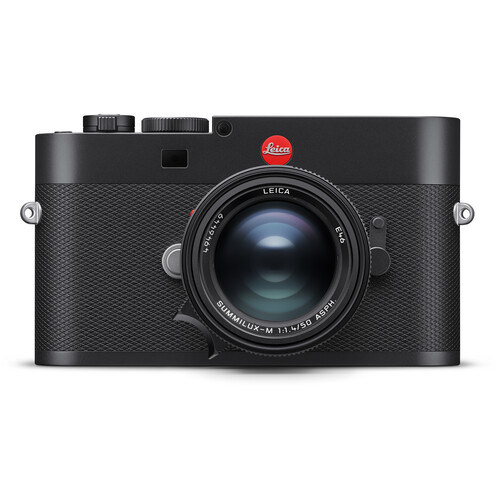
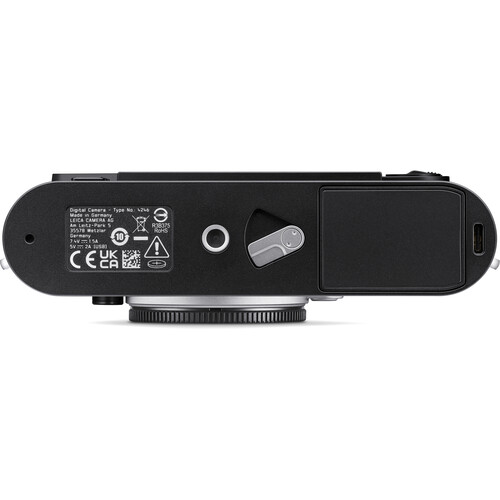
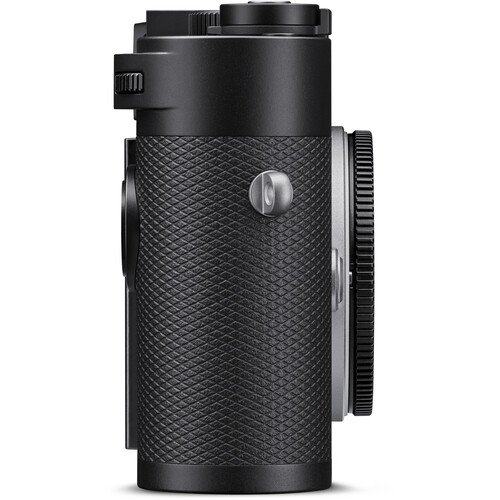
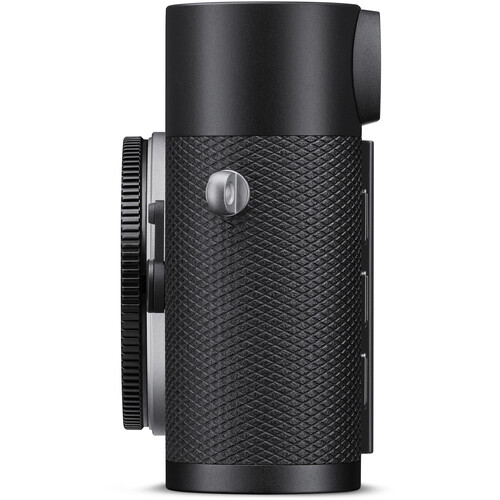
The Leica M EV1 continues the M-Camera’s long tradition of timeless, functional, and iconic design. Handmade in Germany using high-quality materials, it speaks the familiar clear and cultivated design language of an M. The diamond-patterned leatherette covering and minimalist front design intentionally set it apart from the traditional rangefinder M-Camera.
The new M-Camera has been engineered based on the Leica M11 and its full-frame BSI-CMOS sensor with Triple Resolution Technology, which is admired for its precise color rendering, impressive detail resolution, high dynamic range, and excellent noise behavior. Images can be saved in either DNG or JPEG format at a resolution of 60, 36, or 18 megapixels. The Maestro III chip processes image data at the highest resolution quickly and saves it either on the 64 GB internal memory or an SD card. Thanks to seamless connectivity via Bluetooth, Wi-Fi, or cable, the camera can be quickly and conveniently connected with the Leica FOTOS App. Images can also be sent to smartphones energy efficiently in the background using Bluetooth Low Energy technology. Just like the Leica M11-P and Leica M11-D, the new Leica M EV1 supports Content Credentials. With this groundbreaking technology by the Content Authenticity Initiative (CAI), a digital signature is added to images, which verifies their origins and any post-processing in a tamper-proof manner.
The Leica M EV1 will be available worldwide starting October 23rd, 2025 at Leica Stores, the Leica Online Store, and authorized dealers, with a retail price of $8,995.00. For comfortable handling and additional hold, a hand grip with a matching leatherette covering is available for $460.
Update: FCC authorization pending: This product is not available for sale in the United States at this time. Information is intended for international audiences.
Specifications
| Price | |
| MSRP | $8995 |
| Body type | |
| Body type | Rangefinder-style mirrorless |
| Body material | Magnesium alloy / brass |
| Sensor | |
| Max resolution | 9528 x 6328 |
| Other resolutions | (M) 7413 x 4928, (S) 5272 x 3498 |
| Image ratio w:h | 3:2 |
| Effective pixels | 60 megapixels |
| Sensor size | Full frame (36 x 24 mm) |
| Sensor type | BSI-CMOS |
| Processor | Maestro III |
| Color filter array | Primary color filter |
| Image | |
| ISO | Auto, 64-50000 |
| White balance presets | 8 |
| Custom white balance | Yes |
| Image stabilization | No |
| Uncompressed format | RAW |
| File format | JPEGDNG (14-bit) |
| Optics & Focus | |
| Digital zoom | No |
| Manual focus | Yes |
| Lens mount | Leica M |
| Focal length multiplier | 1× |
| Screen / viewfinder | |
| Articulated LCD | Fixed |
| Screen size | 3″ |
| Screen dots | 2,332,800 |
| Touch screen | Yes |
| Screen type | TFT LCD |
| Live view | Yes |
| Viewfinder type | Electronic |
| Viewfinder coverage | 100% |
| Viewfinder magnification | 0.76× |
| Viewfinder resolution | 5,760,000 |
| Photography features | |
| Minimum shutter speed | 3600 sec |
| Maximum shutter speed | 1/4000 sec |
| Maximum shutter speed (electronic) | 1/16000 sec |
| Exposure modes | Aperture priorityManual |
| Built-in flash | No |
| External flash | Yes (via hot shoe) |
| Flash X sync speed | 1/180 sec |
| Continuous drive | 4.5 fps |
| Self-timer | Yes (2 or 12s) |
| Metering modes | MultiCenter-weightedSpot |
| Exposure compensation | ±3 (at 1/3 EV steps) |
| Videography features | |
| Microphone | None |
| Speaker | None |
| Storage | |
| Storage types | UHS II type SD |
| Storage included | 64GB |
| Connectivity | |
| USB | USB 3.2 Gen 1 (5 GBit/sec) |
| USB charging | Yes |
| Microphone port | No |
| Headphone port | No |
| Wireless | Built-In |
| Wireless notes | 802.11b/g/n |
| Remote control | Yes (cable release) |
| Physical | |
| Environmentally sealed | Yes |
| Battery | Battery Pack |
| Battery description | BC-SCL7 lithium-ion battery & charger |
| Battery Life (CIPA) | 244 |
| Weight (inc. batteries) | 484 g (1.07 lb / 17.07 oz) |
| Dimensions | 139 x 80 x 38 mm (5.47 x 3.15 x 1.5″) |
| Other features | |
| Orientation sensor | Yes |
| GPS | Optional |
Preorder
Leica M EV1
Images
Preorder
Leica M EV1