
When you purchase through links on our site, we may earn an affiliate commission. Here's how it works. |
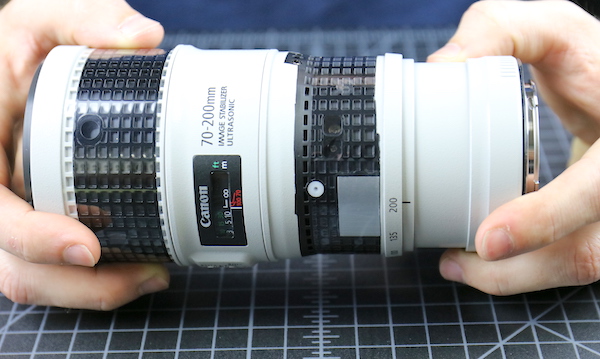
Roger and Aaron at Lensrentals.com decided to do a teardown of the brand new Canon EF 70-200mm f/4L IS II after having one return from a rental with a malfunctioning IS unit. Don't worry about the reliability of the IS unit, as its the same one that Canon uses in its newer lenses and has proven to be very reliable.
Rent the Canon EF 70-200mm f/4L IS II | Buy the Canon EF 70-200mm f/4L IS II
Roger discovered after doing MTF testing on a batch of the EF 70-200mm f/4L IS II lenses, that the copy variation was the lowest he'd ever seen for a zoom lens. Canon's manufacturing abilities are obviously on display here, though they'll never go public with how they're assembling lenses now, but there are usually some clues in tear downs.
Lensrentals.com speculates:
We have some hints, and a lot of Roger speculation, about how Canon is getting lenses with such low variance. Here’s what we know: Canon has more optical adjustments than most lenses, not less. So while they may have tighter tolerances (I have no clue), the key seems to be more in a careful optical adjustment of compensating elements than anything else.
Adjusting compensating elements is time-consuming and can be complicated. We sometimes spend half a day doing it on a complex lens. Canon seems to have made the process modular and logical. In this lens, for example, there are (we think):
– Centering for the focusing element.
– Tilt and centering adjustments for one or more middle elements
– Centering adjustments for the rear element.
It is clear that Canon is going with more, and more straightforward, adjustment of optics than the other manufacturers. Most lenses have a centering, or at most a centering and tilt adjustment. Many lenses have no optical adjustments at all. There are a couple of non-Canon lenses that have multiple adjustments, but it’s the exception, and often the adjustments are shims, which have more limited adjustment possibilities. See the full teardown