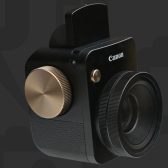

New Canon EOS & Cinema EOS Cameras Appear for Certification

Craig Blair
2 Min Read

When you purchase through links on our site, we may earn an affiliate commission. Here's how it works.

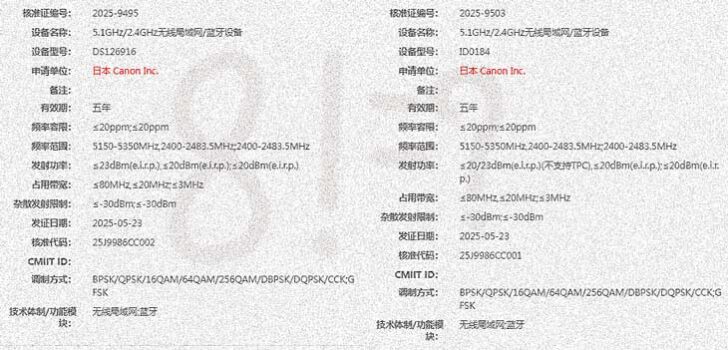
Two new Canon cameras have appeared for communications certification with the necessary agencies. If you didn't know, anything that transmits a radio signal generally needs to get that product certified by government agencies.

New Model Numbers

There are two new cameras that have made it through certification, one is DS126916, which means it's an EOS R series camera and the second one is ID0184, which is some kind of video product.

“ID” model numbers are usually Cinema EOS and other video camera certifications and “DS” model numbers being EOS R and now PowerShot, which is now part of the EOS team.
Canon EOS R6 Mark III?

It is possible that the camera that has appeared for certification here is the EOS R6 Mark III.

Last year, the model number DS12604 was suspected of being the EOS R6 Mark III, but that turned out to be the PowerShot V1.

It has been reported that this certification shows Dual-Band Wi-Fi 5, which is the same as the PowerShot V1. Both the EOS R5 Mark II and EOS R1 use the dual-band Wi-Fi 6 specification, which seems like something you'd see in the next 6 or 7 series camera.

The recent Canon EOS R50 V uses the Dual-Band Wi-Fi 5 specification.

There is no correlation between certification and an announcement date. We have seen them happen anywhere from a month to a year after the certifications are published.

Source: E8M_8888

Go to discussion...

Share This Article
Craig is the founder and editorial director for Canon Rumors. He has been writing about all things Canon for more than 17 years. When he's not writing, you can find him shooting professional basketball and travelling the world looking for the next wildlife adventure. The Canon EOS R1 is his camera of choice.

10 comments

  1. I'm very interested in future RV bodies, I like the R50V a lot, but the slow sensor readout makes a lot of things I want to do more difficult. That's largely operator error, but the R8 does make them possible. I'd sell the R50V in a heartbeat if an R8V or R7V comes available in roughly the same formfactor (and pricepoint). And let's be honest, an R6IIV without IBIS, using an LP-E17 is an R8V 🙂
  2. I'm curious to see what type of PowerShot their 1.4" sensor goes in next - a photocentric model with no fan, or perhaps a superzoom with a limited zoom range.
    A juiced up G3X with that sensor would be a nice touch. Would need an EVF, though. Probably have to limit to around 400mm equivalent to keep the lens size sensible.
  3. A juiced up G3X with that sensor would be a nice touch. Would need an EVF, though. Probably have to limit to around 400mm equivalent to keep the lens size sensible.
    That would depend on the aperture.
    We know that Canon is not afraid of f/11.
  4. That would depend on the aperture.
    We know that Canon is not afraid of f/11.
    f/11 at FF is not the same as f/11 at 4/3. I think Canon engineers do understand the two stop difference. They might go to f/8, but even that would be pushing well into diffraction territory. 300mm (600mm equiv.) at f/8 only requires a 38mm objective, but in practice a super zoom would be larger, and from a length perspective, 300mm is 300mm. I think it would depend on marketing decisions of reach vs portability and that kind of decision is anybody's guess. Nikon went whole hog with the p1000 with a 539mm f/8 (at the long end) and a tiny sensor, and it is actually a fun camera, but huge. Notably, the p1000 has no perceivable increase in detail from 360mm (2000mm equiv.) to 539mm (3000mm equiv.), but then, the same has been said of the RF 200-800 between 600 and 800. This would be an interesting opportunity for a DO zoom. I have a copy of the EF 70-300 DO and for a first gen lens it is actually pretty decent and very short for 300mm.
  5. ...from a length perspective, 300mm is 300mm.
    That was a thought I had, as well. But empirically...
    • RF 800mm, f/5.6 is 461 mm long, f/11 is 362 mm long
    • RF 600mm, f/4 is is 472 mm long, f/11 is 270 mm long
    • RF 100-300mm f/2.8 is is 323 mm long, RF 70-300mm f/4-5.6 is 223 mm long
    So it seems that in practice, aperture matters quite a bit. You could certainly argue that IQ matters as well, but I have no doubt the IQ of a PowerShot V lens would be more in line with that of the latter lens in each pair above rather than a big white L lens.
  6. That was a thought I had, as well. But empirically...
    • RF 800mm, f/5.6 is 461 mm long, f/11 is 362 mm long
    • RF 600mm, f/4 is is 472 mm long, f/11 is 270 mm long
    • RF 100-300mm f/2.8 is is 323 mm long, RF 70-300mm f/4-5.6 is 223 mm long
    So it seems that in practice, aperture matters quite a bit. You could certainly argue that IQ matters as well, but I have no doubt the IQ of a PowerShot V lens would be more in line with that of the latter lens in each pair above rather than a big white L lens.
    That empirical shortening was why I was thinking DO would be nice. Note that both 600 and 800 f/11 are DO lenses.
  7. Interesting to see the DS126916 pointing to a new EOS R, I hope it will be a high-end model.
    As for the ID0184, I am betting on a new compact Cinema EOS camera, perhaps oriented towards solo creators.
    Canon seems to be picking up the pace this year, that's a good sign.
    Can't wait to see the official specs!


  8. I was immediately fascinated when the product code DS126916 was certified, the photography community was abuzz that this was the EOS R9 - a flagship or semi-professional mirrorless camera in the EOS R series.
    6K or 8K video recording with Canon Log 3

    More compact design than the R5, suitable for both shooting and vlogging

Leave a comment

Please log in to your forum account to comment