


|
When you purchase through links on our site, we may earn an affiliate commission. Here's how it works. |
OpticalLimits is one of my favorite lens reviewers, going all the way back to when it was named photozone.de. Recently, they completed their review of the Canon RF 28-70mm F2.8 IS STM.
A little about the Canon RF 28-70mm F2.8 IS STM
While it wasn't readily apparent when the Canon RF 28-70 f/2.8 IS STM was first announced that it would become a series of lenses, Canon has since launched the the Canon RF 16-28mm F2.8 IS STM to complement it.
Will we see a telephoto f/2.8 STM zoom in the future?
A pattern of the method of Canon's madness is starting to form where the F2.8 IS STM lenses form the basis of a cheaper alternative for consumers wanting fast lenses willing to compromise to keep the price reasonable for a fast zoom. You can check out our first look reviews of the Canon RF 16-28mm F2.8 IS STM and see how it matches up.
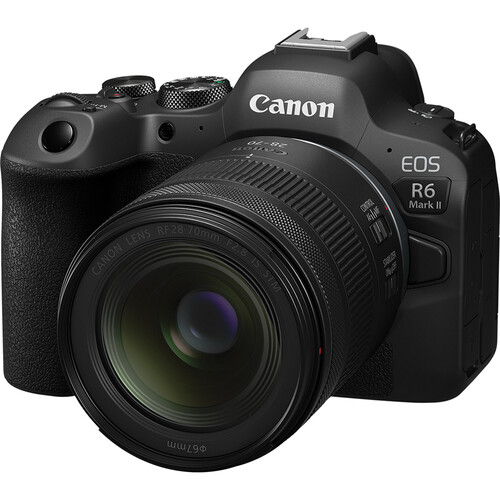
I suspect we'll see another lens that continues from 70mm to form the trinity of lenses for this series. But for now, we have the Canon RF 16-28mm f/2.8 IS STM and the Canon 28-70mm f/2.8 IS STM.
Review of the Canon RF 28-70mm F2.8 IS STM
When reading any review, you must take the data and think how the data mimics your shooting style and objectives for the lens. For me, the fact that it's stellar at 28mm makes this an instant win. I shoot far more at the wide and 50mm focal ranges than 50 to 70mm.
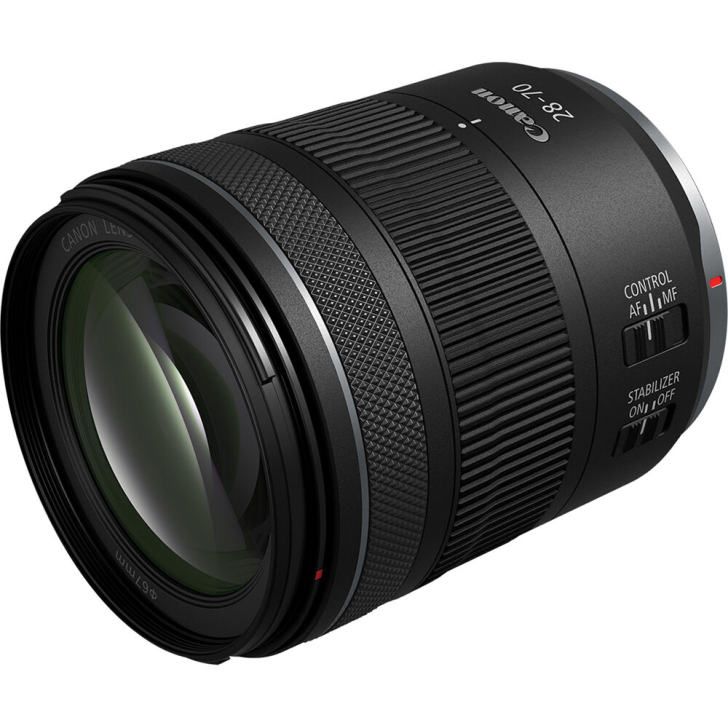
But you may be the type of person to shoot more between 50 and 70mm, and if your sample of this lens is similar to to the reviewers, then there are some question marks over its performance.
The Canon RF 28-70mm f/2.8 IS STM has the weirdest resolution characteristic that we’ve seen from a zoom lens in a long while. In the low to mid-range, the lens can rival prime lenses with an outstanding broader center quality and a very good outer image field.
At 70mm, the broader center is still superb, but the border/corner quality falls apart. The border quality is still good at f/2.8 but the corners are downright poor. For decent corners, you have to stop down to f/11 (!) here, but it’s at least not impossible.
https://opticallimits.com/canon/canon-rf/canon-rf-28-70mm-f-2-8-is-stm-review/
To be honest, this sounds like a design decision. Everything else with the lens (sans no lens hood) Klaus didn't find anything too out of the ordinary and OpticalLimits breaks down the pros and cons as follows for the Canon RF 28-70 f/2.8 IS STM.
PROS
- Excellent quality in the low to mid-range
- Quick AF
- Lightweight and compact
CONS
- What happened at 70mm, Canon?
- Retractable lens design
- Relies heavily on auto-correction
- Overpriced
- No lens hood at this price point is
Optical Limits gives the lens an overall score of 6/10 – but keep in mind what we stated that this may be a bad lens.
- Optical Quality – 6/10
- Build Quality – 7/10
- Price / Performance – 5/10
According to OpticalLimits
The Canon RF 28-70mm f/2.8 STM IS is a somewhat strange combination of qualities that you can find in professional and budget lenses. This doesn't mean that this concept doesn't work. If you can live with a few compromises, the lens can deliver great results.
Optically, it is nothing short of impressive in the low- to mid-zoom range. The center quality is still great towards the long end, but the corners are weak here. If you use 70mm for portraits, this won't matter, but it's not ideal for landscape or architecture photography.
The lens relies heavily on autocorrection. In RAW images, the distortion and vignetting is high, but then again – image autocorrection is a fact of life now anyway.
There are always compromises on lenses. This is certainly a lens about which you have to decide if the compromises are worth it.
Is the Review Accurate?
I rarely question reviews, and this isn't about me being a Canon fanboy.
Klaus may also have had a bad sample of the lens that exhibited a large resolution falloff at 70mm in the corners. I'm wondering if this is a bad sample because we didn't notice the resolution dropping off this significantly, as we discussed in our preview of the Canon RF 28-70mm F2.8 IS STM.
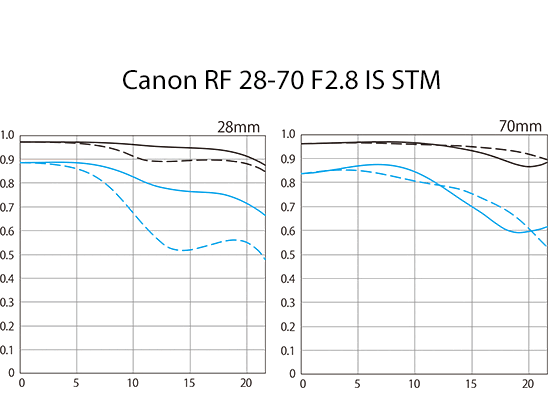
As we can see, the blue lines indicate resolution, and if anything, 70mm should have been better than 28mm.
I'll be curious to see other reviews that scientifically break down the resolution, but that doesn't seem to be true for the Canon RF 28-70mm F2.8 IS STM.
Usually, the MTF is similar to real-life results, and in this case, it's not. This could also indicate a problematic QA lens, so if you buy one, make sure you check it at 70mm quickly.
Addendum: ePhotoZine
ePhotoZine (thanks Alan) also plots out the MTFs of lenses in a methodological manner, and we see quite different results from their copy of the lens, especially at 70mm.
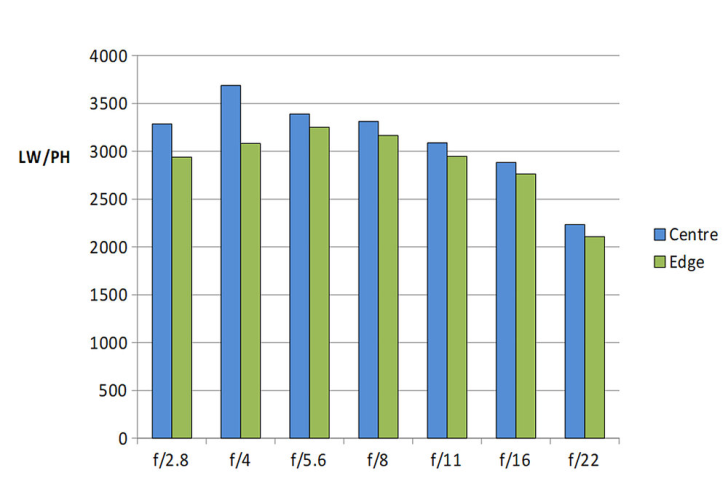
ePhotoZine shows more of what I would expect from this lens when we compare this result to what Canon's supplied MTF graph indicates. Because of this lens sample variation, ePhotoZine's review of the lens is much more positive than OpticalLimits.
There are many different steps in shipping the lenses from Canon's factories, but other reviewers, such as the Digital Picture, have also had mixed results with this lens. While it's been a while since we've seen significant sample variation, here we are.
This is a fantastic lens, and once its price settles down, it will be a great travel lens for those looking for something fast. However, I recommend that prospective purchasers purchase from reputable companies with a good track record on returns and check out your lens after purchase.
Source: Optical Limits



As a quantitative experimentalist, I would never rely on one set of measurements. There is such a thing as statistics, which translates to copy variation.
Here's ephotozine's summary:
Canon RF 28-70mm f/2.8 IS STM Performance
At 28mm central sharpness is excellent from f/2.8 to f/8, very good at f/11 and f/16 and good at f/22. The edges are good from f/2.8 to f/5.6, very good at f/8 and f/11, good at f/16 and fair at f/22. Clearly this favours the centre of the image and the best overall apertures will be f/8-f/11.
At 50mm, central sharpness is very good at f/2.8, excellent at f/4, very good from f/5.6 to f/16 and good at f/22. The edges are very good at f/2.8, excellent at f/4, very good from f/5.6 to f/16 and fair at f/22.
At 70mm, central sharpness is very good at f/2.8, excellent at f/4, very good from f/5.6 to f/16 and good at f/22. The edges are very good from f/2.8 right the way through to f/16 and just fair at f/22.
The longer focal lengths clearly even out the sharpness and the standard overall is very satisfactory.
I don't feel hosed paying full price, but once these hit $899 or so, that'll be great value.
For some, everything is fine, for others, weak corners at 28mm, sharp at 70mm or just the opposite.
I hope Canon manage to sort this out, because this lens has potential.
Presently, I find it risky to buy it.
I used to rely on Gordon Laing's reviews. Unfortunately, they are no longer helpful since he has only previews (named "so-far") of all the latest Canon lenses.
I particularly liked his real pictures, instead of charts. A better method, in my opinion, to assess a lens' sharpness than charts or graphs.
After all, we use lenses to take real pictures...
Does anyone perchance know what happened to his full length reviews?
Klaus values the excellent quality at the wide to mid range, the quick AF and the compact design, and I agree.
However, he pans the edge and corner quality at 70mm, but I certainly don't see such a difference between 40 and 70 mm in my testing as I would call them close to equal. There is the unfortunate issue of lens variation, which is what I have seen in different copies of the RF 24-105/4 L, the RF 50/1.8 and the RF 16/2.8. Its a pity that his tests of the RF 24-70/2.8 and RF 24-105/4 are on the 30MP R and so not directly comparable as I have found the 28-70 to be at least similar, but usually noticeably better than the 24-105 at similar focal lengths, apertures and points in the frame.
He criticises the retractable lens design, while also appreciating the compact size of the lens. I like the small size and don't mind having to extend it to take photos, but I can't understand why some functions such as changing modes or shutter speeds are not available when the lens is retracted. He criticises auto-correction, but this enables the compact size that he praises and as far as I am concerned, its the quality of the image that matters. This lens has much less astigmatism, which is impossible to correct in astrophotography compared to distortion correction.
Elsewhere he comments that "The build quality is otherwise fine, although more in line to what you’d expect from a consumer-grade lens". Well, the inner tube wobbles less than the RF 24-105, and given the decentering issue I had with that lens, I rate the build quality of the 28-70 at least as good, if not better. He notes "There’s even some degree of weather sealing.". The lens rings appear to have the same gaskets at the 28-70/2.0, but the switches might not sealed.
James Reader did a comprehensive test of the RF 28-70/2.8, with the RF 28-70/2.0L, the RF 24-70/2.8L and the RF 24-105/4L. The little lens was similar and often better than the first two of these lenses and waaayyy better than the RF 24-105/4L. I downloaded his raw files and made the comparisons myself and concur with his findings.
So something is up with the performance at 70mm of his lens. What distance do Kalus and Chris Frost test their lenses at? James' were close to infinity. I agree that the differences are otherwise explained by sample variation.
I knew i was forgetting someone else that did MTF's.
One photographer's opinion will never convince me... 🙂
That's why we all miss 😢 Roger's MTF testing several lenses.