
When you purchase through links on our site, we may earn an affiliate commission. Here's how it works. |
New lens patents
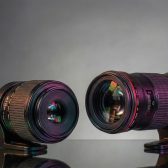
A new patent showing two lenses, the 135 f/2.8 and 180 f/3.5 has appeared. The interesting part of these patents is something called a apodization filter on the lenses. This improves the bokeh performance of the lenses.

Could either of these lens patents translate into a new 135 f/2L or 180 f/3.5L Macro? Only time will tell.
Read more after the break…
Patent Publication No. 2012-128151
- 2012.7.5 Release Date
- 2010.12.15 filing date
Example 1
- 137.2mm – f = 135.0 focal length
- Fno 2.83 -. 3.90
- 9.1 deg half each painting.
- Image height 21.60mm
- 186.7mm – 150.0 full-length lens
- BF 47.4 – 80.7mm
- Lens Construction 10 elements in 7 groups sheet
- 1 UD glass sheet
- 0.25 times the maximum magnification ratio
Example 6
- 179.1mm – f = 180.0 focal length
- Fno 3.50 -. 4.00
- 6.9 deg half each painting.
- Image height 21.60mm
- 218.0mm – 199.8 full-length lens
- BF 70.0 – 89.8mm
- Lens Construction 11 elements in 7 groups sheet
- 1 UD glass sheet
- 0.11 times the maximum magnification ratio
Appearance of (Bokeh) is important out of focus
Apodization filter
- The periphery of the filter transmittance is reduced
- Added to the luminous flux intensity distribution
- Bokeh is beautiful and the outline of the
Apodization element variable
- If the liquid of same refractive index as the shape of the interface, no variation occurs in aberration
- To be the same refractive power of the two liquids, the Abbe number is difficult
Canon ‘s patented
- Variable element shape
- Voltage is applied, changing the shape of the interface
- Obtain the effect of apodization
- Varying refractive power, the Abbe number
- To reduce the time variable aberrations of shape
- By a twist of the material performed, to optimize the absorption coefficient, to suppress the generation of aberration to moderate the curvature of the interface
- To reverse the two materials (such as liquid), the amount of chromatic aberration, do the negation
- Suppress the two materials (such as liquid), refractive index, the difference between the Abbe number
- The entire feeding (with floating)
Source: [EG]
cr