


When you purchase through links on our site, we may earn an affiliate commission. Here’s how it works. |
Photonstophotos dropped a new camera into its analysis, and to be honest, the results surprised me a bit. Now, if you weren’t aware, the V1 has a slightly larger than Micro Four Thirds sensor. I expected the PowerShot V1 to fare worse than Canon’s own APS-C sensors because of the higher pixel density and the more compact nature of the camera with an integrated lens. What is evident is that this new sensor, and the related camera, is a far better compact camera in terms of image quality than Canon has ever done in the past, and pretty close to the results you’d see from Canon’s APS-C sensors. That’s pretty impressive.
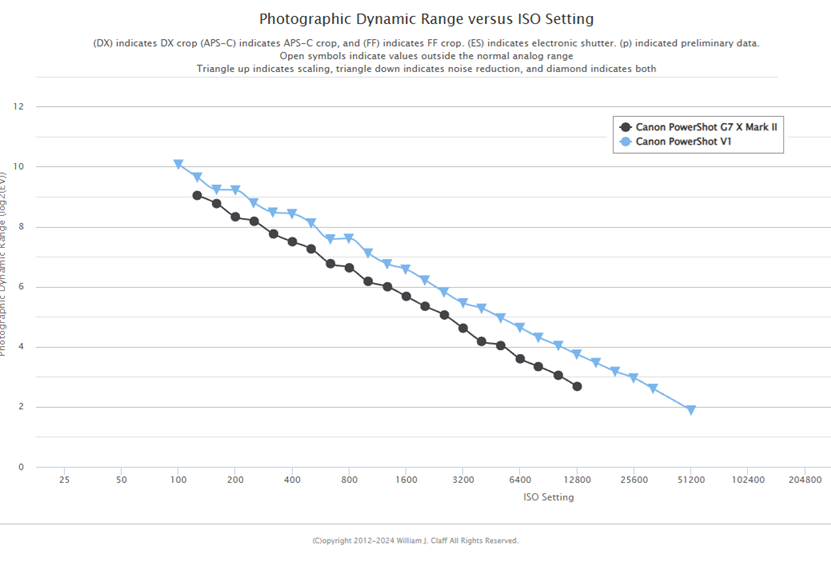
Compared to the PowerShot G7X Mark II
If we look at Canon’s last G7X variant, the Canon G7X Mark II, we see a pretty clear improvement in dynamic range. Somewhere across the internet, there is a Canon G7X Mark II reseller trying to foist a used G7X Mark II for $1500, now shedding tears.
Compared to the Canon R50
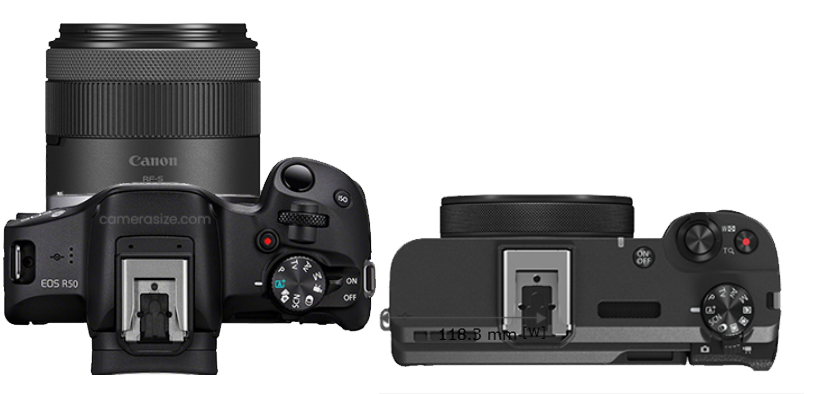
The Powershot V1 is near parity with APS-C sensors from Canon’s own R50 and the like.

The R50 is a bit better than the V1 still, and that’s due to the fact that the R50 has slightly increased pixel efficiency because the density is lower. However, in real life, you aren’t going to notice the difference in .5 EV. But what you will see, though, is the difference in size.
Also, one thing to note is that the Powershot V1 has active cooling as well, so as your camera’s sensor gets warmer, its dynamic range and high ISO noise will increase – this should actually be less of a problem for the V1 than a mirrorless ILC such as the R50, and also far less of a problem than Canon’s prior PowerShots.
Compared to the Sony ZV-1
Now, to be fair to the ZV-1 here, that sensor is much smaller than the PowerShot V1’s – as it’s only a 1″ sensor, versus the V1’s 1.4″ sensor. That all being said, Sony certainly had the choice of putting a larger Micro Four Thirds sensor in the camera, and chose not to.
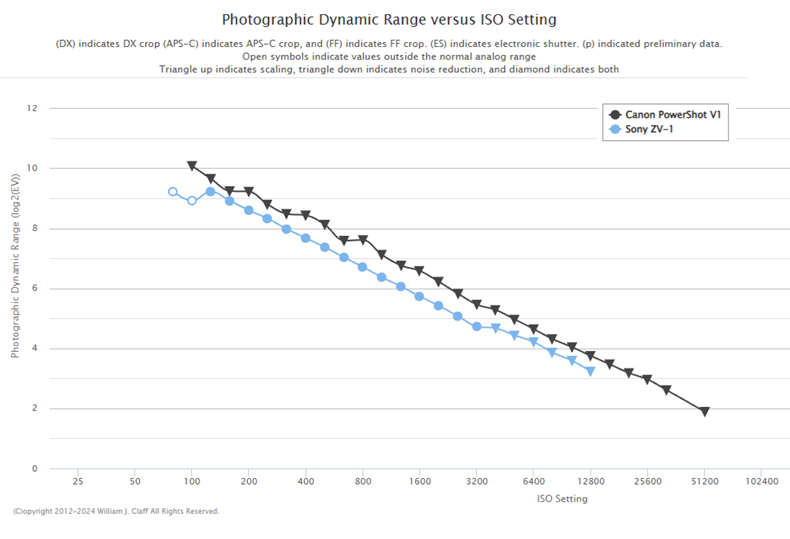
It used to be where Canon played second fiddle and had to rely on its much superior color science and menu system to be competitive, but now that this is no longer the case. Now, not only does the V1 have excellent dynamic range, but it also has excellent color science and menus. Yes, I know you aren’t going to notice the dynamic range difference between these two cameras, but it never used to be the good guys on top – especially with compact cameras.
The Noise Reduction
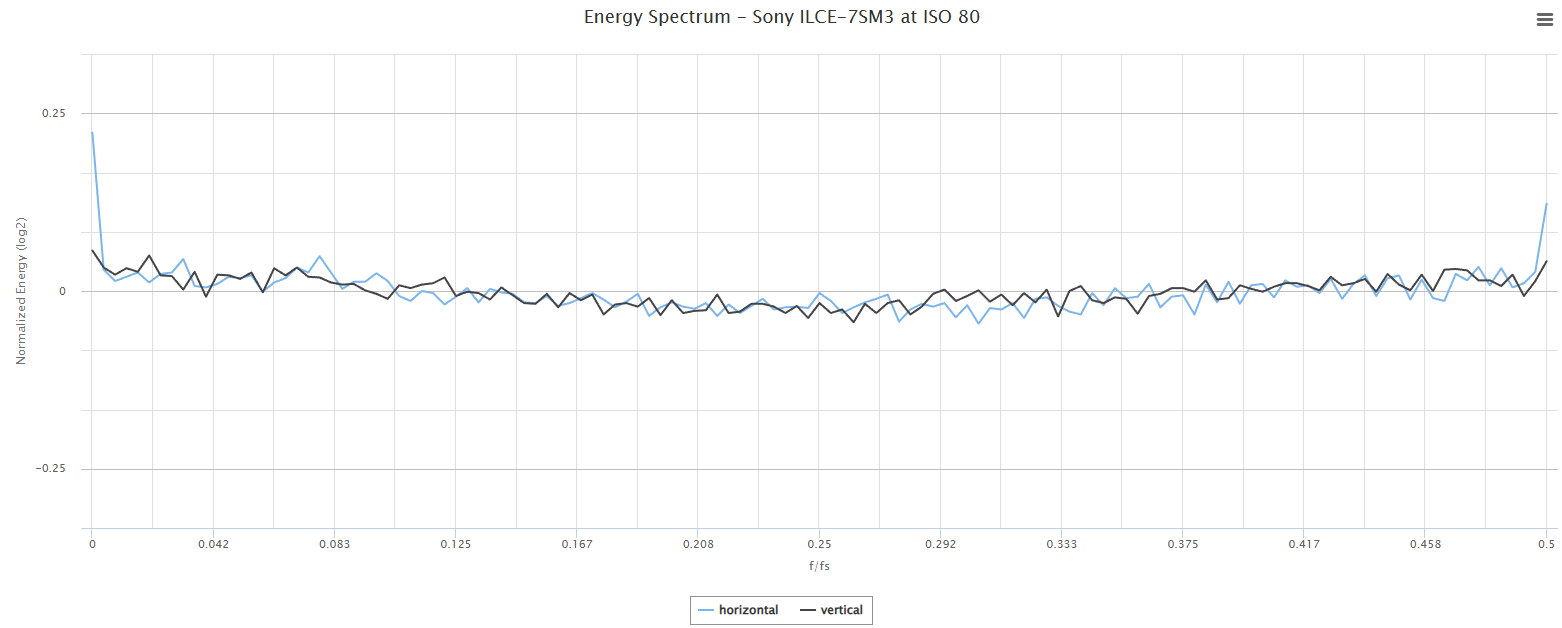
I know some will suggest that Canon is doing noise smoothing and reduction, which is why you see the triangles with the V1; however, that’s never been a definitively proven scenario, and could have more to do with the fact that the sensor is dual pixel and requires some image processing in the image pipeline, versus a deliberate occurrence of noise reduction to boost DR values.
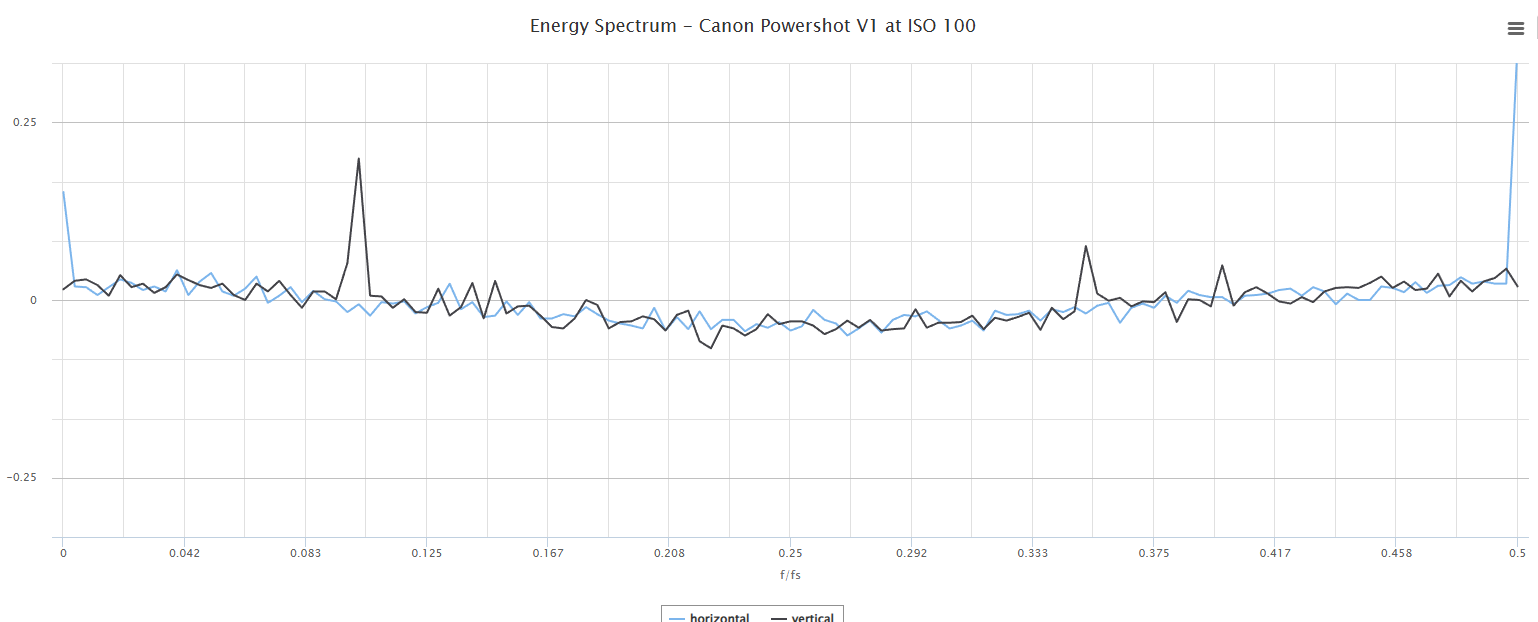
If we look at the “dip” in the energy spectrum, we see something similar to Canon’s other DPAF CMOS II generation sensors. If anything, this dip in the center is actually less than that of other DPAF sensors in the past, such as the Canon EOS R5. For instance, even the Sony A7S Mark III exhibits something similar, making it most likely that the influence of phase detection and quad pixels may have a difference in the overall energy spectra, and not be done by manufacturers to hide their poor sensor designs.
Closing Thoughts
This is good news for those on the fence on the PowerShot V1, and shows that Canon can now domestically make sensors that are competitive with the best smaller sensors on the market today. Canon has taken incredible strides with its sensor development. It should be noted that, as of the time of this writing, Canon Japan has stated this is a 1.4-inch CMOS sensor. They haven’t labelled this as a BSI-CMOS, and all I can find is less reliable websites saying it’s BSI. So it’s likely that this sensor isn’t even back-side illuminated and already almost as good as its back-side illuminated near peers.
Diverting off track, this really does not surprise me at all. Canon spent a decade or more honing its sensors with very large lithography structures, tweaking the maximum efficiency out of 180nm and 120nm design rules with blood, sweat, and tears. Then, when the smaller design rules were ready and new sensor lines fabricated, they took that institutional knowledge, IP, and experience down to under 100nm and can now produce more efficient sensors than other companies’ back-side illuminated ones.
This is, of course, why no one talks about DR as being a problem, and they’ve all moved over to my favorite topic, third-party lenses for mirrorless cameras, and of course, the legendary R100.
Many thanks go to Bill for getting this information out to the community, and we look forward to the R50V and R6 Mark III showing up in the results soon.





Your central thesis that dynamic range is proportional to pixel density is a very common misconception. Dynamic range is proportional to sensor area, not pixel size (pixel density). This is made quite clear on the photonstophotos site in the Notes under the graph he plots of dynamic range vs sensor area. https://www.photonstophotos.net/Charts/PDR_Area_scatter.htm
"Notes:
Photographic Dynamic Range increases as sensor area increases.
This is because the Signal to Noise Ratio (SNR) increases roughly by the square root of area.
Therefore the x-axis on this chart is the square root of the sensor area.
Note that pixel size does not enter into this relationship."
The dynamic range of the V1 sensor is what you expect from that relationship. The V1 sensor 18.4mm x12.3mm = 226mm^2, the R7 22.3mm x 14.9mm = 332mm^2, and FF = 36mm x 24mm = 864mm^2. The photonstophotos plot of the dynamic ranges of the V1, R7 and R5 fits nicely to that pattern