


When you purchase through links on our site, we may earn an affiliate commission. Here's how it works. |
Some internet chatter has been circulating; it's a good idea to address it here. The rumors suggest that Canon will make a soft announcement sometime between now and September 15th. This would lead Canon to place the R6 Mark III in the announcement stream just before the IBC conference (International Broadcasting Convention), which usually covers cinema cameras more than stills.
While Canon may make more than one announcement in the coming two weeks, the R6 Mark II is one of Canon's most popular cameras. I would think that they want its successor to occupy its own media coverage space without a lot of unnecessary distractions. However, it's Canon, and at times, my common sense does not apply.
Canon Europe has now posted a teaser for September 9th at 2 PM BST / 3 PM CEST. However, they show a cinema camera and not the R6 Mark III. It's unknown if the R6 Mark III will be announced at the same event.
The R6 Mark III Sensor
Jan discusses the R6 in his video (see link below) and comments on it being a non-stacked sensor. As I've discussed in the past regarding Canon's faster sensors in the R1 and R5 Mark II, there's a price to pay for speed, which typically involves a slight reduction in dynamic range and an increase in noise. Would this impact you in the real world? Not really, but it's there and measurable. I think in either case, Canon will work hard on making the sensor quick enough for electronic shutter – even if it's not as fast as a pure stacked sensor.
While speed for electronic shutters is always a key aspect we usually discuss in terms of stacked sensors, there's more to it than just the ability to read the sensor to eliminate rolling shutter distortion. A stacked sensor with a faster readout speed can also calculate auto focus from the dual pixel sensor more quickly. A stacked sensor may even include some autofocus logic right on the sensor itself.
So there are trade-offs, and the slight disadvantage of image quality versus faster readout speed is offset by other benefits, even if you don't shoot any video or use the electronic shutter. Jan also mentions a resolution increase, which we had also been told was around 30 to 32 megapixels.
There appears to have been considerable fluctuation in rumors regarding the actual nature of this sensor. Canon may have changed its mind on this camera multiple times, which may be the reason for the conflicting reports. I recall a time in the past when Canon and Nikon were competing – Canon would develop more than one version of a camera and wait to see what Nikon did, then decide which one to release. Whether that was true or simply an internet myth, it sounds reasonable for a company of Canon's size.
However, please note that this is intended to be the more affordable of the two bodies, the R5 Mark II and the R6 Mark III. So we shouldn't necessarily expect to get all the features from the R5 Mark II and the R3 in a smaller and less expensive camera body – I think it's perfectly reasonable for Canon to put in a lesser performing sensor as long as it performs adequately for the tasks in which the R6 Mark III is supposed to handle.
What ergonomics will the R6 Mark II have?
In terms of body and handling, I think Canon has solidified its ergonomic layout, and I expect it to be very similar to the R6 Mark II.
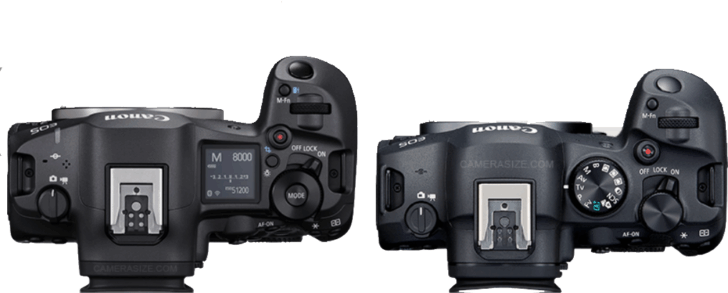
Let's examine the R6 Mark II and the R5 Mark II, both of which are shown above. You can see where Canon has ergonomically kept the power, Record, Movie/Still, and m-Fn buttons in the same place to aid in muscle memory switching between the two cameras. The R5 and the R6 were radically different than the R6 Mark II and R5 Mark II. With the R5 Mark II just a little over a year old at this time, I wouldn't expect much deviation.
The other details on the R6 Mark III remain fairly sketchy, but we hope to have more information this week from some of our sources that shall not be named. Stay tuned!







I want to see AF and sensor performance asap 😉
Still, I very pleased with my Mk II. Won't be an instant buyer.
Only if the leap is big enough.
So, what will go into the R6iii? What will go into the also upcoming A7v?
Nikon ZR coming soon too, supposed to compete with the FX2 or FX3 but with the Z6iii/S1ii sensor. Mini-cine style body like the FX3/30/2.
A7Siv/FX3ii should be along sometime soonish too, probably with the Z6iii/S1ii sensor. Hopefully with a better implementation.
R7ii coming sometime probably early next year.
Lots of interesting cameras coming to market.
Mine are covered with 3M's strongest duct tape. And I hate having to do this to Euro 4000+ cameras.
- YouTube
Canon to announce a new entry level cinema camera on September 9th (Canon EOS RC?)
Looks like the next model in line to be announced is the EOS C50
- YouTube
In the end, confirmed to be 32MP, so it may be the R6 III sensor.
For R6 MK3 I would love to have a top LCD like the R5 line to have a consistent layout with things changing only internally but I'm pretty sure they will not add it... Which is disappointing because with a 3000€ budget you will have to decide between a R5 MK1 with big EVF + top LCD + 45 mp vs a R6 MK3 with better AF and (hopefully) new tilt screen.
And the first camera that would combine these external characteristics would be the R5 MK3 in 2028-2029...
4K 120 fps would be nice too.
I'll probably pass on the R6iii if the sensor isn't substantially faster read out than my R6ii and carry on saving for an R1 and even if it is stacked I might skip it.
I told it to wait until the R6 Mark III becomes available.
We're both impatient!
Tough I wonder if I would not prefer a R5 MK1 for a similar price.
30MP and stacked 😍 😵 ;P....
After the 5D III, I never bought and never will buy a camera without this feature. Good for Canon, since it made me buy a second R5 II instead of an R6 II or III.
😏
I can’t say I find the top screen useful on the mirrorless cameras. Rear screen gives far more information and is easier to read. It was useful on the dslrs
I use it all the time, I always have the screen turned around.
Yes