


When you purchase through links on our site, we may earn an affiliate commission. Here’s how it works. |
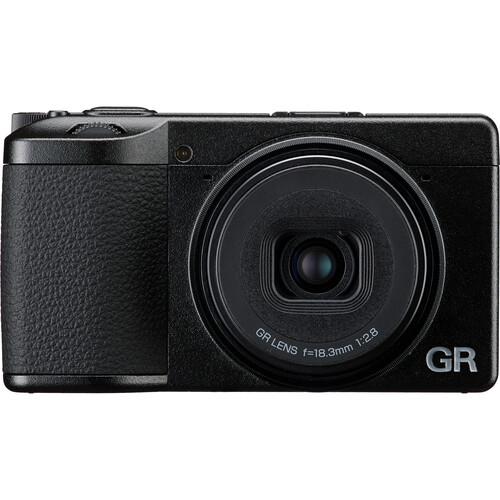
Ricoh has introduced the RICOH GR IV HDF as a new version of its premium compact camera line, which extends the recently launched standard GR IV model. The model maintains all essential features from the GR IV, which include its 25.7-megapixel APS-C sensor, 28mm-equivalent f/2.8 lens, 5-axis image stabilization, 3-inch LCD, and excellent image quality. The GR IV also boasts quick automatic shooting and a compact, small design.
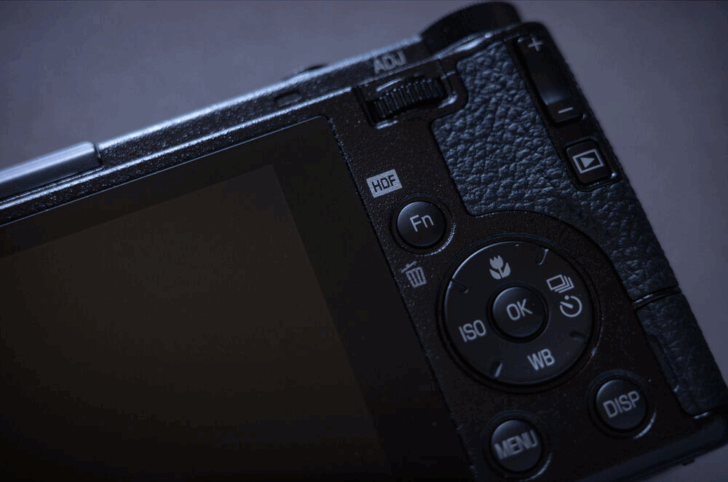
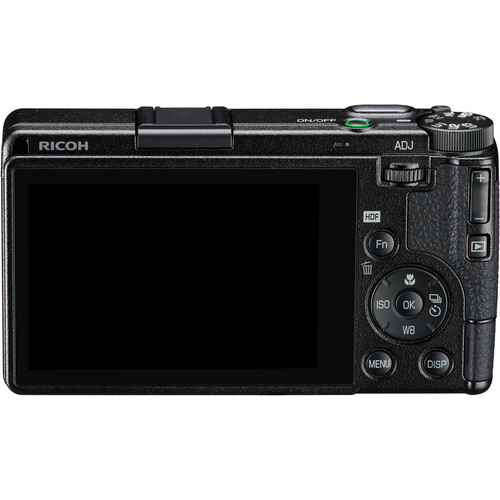
The HDF means Highlight Diffusion Filter (HDF), which Ricoh developed as a unique feature that produces a soft highlight effect, creating a warm diffused look that resembles vintage film or cinematic styles. The filter operates through a dedicated Fn button, which enables users to turn the filter on or off for immediate access to high-contrast images and soft emotional effects without needing post-processing or external filters. The HDF model features a built-in diffusion capability, rather than the standard GR IV neutral density (ND) filter.
The system brings a new high-speed electronic shutter, which operates at 1/16,000 second to allow photographers to use larger apertures when shooting in bright environments. The standard GR IV will receive this update through a firmware release.
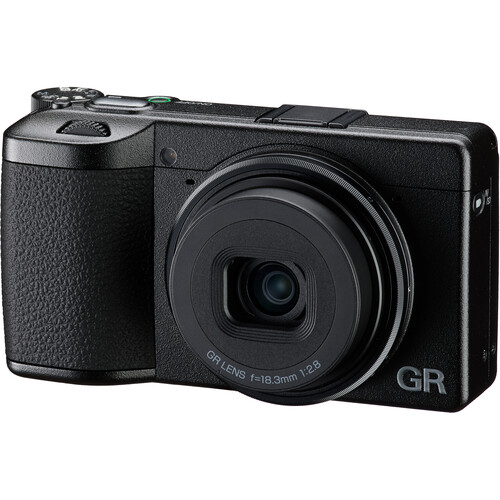
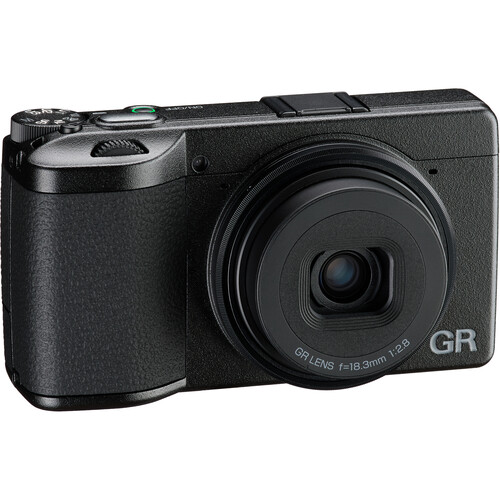
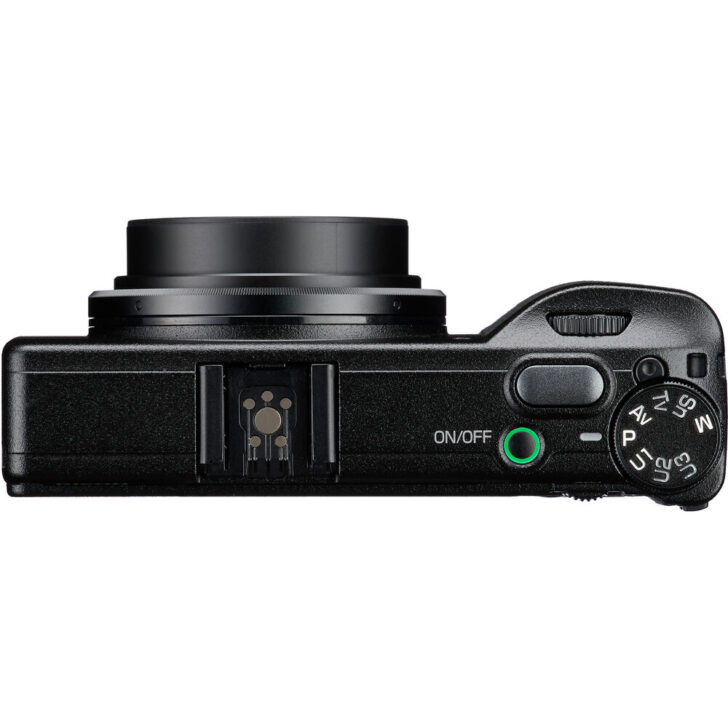
The grayish-silver shutter button on this model differs from the all-black standard model shutter button. The Fn button area features minimal branding, which distinguishes this model from others. Ricoh demonstrates how vintage film-like effects have become more popular while showing the GR IV HDF as a creative camera for street and everyday photographers who want to achieve a more nostalgic tone for their photography.
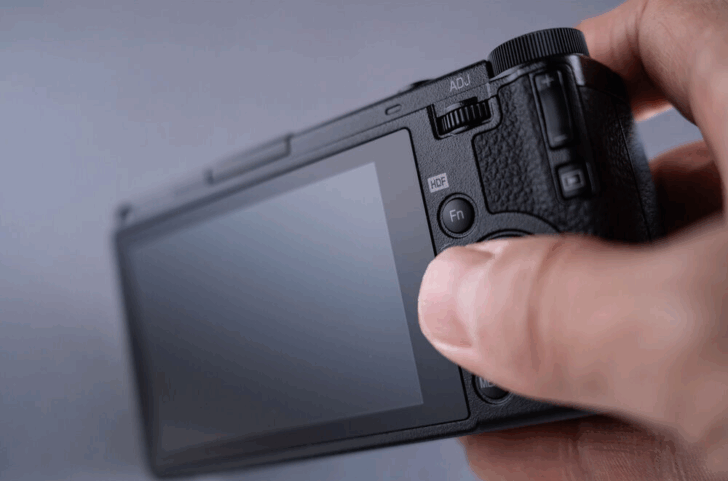
The new GS-4 finger strap accessory provides optional comfort enhancement for users who want to carry their GR IV cameras.
The camera is available for preorder with delivery scheduled for January 2026. You can pre-order the camera through participating retailers such as B&H Photo.
Key Features
- Built-in Highlight Diffusion Filter
- 25.7MP APS-C BSI CMOS Sensor
- New 28mm f/2.8 Lens (Full-Frame Equiv.)
- Improved AF and Low-Light Focusing
- 5-Axis 6-Stop Shake Reduction System
- 3.0″ 1.04m-Dot Touchscreen LCD
- 53GB Built-In Memory & microSD Card Slot
- Full HD 1080/60p Video Recording
- Snap Distance Priority & Focus Limiter
- GR WORLD App for Updates and Control
Pre-Order
B&H Photo – Ricoh GR IV HDF Digital Camera – $1596.95
Foto Erhardt – Rich GR IV HDF Digital Camera – 1449.99€
Press Release
RICOH launches RICOH GR IV HDF
Highlight Diffusion Filter softens light sources and diffuses highlights for more expressive images
PARSIPPANY, NJ, December 16, 2025 — Ricoh Imaging Americas Corporation today announced the launch of the RICOH GR IV HDF. Based on the RICOH GR IV premium digital compact camera, this new model incorporates an HDF (Highlight Diffusion Filter) designed to deliver a mellow, diffused expression with a single-action control.
While inheriting the fundamental merits of the GR IV base model – exceptional image quality, flawless point-and-shoot operation, and outstanding portability – this new model also incorporates the RICOH-original HDF(Highlight Diffusion Filter), enabling the user to capture mellow, soft images with diffused highlight areas, in addition to the clear, sharply focused images made famous by its base model. This creative versatility expands the visual expression boundaries of snapshot photography.
The RICOH GR IV HDF is scheduled to be showcased at GR SPACE in Tokyo, Shanghai, Beijing and Brisbane beginning on Wednesday, December 17, 2025; in each of these locations, visitors can try out this new model firsthand.
| Pricing and Availability |
The RICOH GR IV HDF will be available late January at www.us.ricoh-imaging.com as well as at Ricoh Imaging-authorized retail outlets nationwide for a manufacturer’s suggested retail price of $1,599.95.
| Main features of the new RICOH GR IV HDF |
- Single-action switching to the built-in HDF, to create mellow, soft images
The GR IV HDF incorporates the RICOH-original HDF (Highlight Diffusion Filter), which is designed to emphasize highlights and produce mellow, soft images. Developed by taking advantage of the advanced inkjet technology RICOH has cultivated over the years, this special-effect filter diffuses highlight areas and creates a blurred effect along the image’s edges, making it possible to capture nostalgic images resembling those captured in film photography or movies. Since the HDF can be instantly switched on and off with a single action, it lets the user alternate between two completely different visual expressions — clear, sharply focused images representative of the RICOH GR series, and mellow, soft images captured by the HDF —depending on the subject or creative intention.
Note: The development process of the HDF is explained in greater detail in the technologies section of the official RICOH website.
- High-speed electronic shutter with a top speed of 1/16,000 second for shooting at extremely bright locations
In addition to a conventional mechanical shutter unit, the GR IV HDF also features an electronically controlled shutter mechanism*, which allows the user to intentionally raise the shutter speed up to 1/16,000 second, making it possible to capture images at extremely bright locations while still setting a larger aperture.
* This mechanism can also be installed on the RICOH GR IV using new function expansion firmware (scheduled to be released following the launch of the RICOH GR IV HDF).
The color of the shutter-release button has been changed from the GR IV’s black to grayish silver, to symbolize the camera’s ability to instantly shift the image’s visual expression. The default setting of the Fn (Function) button is set to the on/off action of the HDF.*
* The default setting of the Fn button can be changed to other functions.
Note: All other functions of the RICOH GR IV HDF are identical to those of the RICOH GR IV, except for the availability of the ND (Neutral Density) filter.
Image Gallery
Pre-Order
B&H Photo – Ricoh GR IV HDF Digital Camera – $1596.95





As far as DOF goes, yes.
DOF matches f/4.5 on FF, but light gathering is the same as f/2.8 FF (exposure triangle doesn't change). It's not easy to really understand this, I had to douple check multiple times with my cameras 😀
this is the way I think about it as well. it only really matters for DoF or if you are comparing the physical size / cost of a lens across different formats.
It’s not true that ‘light gathering is the same’. Light gathering is a function of the size of the iris diaphragm, not the f/number. The lens on the Ricoh GR IV gathers the amount of light of an 18.3mm f/2.8 lens, not a 28mm f/2.8 lens. The latter would have a larger iris diaphragm and gather more total light.
Exposure is a function of the light intensity (per unit area), and that is proportional to f/number. Also, even though the exposure triangle doesn’t change, image noise at the same ISO setting is higher with a smaller sensor. There’s no free lunch.
For most applications it boils down to less DOF and more noise, while comparing FF-equivalent focal lengths and a certain aperture value.
I think this is the mechanism that keeps medium format in the niche it is, because while there are very bright hand-holdable FF lenses, medium format lenses are relatively slow and can't exploit the much larger sensor sizeLet's not start that tangent here 😀