

When you purchase through links on our site, we may earn an affiliate commission. Here's how it works. |
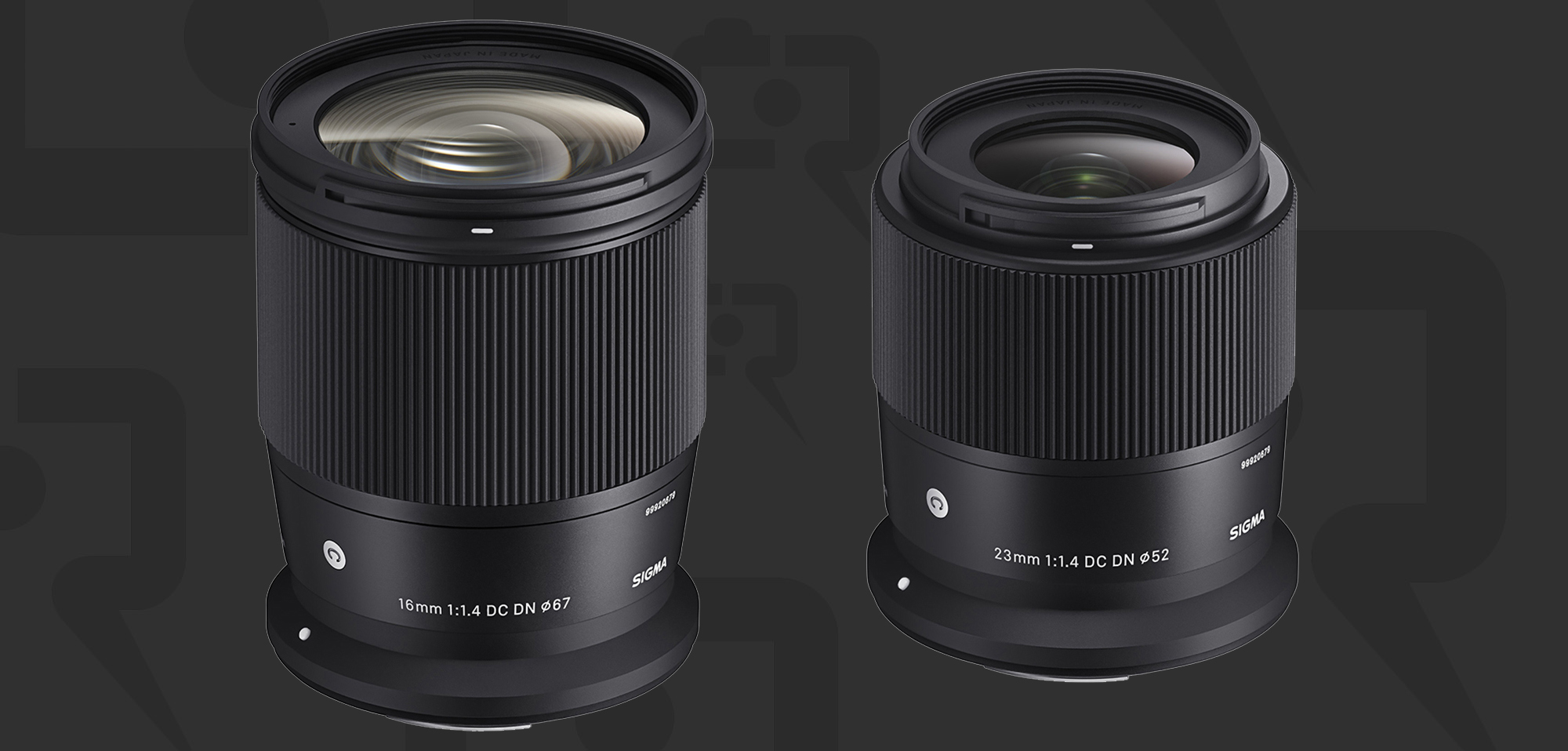
Sigma has announced that the two wide-angle primes, the 16mm f/1.4 DC DN Contemporary and the 23mm f1.4 DC DN Contemporary for RF APS-C will begin shipping on January 23, 2025.
This will complete the initially announced Sigma lenses for the RF mount. I hope that we will hear of further upcoming Sigma lenses for the RF mount, including some of their full-frame offerings this year.
Sigma 16mm F/1.4 DC DN Contemporary
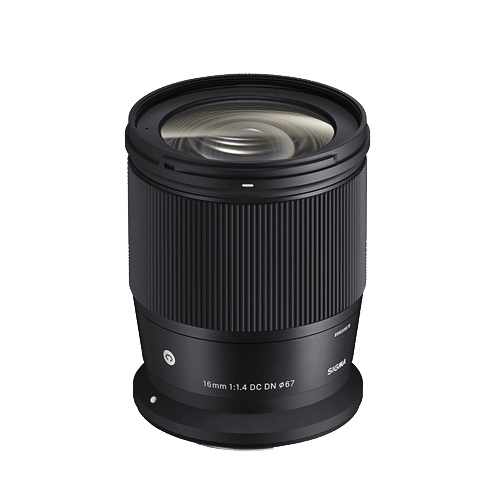
- APS-C | f/1.4 to f/16
- 25.6mm (Full-Frame Equivalent)
- Rounded 9-Blade Diaphragm
- Stepping Motor AF System
- Super Multi-Layer Coating
- Two Aspherical Elements
- Two SLD Elements, Three FLD Elements
- Weather-Sealed Construction
Sigma 23mm F/1.4 DC DN Contemporary
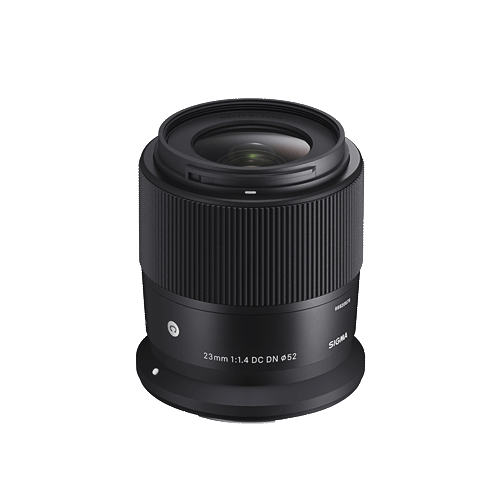
- APS-C Format | f/1.4 to f/16
- 37mm (Full-Frame Equivalent)
- Excellent Low-Light Performance
- Fast Internal Focus System
- Rounded 9-Blade Diaphragm
- Dust & Splash-Resistant Design
Press Release
Sigma Corporation (CEO: Kazuto Yamaki) is pleased to announce the release dates for the SIGMA 16mm F1.4 DC DN | Contemporary and SIGMA 23mm F1.4 DC DN | Contemporary, F1.4 prime lenses for Canon RF mount, which were previously announced to be released in January on November 19th.
Release date: January 23, 2025
SIGMA 16mm F1.4 DC DN | Contemporary Overview
- Suggested retail price (tax included): Open price
- Accessories: Flower-shaped hood (LH716-01), front cap (LCF-67 III), rear cap (LCR II)
- Mount: For Canon RF mount
- Product page: SIGMA 16mm F1.4 DC DN | Contemporary
Combining a comfortable wide-angle design with an ultra-fast maximum aperture, the 16mm f/1.4 DC DN is part of Sigma's Contemporary series of lenses and designed for use with Canon RF-mount mirrorless cameras.
Characterized by its bright f/1.4 maximum aperture, this lens is adept at working in low-light conditions and also affords increased control over depth of field for selective focus control. The optical design makes use of several low dispersion and aspherical elements, which control color fringing and various aberrations in order to provide high sharpness and clarity throughout the aperture range.
Individual elements also feature a super multilayered coating to suppress flare and ghosting for greater contrast and color fidelity when working in strong lighting conditions. Benefitting the optical assets, this lens also sports a stepping AF motor for quick, quiet, and smooth focusing performance that suits both still photography as well as video applications.
SIGMA 23mm F1.4 DC DN | Contemporary Overview
- Suggested retail price (tax included): Open price
- Accessories: Flower-shaped hood (LH554-01), front cap (LCF-52 III), rear cap (LCR II)
- Mount: For Canon RF mount
- Product page: SIGMA 23mm F1.4 DC DN | Contemporary
A fast-aperture wide-angle prime for APS-C-format mirrorless cameras, the Sigma 23mm f/1.4 DC DN Contemporary Lens provides a field of view equivalent to 35mm on a full-frame camera.
Offered here with a Canon RF-mount, this lens delivers high resolution along with beautiful bokeh effects thanks to its large f/1.4 maximum aperture.
An inner focus system with a stepping motor delivers fast and accurate autofocus for still and video use, and with a minimum focusing distance of 9.9″ the lens is well-suited for close-up photography and portraiture.





Features of the SIGMA lenses for Canon RF Mount include:
Aberration correction supported
The lenses will be fully compatible* with in-camera aberration correction, which includes corrections for peripheral illumination, chromatic aberrations and distortion. By matching corrections to the optical characteristics of the lens, this function takes image quality to an even higher level.
* Only when the camera is compatible.
SIGMA Introduces Lenses for Canon RF Mount: What You Need to Know
This is a big plus for JPG shooters. And we already know from reviews of these lenses in other mounts that they do not require extreme correction simply to fill the image circle.
Edit: as pointed out above, your reason for believing that is moot, you were wrong. I’m shocked. Not.
I don't want to disparage Mr. Frost, but in general I am always suspicious of selected reviewers who have access BEFORE delivery release.
Selected lenses could have been distributed, which I don't think is the case with Sigma.
That's really interesting because it suggests a much deeper integration between the camera and lens is being made possible than just what we were used to with focusing and metadata (focal length and aperature.) This might be part of the source of the delay (new IP rights to negoiate and protocol to implement.)
Having that, the same basic lens is used for Sony, Nikon, and Canon EF-M/RF (my bet is there's just a difference in the lens smarts.) There's no mention on SIgma's web page about this feature being on anything except RF. Sigma only publishes one MTF graph for this lens, not one per camera maker.
What that tells me is that Sigma can't cheat like Canon does because not only are the same corrections not supported elsewhere, Sony/Nikon have a bigger APS-C sensor than Canon which means the very extremes of the picture edges should be better than an equivalent priced Canon lens. Thus I reiterate that where Canon are cutting corners with light fallout in smaller lenses, Sigma can't afford to if it wants to benefit from lens reuse.
Yes, absolutely.
I wonder if Tamron will go a similar way.
It's been the norm for a decade, since before EOS R bodies and RF lenses even existed. From Canon Europe:
What does matter is differences in sensor cover glass design - thickness, microlenses. But my impression is that if this is a design criterion from the start, it's not too difficult to design lenses that can handle that variation gracefully as is, or with minor element spacing or other adjustments for the different mounts supported. If we have anyone around here with optical design experience I hope they can weigh in.
Correct. But if you want to sell your lens to owners of cameras that do not support in-camera correction then you need to provide a good image without the software correction happening - or at least I'd argue that it would be necessary. Different schools of thought on that I'm sure.
Imagine you're Sigma. You want to design a lens once that produces acceptable images on as many digital cameras as possible. Do you:
(a) crimp on the oprtical design because some digital cameras will do in-camera fixes to images
(b) produce an optical design that gives maximum benefit to all digital cameras
Note that (b) doesn't mean you can't supply lens correction data when supported by the camera.
If there are open standards, nobody talks about it in lens features, therefore assume proprietary
I'm going to say this once, so listen up (or not.)
Find a good psychologist, make an appointment, and start talking to them about your incesssent need to be hostile and insulting in public forums on the Internet where there's no requirement for either.
Stop worrying about other people and worry about yourself before you're on the 6'oclock news for all the wrong reasons.
It may be too late for this, but it's worth at least one shot.
This message will self destruct in 5... 4... 3... 2...
Agreed.
It would take a lot of effort by Sigma (or any other manufacturer) to deliver a better than average quality piece of equipment to a reviewer. That's not the problem. The problem for the public is do manufacturers want to go to the effort of supplying parts in advance if there's no commercial benefit in doing so.
History suggests you’ll fail at that, so it will surprise no one when you do.
You can also map the progress in processing power through the corrections, at first it was just vignetting correction in stills, then vignetting and distortion in stills, followed by DLO. Around the time Digic 8 came along movie mode could do corrections and with Digic X the camera can do everything both in stills and video.
As for being part of the protocol, I suspect Canon reserved a few "ask lens for data" options in the protocol and started implementing specific functions for that much, much later. Like the ability to update the lens firmware from the body in 2012!