

When you purchase through links on our site, we may earn an affiliate commission. Here’s how it works. |
This is a subject that will drive Craig bonkers, so naturally I have to write it ;)
With the official release of the Tamron 18-300mm F3.5-6.3 Di III-A VC VXD, we seem to have a complement of super zooms from Sigma and now Tamron to look at.
Why use a Super Zoom?
I have to admit, I loved the Canon EF-M 18-150mm lens – and I’ve never been a super zoom kind of guy, but it was a compact lens that was great for travel and I found a ton of cases that I would use either end of the zoom while out exploring a new city, or a new area. So while the purist in me says, thou shalt stick to primes with pristine resolution, a case can be made for super zooms.
What lenses are we comparing?
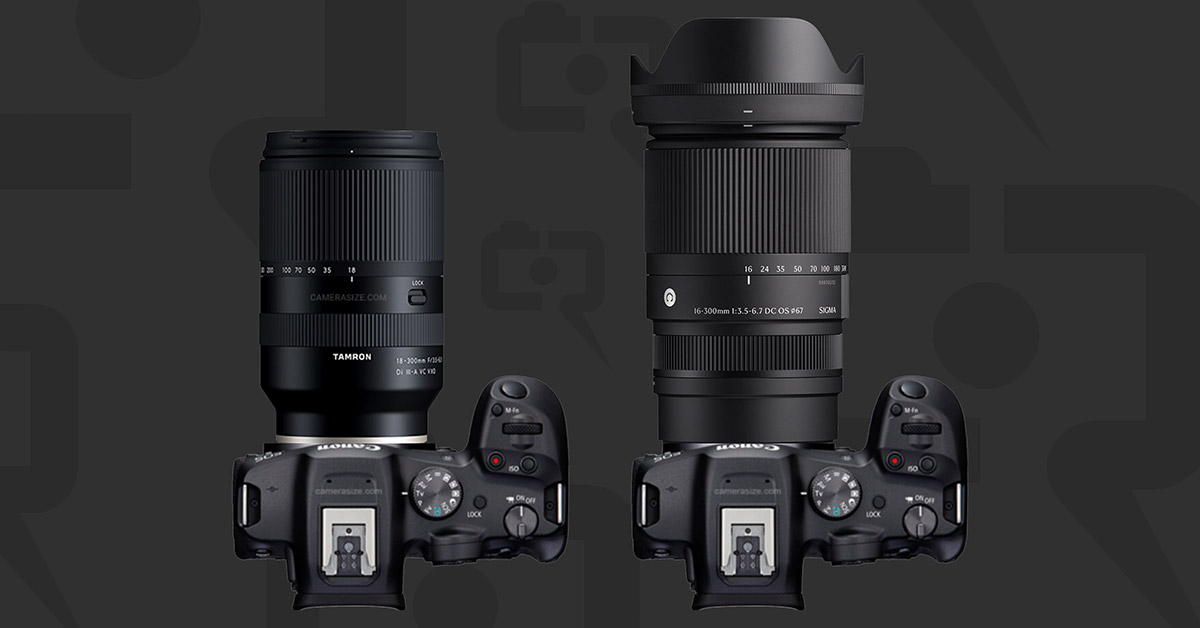
We will give an in-depth comparison of the Sigma 16-300mm F3.5-6.7 DC OS and the aforementioned Tamron 18-300mm F3.5-6.3 Di III-A VC VXD, the two new superzooms for the Canon RF mount specifically designed for APS-C cameras, as they are known for Canon, the “RF-S” mount.
The Super Zooms
Sigma 16-300mm F3.5-6.7 DC OS

The Sigma 16-300 is a very versatile super zoom, offering a wider field of view, even while having an 18.8 zoom ratio. On a Canon APS-C camera, this lens has a 25-480mm zoom range. Outside of perhaps ultra wide angle, this lens covers everything, including macro (close up photos) as the Sigma has a 1:2 Macro reproduction ratio. What this means is that if you have an object that is around the physical size of the sensor, it will be projected on the sensor in half its size. You can zoom in quite a bit with a 1:2 Macro reproduction ratio.
Now, as with all the lenses in this category, regardless of manufacturer, there are significant compromises to providing a substantial zoom ratio, and this lens is no exception. In terms of pure optical image quality, you are not going to get it with this lens. But is it good enough for smaller prints, digital picture frames, and social media? Absolutely.
The Sigma lens has one feature that stands out to me: it starts at 16mm. This, in my opinion, makes this a one-lens that can do everything if you are willing to compromise on image quality for convenience. I find that on Canon cameras and the 1.6x crop, 18mm (29mm effective focal length) isn’t wide enough for me; that extra 2mm on the wide end that takes it down to 25mm is quite drastic in terms of field of view. Someone took the time to do a visual difference between 16mm and 18 mm, so credit goes to boogisha of dpreview forums for the image.
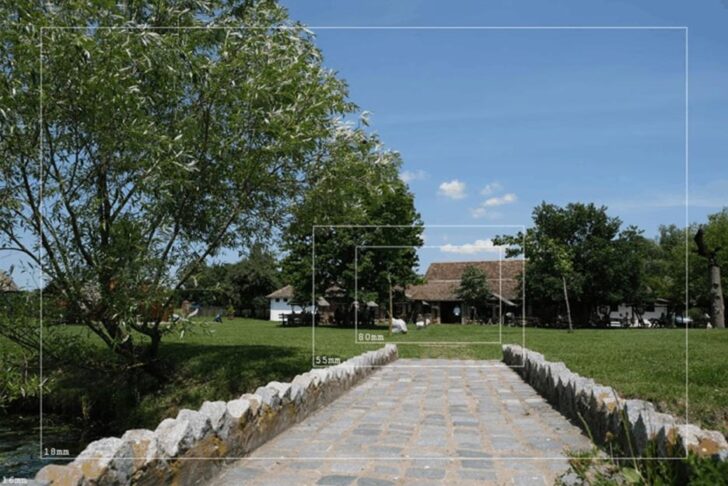
As you can see, the difference between 18mm and 16mm can be pretty dramatic. This is something the Sigma lens can do for you that the other two cannot. This, for me, is more important than reach. But everyone has different photography styles, so while you should keep this in mind, it’s not everyone’s preference.
[affiliatable id=’301180′]
Tamron 18-300mm F3.5-6.3 Di III-A VC VXD
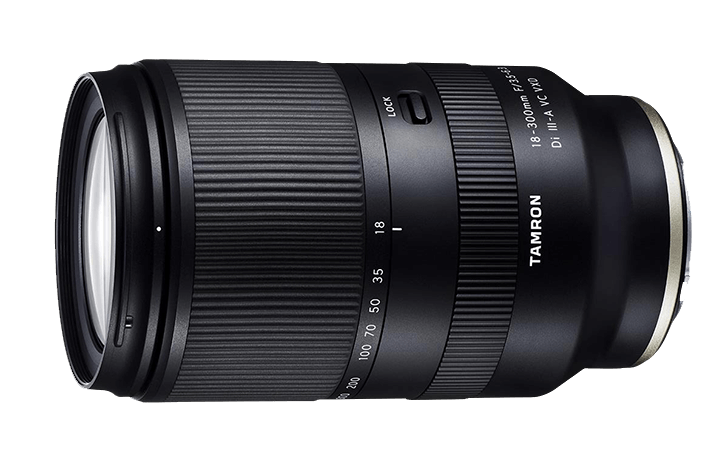
Tamron always wins the awards for the more complicated names for lenses. I think they take a special joy in creating the most tongue-twisting and brain-twisting names possible. Yes, I know, each thing means something, but still. I’m here for simple naming conventions. It’s a very clean-looking lens, and I always liked the Tamron colour scheme of off white near the base with a pure black lens.
This lens has a little less zoom ratio than the Sigma at 16.6x, and on a Canon APS-C camera, has an equivalent zoom range of 29mm to 480mm, which is still a very impressive zoom ratio. As with the Sigma lens, the Tamron has a maximum magnification of 1:2 reproduction ratio, allowing this lens to take close-up macro photographs easily.
Tamron also states that the construction of this lens is weather sealed, while the Sigma is dust and splash resistant, which usually signifies less sealing in the lens construction.
[affiliatable id=’306682′]
Lens Size Comparison
As you can see, the Tamron and Sigma are significantly heavier, and I’ve included the Canon RF-S 18-150mm as a reference to give you an idea of the size as compared to Canon’s smaller superzoom.
| Sigma 16-300mm | Tamron 18-300mm | Canon 18-150mm | |
| Lens Width | 2.9” / 73.8mm | 3” / 75.5mm | 2.7” / 68.6mm |
| Lens Length | 4.8” / 121.4mm | 4.9” / 123.6mm | 3.3” / 83.8mm |
| Weight | 22oz / 625g | 22oz / 625g | 10.9oz / 310g |
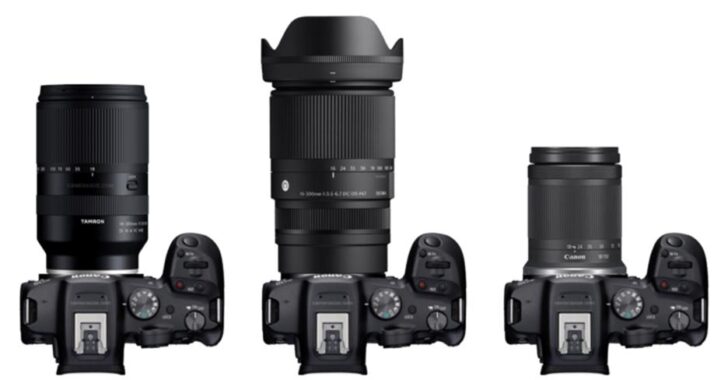
With lenses, there is no free lunch when it comes to providing a considerable focal length. The lens will take up more space to accommodate the optical elements inside the lens, and also the tubes to fully extend out to the telephoto. All this increases the size and also the weight of the lens.
Size or weight may be your most important consideration if you want a lens that you can travel with and have on you frequently; the difference in size and weight may be an issue that you need to consider. Between Sigma and Tamron, they are almost identical in both size and weight, to the point where I had to double-check that I was copying the correct information.
MTF Comparison
MTF means Modular Transfer Function, which probably sounds even more strange. Each lens manufacturer publishes the MTF graphs, and we can use these graphs to determine the quality of the resolution and contrast at the center and corners, and also make some educated guesses on the bokeh quality and astigmatism.
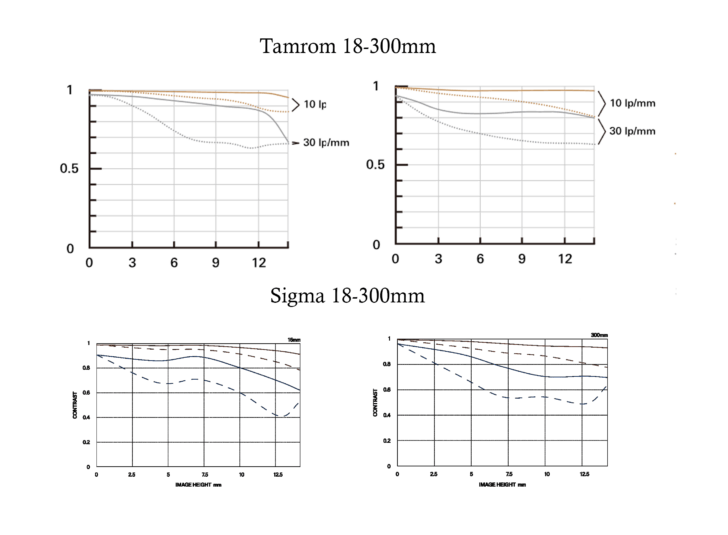
One note is that you have to take comparing MTF charts from two different vendors with a bit of salt, because they can vary in how they calculate the MTF charts. Some vendors will use actual lenses to plot the MTF charts; others will use computer simulations to derive the charts. However, it’s a good starting point to see how well these lenses perform when you put them on a camera.
The top two lenses (one solid and one dotted or dashed) represent contrast or (10pm/mm), and the lower pair of lines (one solid and one dotted or dashed) represents essentially resolution at (30lp/mm). We can use these to get some educated guesses on both lenses.
The Tamron lens at the wide end is slightly sharper in terms of resolution, especially when you get out of the center region of the lens, but this is also a difference between 18mm and 16mm, so you trade a little resolution to get a much broader image. Contrast appears to be close enough between the two lenses that you would not necessarily see a difference. The MTF plots on the wide end favor the Sigma for astigmatism and bokeh, except in the far corner region. But neither lens on the wide end will have exceptional bokeh characteristics.
On the telephoto end, the Tamron performs objectively better again in terms of resolution over the Sigma, which shows a softer resolution except at the absolute center. Contrast is similar between the two lenses. The Tamron shows a nicer plot when it comes to bokeh and astigmatism on the telephoto end of the lens.
Overall, the Tamron seems to perform better, but it’s a 16x zoom compared to the 19x zoom – and the Sigma is the same size and weight as the Tamron. The Sigma obviously made optical compromises.
Would you notice the difference in real life? Perhaps. If you were creating artwork that you were hanging on your wall in 40×30 prints, then the differences would be more obvious. For social media and smaller digital images and picture frames, you’d never notice it.
Special Mention: Canon RF-S 18-150mm f/3.5-6.3 IS STM
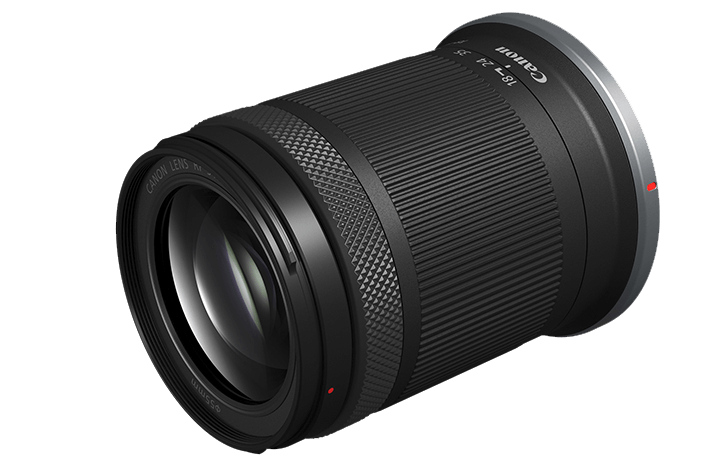
The Canon RF-S 18-150mm f/3.5-6.3 IS STM Lens is a much smaller and lighter super zoom made by Canon for the RF APS-C system. It, however, also has a much smaller zoom range than both the Tamron and Sigma lenses.
But here’s the thing: if you don’t think you need from 240mm to 480mm in a super zoom, then the Canon lens is a much more attractive option. The only downside (at least for me) is that the lens starts at 18mm.
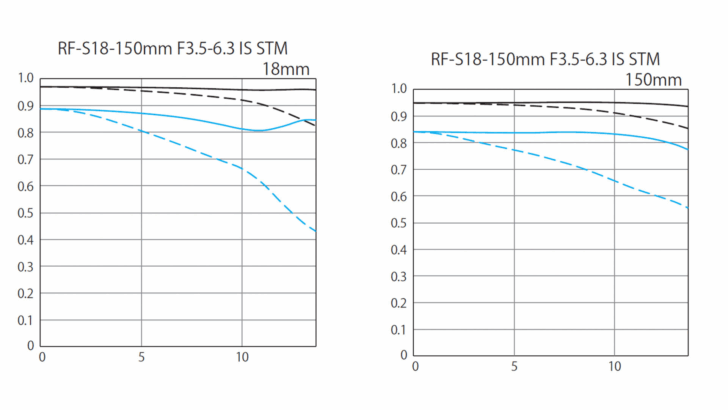
The MTF response seems to be very similar to the Tamron lens, so it’s still not an exceptional optic, but you are getting a much smaller lens as we illustrated when we compared the sizes of the lenses. You wouldn’t be purchasing this lens over the others for its optical performance, but you would buy this lens if you wanted a small, compact, and lightweight superzoom for your RF-S camera.
[affiliatable id=’303469′]
Special Mention: Canon RF 24-240mm f/4-6.3 IS USM

Not all super zooms are for APS-C cameras, as Canon also makes a super zoom lens for full-frame cameras. That lens is the Canon RF 24-240mm f/4-6.3 IS USM Lens. I should mention that it is much more challenging to make a full-frame super zoom because the image circle that it has to project into the camera’s sensor is much larger. That requires more precise optics and a heavier lens. This then goes against the other requirements of a super zoom of being relatively low cost, small, and lightweight.
So a full frame super zoom usually has far more optical compromises, and the Canon RF 24-240mm f/4-6.3 IS USM Lens is not immune to that.
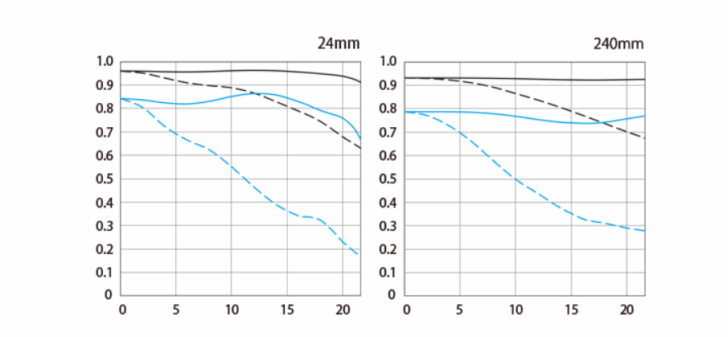
If you look at the MTF plot, you see that the lines go far lower than what they do in any of the APS-C lenses, but if you “chop” the graph off at 15mm or crop the image at APS-C dimensions, then the lens looks pretty similar to the APS-C lenses. You are buying a lens that, in this case, is fairly compromised for full frame, but you can also eek out better performance by stopping the lens down to F6.3 or F8.0 as well.
You’d also be better off purchasing the Canon RF-S 18-150mm f/3.5-6.3 IS STM, which is smaller, lighter, and cheaper – and using your full-frame RF camera in crop mode unless you don'[t mind stopping down the lens further to extract slightly better performance, and not using it for any larger images.
[affiliatable id=’303360′]
Conclusion
Now that we are seeing some different lenses from third-party manufacturers, we as photographers now have the agency to pick the lens that best suits our individual taste and use cases.
Even for me, while I appreciate the one lens zooming from 16mm of the Sigma, I counter that with the much smaller size of the Canon RF-S 18-150, and I can always add in the equally small Canon RF-S 10-18 if I want to go wider. This is why, as a lot of readers here will know, I have been whining about third-party support for the RF mount for what seems like decades.
I can’t recommend a lens to you, because everyone will have a different opinion about what is essential. But between the Canon, Tamron, and Sigma choices, there are good options out there for almost everyone.




*snorts*
Oh yes, that reminds me I need to do that EOS-M article 😉