

When you purchase through links on our site, we may earn an affiliate commission. Here's how it works. |
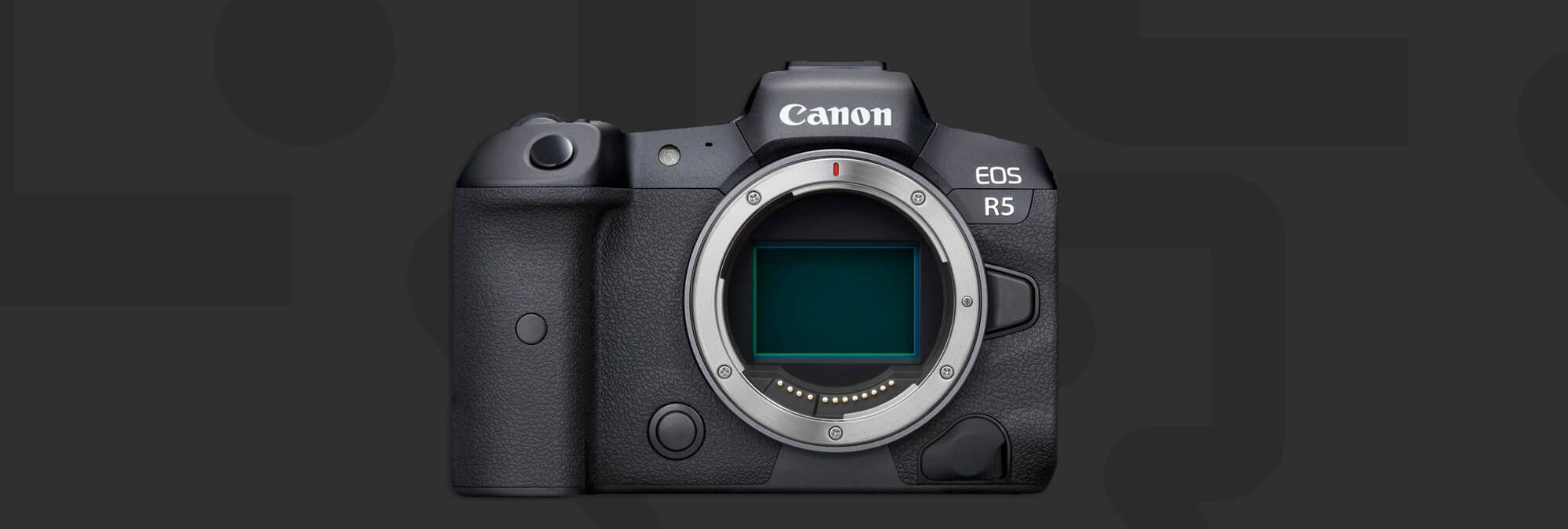
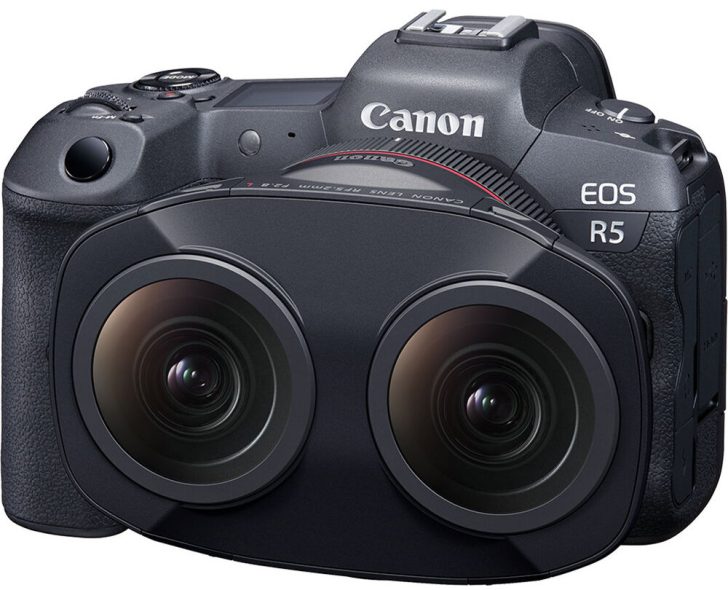
It looks like Canon is making 3D photography more accessible with a new app that uses the Canon EOS R5 with regular lenses like the Canon RF 5.2mm f/2.8 L Dual Fisheye 3D VR.
At the CP+ 2025 show in Japan, they showcased new software that allows shooters to create 3D images using standard lenses, eliminating the need for more expensive niche lenses.
How Does It Work?
Canon's Dual-Pixel sensor, which is normally used for autofocus performance and features like pixel-shift. However, they're using it create the necessary files so the software can make a 3D image from them.
As a Canon engineer explained
That means two photodiodes in one pixel. Currently, we are using that for the autofocus. However, we can use that pixel to [produce] 3D.
“So we can take a photo as RAW data – we call it DPRAW, the extension is .CR3 – and then we made special application software for 3D.”
From Digital Camera WorldThe app processes this data, turning a single photo into a 3D image. During the demonstration shown to DCW, a standard EOS R5 with a regular lens captured an image of a doll.
When viewed on a screen, the image could be rotated, revealing its three-dimensional nature. This capability rivals the 180-degree 3D modeling of Canon’s costly Dual Fisheye lens, but at a fraction of the cost.
Canon showcased the creation of 360-degree 3D images. By placing an object on a rotating turntable and capturing multiple images, the app combines these photos into a fully rotatable 3D model. This was demonstrated on a large touchscreen, where users could interact with the 3D images by panning, zooming, and rotating them.
Currently, to achieve any sort of 3D output from an EOS R camera, you need a lens such as the Canon RF 5.2mm f/2.8 L Dual Fisheye 3D VR. and that generally runs between $1500-$2000. Making it a significant investment even just to play around.
Canon also has APS-C dual lens lenses such as the Canon RF-S 3.9mm f/3.5 STM Dual Fisheye, Canon RF-S 7.8mm f/4 STM Dual Lens for VR and Spatial video.
When Will The Application Be Released?
The demonstration confirms proof of concept and appears to work well. However, we may be a long way off from seeing this application released to the public. Canon made no mention of when we might expect it.
Digital Camera World has posted some visual examples of Canon's 3D demonstration with the Canon EOS R5 and standard lens.
Source: Digital Camera World




You need to pay monthly for the software.
You can buy one of the lenses and use them forever.
For people who rent the Canon software anyway it would be a major savings.
2) IDK why it would need dual pixel? You already have a stereo lens attached, so it already records two stereo pair images. Should be quite easy to generate a 3D image from that, even without the Canon software.
I can't imagine they'd try to charge for it, at least not the basic functionality. Maybe the cloud rendering or something like reality capture does through. Here's hoping.
The dual fisheye gives you a stereo image. One you can use with VR/AR to represent the entire scene to an audience as 3D. The distance between each lens aperture is similar to the average distance between pupils.
Dual pixel RAW cannot capture depth for a full scene (it's not a light field camera). And can only give you a depth map within a working range that is going to be different for each lens used, subject, distance to subject, settings used, etc. And it requires more processing. That processing let's you build a model with a mesh and texture of the usable area that is then viewed.
With the dual fish eye you can just display the 2 images or video through a headset (or get creative and generate a cross eye).
As for the overlap capturing process necessary for photogrammetry the dual fisheye lens is useful because you get 2 images of exact known projection. Makes processing more accurate in many cases.
But it's wide angle fisheye too... So an entire other can of worms to deal with for photogrammetry.
As it stands you can capture dual pixel raw and use those images in photogrammetry workflows already. But that's without the special knowledge that they're dual pixel, and without the correlated depth map. It's treated as very highly overlapped images instead - still useful!
I found this nice animated image from the 5D Mk IV 2016 here: https://www.magiclantern.fm/forum/index.php?topic=17695.msg171832#msg171832
And just a bit further down theres a computed depth map: https://www.magiclantern.fm/forum/index.php?topic=17695.msg172097#msg172097
Ultimately how useful it is in a consumer context depends on how easy the software is to use and how the depth information is actually used.
When the iPhone X came out with portrait mode in 2017, this was basically what Apple did. They just hid all the implementation details and named it portrait mode.
While Canon just put the raw Dual Pixel feature in their cameras but never did too much with it.
I hope the DPRAW will be enabled in R5II with firmware upgrade. It helped me occasionally with previous cameras, and I had it always enabled unless I need the maximum fps.
Make a request to Canon.
"using regular lenses like the Canon RF 5.2mm f/2.8 L Dual Fisheye 3D VR."
"When viewed on a screen, the image could be rotated, revealing its three-dimensional nature. This capability rivals the 180-degree 3D modeling of Canon’s costly Dual Fisheye lens, but at a fraction of the cost"
Currently, to achieve any sort of 3D output from an EOS R camera, you need a lens such as the Canon RF 5.2mm f/2.8 L Dual Fisheye 3D VR. and that generally runs between $1500-$2000."
If the software only uses DPRAW and not the dual fisheye lens then it would be the only useful application of DPRAW in post that I am aware of.