
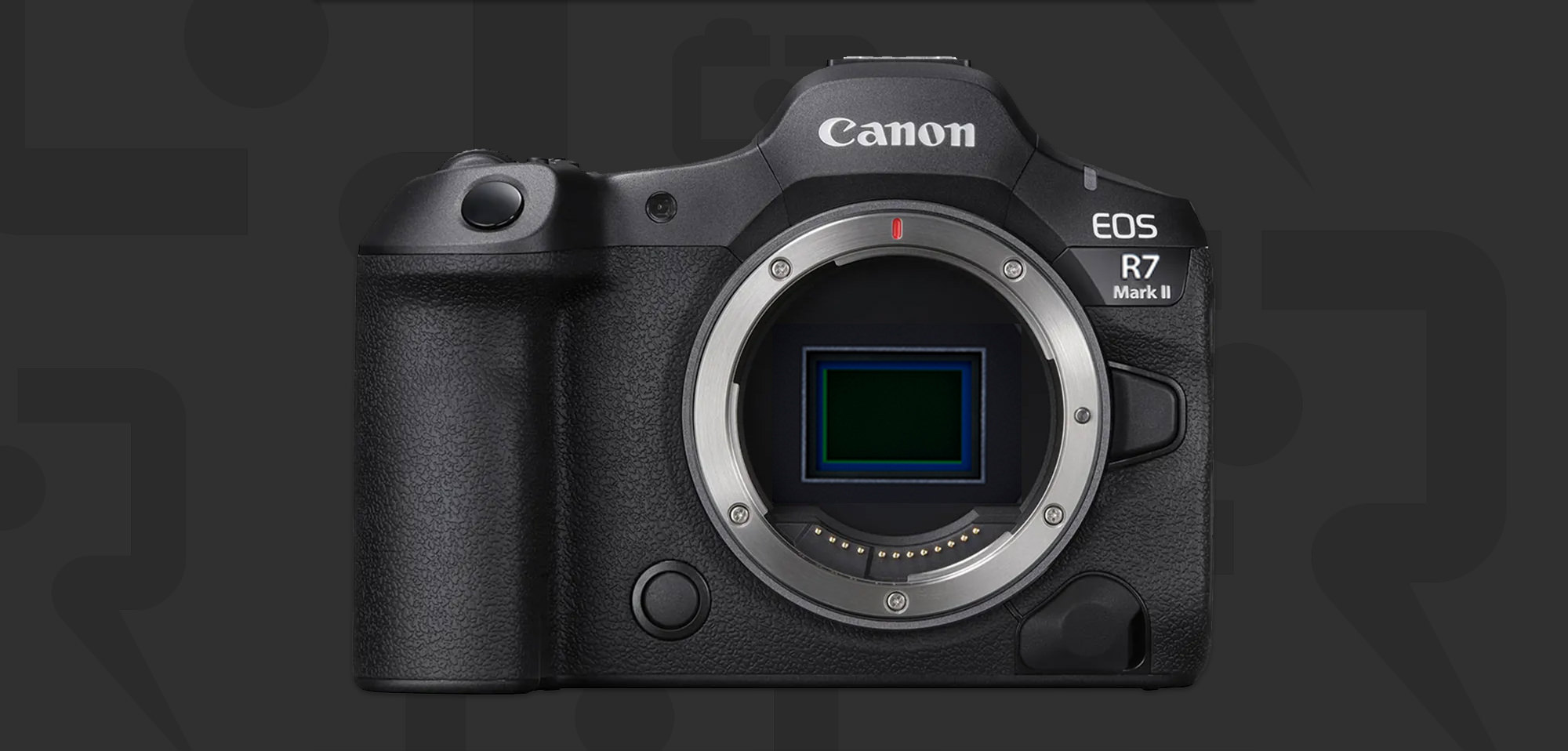
The Canon EOS R7 Mark II May Be a Big Departure From the Original

Craig
3 Min Read

When you purchase through links on our site, we may earn an affiliate commission. Here’s how it works.

The Canon EOS R7 Mark II has been talked about for a few months now. There was some speculation that we would see it in later 2025, but that isn’t happen. We’ve been told that it won’t come until late Q1 2026 at the earliest.

We have recently received some anonymous information from someone, which does happen from time to time and can be accurate. However, the batting average probably in the area of 70% from these type of sources.

A Big Departure?

The source claims that the EOS R7 Mark II will be a “big departure” from its predecessor and that we should expect something like an APS-C EOS R6 Mark III. There will be ergonomic changes as well as a “new form factor”. The latter wasn’t explained, but there have been rumblings that the body will be slightly bigger.

Stacked Sensor!?

The big mention from the world of anonymous: The EOS R7 Mark II will have a brand-new stacked CMOS sensor. The EOS R6 Mark III won’t be getting a stacked sensor, and this revelation may annoy some people.

The probable reason? Stacked sensors cost a lot more to manufacture and they are quite complex. The smaller image sensor would definitely cost less to make.

Do I believe it? I’m not sure for now. It would be a welcomed surprise, but I’d put that at 50/50 for now.

New DIGIC Configuration

It will be equipped with the DIGIC accelerator. There was no word if it was an updated DIGIC X processor. For those that don’t know, DIGIC X is the name of the series if processors. They are consistently updated with new camera models. We know from talking to someone that knows, there are actually 3 different configurations of the processors. The higher end cameras get the best version.

What I liked about this communication is there wasn’t really a lot of claimed specifications and it’s possible that the camera is already in the wild. The EOS R6 Mark III was for a long time, which may mean Canon is doing a lot of more testing after some of the quality control issues with the EOS R5 Mark II.

The Grain of Salt

Take this report with a grain of salt, until I hear from people that I do communicate, I can’t verify any of this information, but there is plausbility in it, except that stacked sensor claim? That would be nice.

Go to discussion...

Share This Article
Follow:
Craig is the founder and editorial director for Canon Rumors. He has been writing about all things Canon for more than 17 years. When he's not writing, you can find him shooting professional basketball and travelling the world looking for the next wildlife adventure. The Canon EOS R1 is his camera of choice.

42 comments

  1. To me, it makes sense. Make it a real wildlife pro camera and move it up in the line-up. The R10 could be become what essentially is the current R7: An APS-C all-around camera equipped with IBIS.

    I´d bet that the R7ii will be compatible with a BG!
    • 0
  2. I will have to check again to see what lenses are available for RF-S. IIRC it's a pretty complete system. Like @Exploreshootshare said this would leave room for an IBIS equipped R10. Though to be honest, that's kind of what the R7 could become if they don't discontinue it.
    • 0
  3. I use my R7 a lot for stuff that moves rapdily. Could this new type shutter be expected to reduce/eliminate the amount of tilt in trees, motorcycles and cars?
    Yes - it also helps with LED flickerring and improves AF performance
    • 0
  4. I use my R7 a lot for stuff that moves rapdily. Could this new type shutter be expected to reduce/eliminate the amount of tilt in trees, motorcycles and cars?
    What you are seeing there is Electronic Shutter distortion due to the slow sensor read out. The R7's readout is suprisingly poor at nearly 30ms. The R6ii and R5 come in at around 15ms and the 1st Curtain shutter is around 3ms. The stacked sensor in the R3 and R5ii come in around 5-6ms. With the R1 being Canon's fastest at sub 3ms.
    If you use the R7's 1st curtain shutter you will not see any of the shutter / sensor readout disortion but you will only have 15fps. If the R7ii has a stacked sensor design, then we can expect a huge reduction in sensor read out speed compared to the very poor 30ms of the current R7.
    Some people find that the R7 is better suited to 15 fps because the AF can struggle to keep up with the full ES 30 fps, epecially in low light situations.
    • 0
  5. A change in form factor, huh? I've said it before; R3 body with APS-C sensor. Stacked sensor, eye-control AF, everything the R3 has but with an APS-C sensor
    • 0
  6. I’d be fine with a “slightly bigger” body if it came with an extra dial or buttons, but would hate to see a G9ii situation of an unnecessarily massive body just to match some sort of full frame standard. Make it compatible with a grip of some want a R3R1 style camera.

    I also hope the R7ii comes alongside a 24-70/105mm FF equivalent lens, like that patented RF-S 15-60mm f/2.8: it’s a glaring hole in the ecosystem, and the closest option we have is the EF-S 15-85 which is long in tooth, dark, and variable aperture.
    • 0
  7. A change in form factor, huh? I've said it before; R3 body with APS-C sensor. Stacked sensor, eye-control AF, everything the R3 has but with an APS-C sensor

    I think in the best case Canon will put the sensor in a R6 style body with an R6 style button layout and that's it. And maybe will be compatible with the R5/R6 series vertical grip.
    • 0
  8. OK, we have Stacked Sensors, Backside Illuminated Sensors and Fast Readout Sensors. all of which can be implemented independently and seem to independently have benefits. I understand the benefits of BSI and Fast Readout Sensors, but not Stacked Sensors. What's the big deal with those?
    • 0
  9. OK, we have Stacked Sensors, Backside Illuminated Sensors and Fast Readout Sensors. all of which can be implemented independently and seem to independently have benefits. I understand the benefits of BSI and Fast Readout Sensors, but not Stacked Sensors. What's the big deal with those?
    Stacked sensors have an extra layer of circuitry that improves readout speed. This enables better AF and reduces rolling shutter.

    See: https://www.digitalcameraworld.com/cameras/what-is-a-stacked-sensor
    • 0
  10. ... The source claims that the EOS R7 Mark II will be a “big departure” from its predecessor and that we should expect something like an APS-C EOS R6 Mark III. There will be ergonomic changes as well as a “new form factor”. ...
    Sounds very promissing. In that case I could be in the market for this one.
    • 0
  11. I hope it's a big departure....I hate the R7 about as much as Richard hates the R100. I used it less than 20 times and never picked it up again. The shutter slap alone was enough to put me off. Set off local earthquake sensors.
    • 0
  12. I hope it's a big departure....I hate the R7 about as much as Richard hates the R100. I used it less than 20 times and never picked it up again. The shutter slap alone was enough to put me off. Set off local earthquake sensors.
    If your count means the number of times you took it on a shoot, then my count may be less than yours. Shutter slap, shutter noise (machine-gun level), almost non-existent buffer, poor (compared to R5 and above) AF performance, all turned me off. Bigger size is a plus along with CFe support. 30fps in raw with a decent (strong) buffer is fine with me, but it seems that 40fps is the new norm for action camera bodies.
    • 0
  13. There has been a lot of talk that the R7II will not have a mechanical shutter... only an electronic shutter. In order to accomplish that, Canon MUST vastly improve sensor readout speed to minimize rolling shutter issues. A stacked sensor is one way to do that.
    So it makes sense that the R7II would have a stacked sensor. Especially since it would also improve auto focus performance, which is another area where the original R7 comes up a bit short.
    The form factor change SHOULD BE nothing more than adopting the proven control layout of other Canon cameras like the R5II etc.
    No, I don't believe Canon will give the R7II an R1 or R3 style body, with built-in battery grip. At least, I certainly hope not! But they do need to make the R7II compatible with a battery grip. Ideally would be it sharing the same grip(s) used by the full frame models. That is probably why the body will be slightly larger... although the original R7's footprint was very close to that of the R5's. There was just a few millimeters difference, which is why it was so sad the original R7 couldn't be fitted with a BG-R10.
    Likely a truly improved R7II will cost more than the original... perhaps in the $1800 to $2100 US range. But keep in mind that the original 7D sold initially for $1700 and the 7DII for $1800... in 2009 and 2014 respectively! Both of those sold like hot cakes! It's baffling why Canon felt the need to cheapen the R7 and give it an introductory price of $1500 in 2022. Between 2014 and 2022 inflation was almost 24%... so theoretically the market shiould have welcomed a modernized, mirrorless 7DII that cost over $2000. Instead Canon went the other direction.
    While there was a lot to like about the original R7... however there also were a lot of disappointments. Let's hope Canon has been paying attention customer comments about the R7 and R7II!
    • 0
  14. There has been a lot of talk that the R7II will not have a mechanical shutter... only an electronic shutter. In order to accomplish that, Canon MUST vastly improve sensor readout speed to minimize rolling shutter issues. A stacked sensor is one way to do that.
    So it makes sense that the R7II would have a stacked sensor. Especially since it would also improve auto focus performance, which is another area where the original R7 comes up a bit short.
    The form factor change SHOULD BE nothing more than adopting the proven control layout of other Canon cameras like the R5II etc.
    No, I don't believe Canon will give the R7II an R1 or R3 style body, with built-in battery grip. At least, I certainly hope not! But they do need to make the R7II compatible with a battery grip. Ideally would be it sharing the same grip(s) used by the full frame models. That is probably why the body will be slightly larger... although the original R7's footprint was very close to that of the R5's. There was just a few millimeters difference, which is why it was so sad the original R7 couldn't be fitted with a BG-R10.
    Likely a truly improved R7II will cost more than the original... perhaps in the $1800 to $2100 US range. But keep in mind that the original 7D sold initially for $1700 and the 7DII for $1800... in 2009 and 2014 respectively! Both of those sold like hot cakes! It's baffling why Canon felt the need to cheapen the R7 and give it an introductory price of $1500 in 2022. Between 2014 and 2022 inflation was almost 24%... so theoretically the market shiould have welcomed a modernized, mirrorless 7DII that cost over $2000. Instead Canon went the other direction.
    While there was a lot to like about the original R7... however there also were a lot of disappointments. Let's hope Canon has been paying attention customer comments about the R7 and R7II!
    The R7 has the same sensor as the EOS 90D and the EOS M6 Mk II. Re-using that sensor reduced development time and costs. The sensor performance may be the reason why the R7 went “downmarket” compared to the 7D Mk II.
    • 0
  15. ... It's baffling why Canon felt the need to cheapen the R7 and give it an introductory price of $1500 in 2022. the R7 and R7II!
    Not that baffling. Price is probably the number one factor in people's buying decisions.
    • 0
  16. What you are seeing there is Electronic Shutter distortion due to the slow sensor read out. The R7's readout is suprisingly poor at nearly 30ms. The R6ii and R5 come in at around 15ms and the 1st Curtain shutter is around 3ms. The stacked sensor in the R3 and R5ii come in around 5-6ms. With the R1 being Canon's fastest at sub 3ms.
    If you use the R7's 1st curtain shutter you will not see any of the shutter / sensor readout disortion but you will only have 15fps. If the R7ii has a stacked sensor design, then we can expect a huge reduction in sensor read out speed compared to the very poor 30ms of the current R7.
    Some people find that the R7 is better suited to 15 fps because the AF can struggle to keep up with the full ES 30 fps, epecially in low light situations.
    It should be noted that the sensor in the R7 is derived from/almost the same as in the EOS M6 Mk II, which debuted in 2019. The 90D is also from that era, and has/had the 32.5 mpx sensor. So it's not the absolute latest technology. It came in an era where mechanical shutters were the rule rather than the exception. I think it was refined a little for the R7, but the sensor's basic build is the same.

    Anyway, we're due for a new one, hopefully with the same or better high-ISO noise performance (since Canon loves these smaller aperture lenses) along with much brisker readout speeds.
    • 0

Leave a comment

Please log in to your forum account to comment