

When you purchase through links on our site, we may earn an affiliate commission. Here's how it works. |
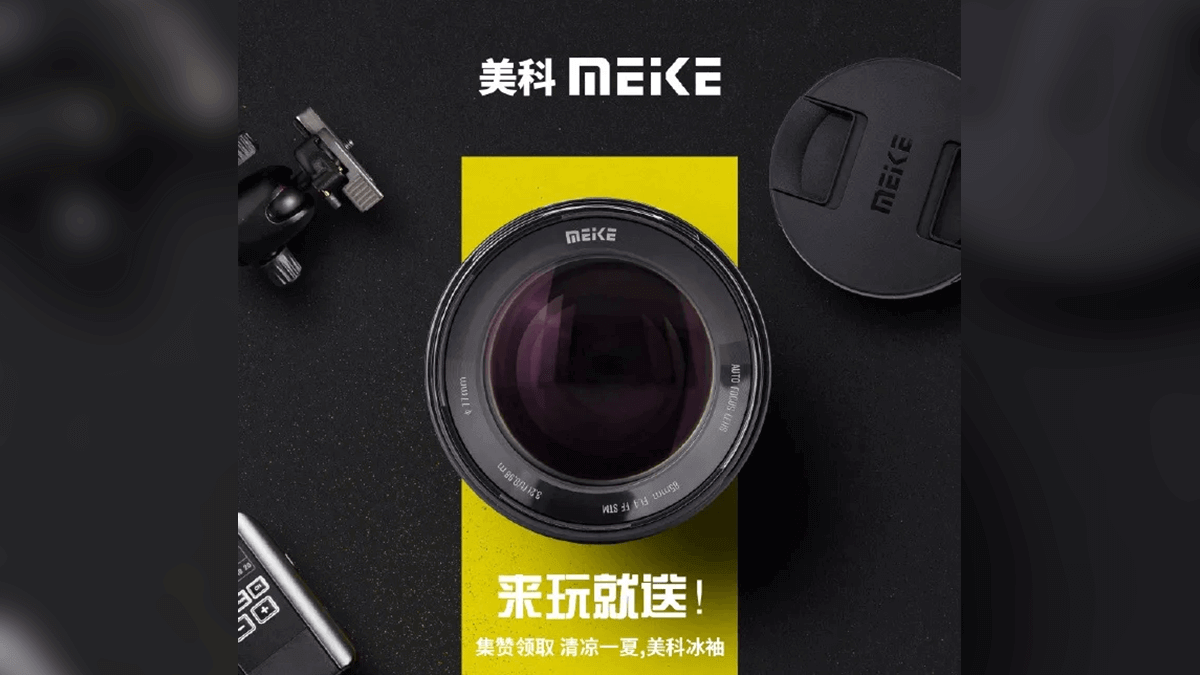
The Meike AF 85mm f/1.4 was first shown to the world at the NABShow 2023 back in April, but not much has been seen or heard of since. It now appears that Meike is planning to officially announce the lens this month.
It also appears that this will be the first licensed autofocus third-party lens available for the RF mount.
During the Photo & Imaging Show Shanghai earlier this month, Canon did comment on the state of third-party lenses and said that they have been actively engaged with various manufacturers about licensing the RF mount. Cosina was the first to receive a licenses, but for a manual focus lens, Meike looks to be the first to release an autofocus lens for the mount.
We think that the Chinese manufacturers are going to be extremely aggressive in building their brands through licensing of the RF mount, and we expect to see more manufacturers enter the space in the next year.
Autofocus is hard, as it's more than just hardware. We're looking forward to seeing the performance of the Meike AF 85mm f/1.4 mounted to an EOS R camera.
There is still no comment from Sigma or Tamron on producing RF mount lenses under license.
Meike AF 85mm F1.4 Specifications
- 13 elements in 8 groups
- 77mm filter diameter
- 12 aperture blades
- Minimum focusing distance: 0.98m
- AF/MF selector switch
- Fn button
- Weight: 800g
- E・Z・RF・L Mount
- Scheduled to be released in August
Source: Meike Weibo via Asobinet







77mm filter thread is perfect for primes. Matches the 14-35 and 70-200's.
Canon's rollout of EF was pretty similar the 50/1.0 and 50/1.8 coming out quickly (the 50mm being a pro-quality build, unlike the EF50/1.8 MkII).
It's possible Canon's slowly-coming 35mm will be f/1.2, and they'll leave 35mm 50mm 85mm f/1.4 lenses to third parties?
Maybe this way they can say: "We allow third-party lens makers, look at the Meike RF lenses", knowing they are only a small player and no real danger to Canon lens sales.
In Canon's shoes I might want to license only lenses that are less sharp than the in-house lenses, and Sigma wasn't willing to come up with worse designs?
I'm not really a Canon fan, it's more of a codependency. Since I got into the outfit in 1996 or so, I knew they were mainly doing what was best for them, not best for me, but also, what was best for them would probably benefit me a fair bit anyway (e.g., making really good equipment is a way to make money!). I sure wish Canon licensed every other maker to RF, but sigh, I know why it's not happening, and I'm not about to move to Sony or Nikon over it. It's also possible that a company that was so generous in that way might ultimately make less or no money and shut the product line down. So if Canon's being a greedy tightass that's an annoyance but one that could also conversely benefit me in the long run.
I want to see the new sigma 20mm mirrorless lens on the RF mount, great for astro. And maybe the 150-600. A refreshed 50mm 1.4 Art could be cool, but my EF one is so good I'm not sure it'll be worth the upgrade. Lets hope this opens up the gates eventually.
-Brian
Not for me, at least until today; then things may certainly improve.
Until the release of Art series, "I wouldn't have touched a Sigma lens with a 10 feet pole" as someone says, while today I'm just waiting for the day (if it will ever came) Sigma would release RF lenses, so I can trade all my Canon lenses with Sigma equivalents (and trade all my Sigma DSLR lenses for their mirrorless equivalents), as I deem Sigma the best lens manufacturer today on the market.
Maybe Meike, or Viltrox, Yongnuo, or Samyang (brands that today I wouldn't touch with a teen feet pole) in 10 years will be my favourite lenses manufacturers, who knows?
Serious economic downturns from Covid shutdown to property market disasters will hurt them a lot and will flow to other countries in some way.
India has been different in that IT services quality/cost was their predominant outsourcing attraction to western countries. I couldn't work out why outsourced manufacturing didn't became a big thing there. Infrastructure eg stable electricity may have been one factor but they sorted our telecommunications.