

When you purchase through links on our site, we may earn an affiliate commission. Here’s how it works. |
Rumor on the street is that Fujifilm is also readying their X-T6 for release later this year, rumored for September. This will follow Canon’s expected release of Canon’s R7 Mark II, expected to be put sometime in the first half of this year. This will set off an interesting comparison between two APS-C contenders.
I honestly think that Canon knows exactly what Fujifilm, Nikon, and Sony are doing in terms of camera releases. Of course, I could be entirely tin-foil hat-wearing in this, though, but let’s, for the sake of argument, run with that theory. So I don’t think these cameras are created their cameras in an information vacuum, so what we glean from others may give us clues about Canon’s thoughts as well.
I originally was going to talk about the Fuji X-T6 rumor in detail in this article, and then I realized that I had too much to say on the subject. As all of you are well aware, sometimes I get on a roll, and the next thing you know, I’m forcing you all to read for 20 minutes. So, in light of that, the X-T6 has gotten its own article. If you want to know my Fujifilm ramblings in detail, go have a read now.
Read More about the X-T6
Fujifilm has the largest DNA of APS-C cameras and lenses, and if there was a company in which I wish Canon would emulate the APS-C line of RF cameras and lenses, hello, my dear friend Fujifilm.
Just to put these two systems into perspective and completely shame Canon, like I usually love to do.
| Canon | Fujifilm | |
|---|---|---|
| APS-C Zoom Lenses | 5 | 16 |
| APS-C Prime Lenses | 0 | 18 |
Now, yes, Canon’s RF mount and especially the RF-S system are relatively new, but Canon certainly hasn’t put the accelerator down to the floor on creating RF-S lenses. Yes, there are tons of full-frame lenses that you can use, but the vast majority are impractical from a cost, size, and focal length point of view.
For instance, yes, a 16-28mm f/2.8 IS STM may work as a very limited kit zoom, but I’m sure Canon users would rather have the equivalent of Sigma’s 18-50mm f/2.8, which is smaller, lighter, and less expensive. Rough examples, I know, because unlike the EF system, there isn’t a comparable full-frame lens that I would look at and think it would actually make sense on a crop camera (the Canon EF 17-40mm I’ve seen used quite a bit on EF cropped cameras, and was pretty decent at it – as an example).
In the Past: R7 vs X-T5
Even though the X-T5 was released in the same year as the Canon R7, the R7 was arguably Canon’s first serious APS-C RF camera, and the RF-S system began with it and the EOS R10, and thus, perhaps didn’t go as far as Canon would normally if it were part of a normal release cycle. That being said, it did match up fairly well against the X-T5, but for an additional $200, you certainly got a higher resolution sensor and larger viewfinder than the EOS R7, and also, you didn’t experience the confused ergonomic decisions of the R7. It was actually impressive just how well the R7 matched up to the X-T5, you know, like they knew in advance or something ;)
| Fujifilm X-T5 | Canon EOS R7 | |
|---|---|---|
| Announcement Date | November 2, 2022 | May 24, 2022 |
| MSRP at launch | $1,699 | $1,499 |
| Sensor size | APS-C | APS-C (1.6x) |
| Pixel count | 40MP | 33MP |
| Maximum burst rate | 15fps (Mech) 13fps (Elec) | 15fps (Mech) 30fps (Elec) |
| Buffer depths | 119 JPEG | 224 / 126 JPEG |
| Viewfinder mag / res | 0.8x equiv 3.69M dots | 0.72x equiv 2.36M dots |
| LCD | 3.0″ 1.84M dot two-axis tilt | 3.0″ 1.62M dot fully-articulated |
| Max IBIS rating | 7.0EV | 7.0EV |
| Multi-shot high-res mode | 160MP, 20 shots. No motion correction | No |
| Max video rate | 6.2K/30 (1.23x crop) 4K/60 sub-sampled | 4K/30 oversampled 4K/60 line-skipped or 1.8x crop |
| 10-bit video options | F-Log, F-Log2, HLG Up to 4:2:2 | C-Log HDR PQ Up to 4:2:0 |
| Mic / headphone | Yes / via adapter | Yes / Yes |
| Card slots | 2x UHS-II SD | 2x UHS-II SD |
| Battery life, LCD / EVF | 580 / 590 | 660 / 380 |
| Weight | 557g (19.6oz) | 612g (21.6oz) |
The X-T5 also suffered from a slow readout speed of around 37ms, a dramatic jump from the X-T4’s 19ms readout speed, and was certainly slower than the Canon R7’s 29ms.
Dpreview had this to say about the X-T5 versus the R7
Canon’s EOS R7 runs the X-T5 pretty close in spec terms, with a faster burst rate, decent video specs and a sensor only 7MP behind. Its autofocus is also very good in stills mode. The X-T5 offers a more analog shooting experience, a larger, higher-res viewfinder and our favorite rear screen arrangement for stills shooting.
https://www.dpreview.com/reviews/fujifilm-x-t5-in-depth-review#HCWhat’s Expected in the X-T6?
We don’t have a lot of information to go on for Fuji’s X-T6, but we can guess, especially if we look at the jump from the X-T4 to the X-T5 and use that to do some tea leaf reading. For most of that, I’m going to suggest you head over to the X-T6 rumor article and get the dirty details there, but we will summarize for those who don’t want to.
Read More about the X-T6
Given what we know about the X-T6, it’s difficult to say if the raw specifications would match up well with the R7 Mark II, but there’s one aspect I want to focus a little more on, and that’s sensors.
The Sensors that May Kick off a New DR War
Let’s go on the theory that Canon wants the R7 to be the class leader, which is a reasonable assumption. The X-T6 would be the R7 Mark II’s natural competitor, and I suspect that Canon will want to ensure that the R7 Mark II competes well against it.
If the X-T6 gets a partially stacked sensor, this would allow the X-T6 to achieve a very fast readout speed, most likely sub-10ms. For Canon to come close to that, Canon would have to use a stacked sensor in the R7 Mark II. Even if Canon wasn’t sure about the upcoming X-T6, the threat of it having a much faster sensor may force Canon’s hand to prematurely include a stacked sensor. Let’s face it, partially stacked sensors are here to stay.
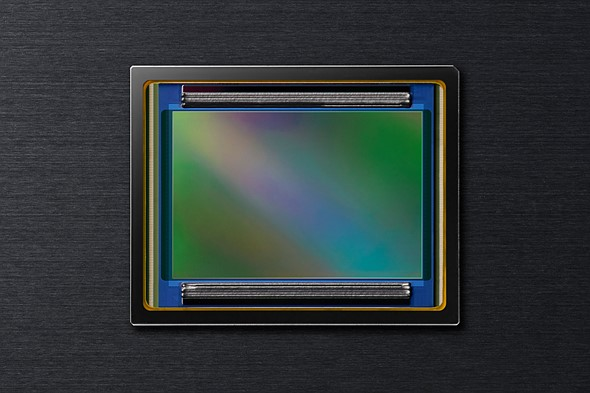
The on-and-off again nature of the rumors around the stacked sensor versus a simple BSI sensor for the R7 Mark II could be that Canon is preparing two or more models and waiting until the last moment to make a decision. Yes, Canon has been rumored to do this in the past when it came to watching what the competition does.
Just as all this conjecture about Canon’s perspective may be accurate, the reverse may also be true. Fujifilm may just as well be waiting to see what the R7 Mark II has in terms of sensor and readout speed before making the final decisions on the X-T6. But it’s easier for Canon, with its vast engineering, manufacturing, and, well, funds, to do such a thing.
As much as I wish it to be, I doubt that Canon implements DGO technology into the R7 Mark II, as I would expect that to be in thier full frame cameras first, so there’s still the possibility that once again, we have the dynamic range wars, where suddenly 10EV just isn’t enough anymore to take pictures on the planet earth, let alone mars and the moon, according to Elon, anyways.
The Other Factors
The R7 is expected, according to Craig’s last rumor post, to have the following specifications,
- 39MP CMOS
- BSI sensor (conflicting stacked sensor information)
- DIGIC Accelerator (Conflicting)
- 8.5 Stop IBIS (5 Axis)
- 40fps e-shutter
- “The best autofocus of any APS-C camera”
- RAW Video (no resolution given)
- CFe/SD Card slots
You can read more about what Craig has heard here:
Read More about the R7

A lot of the upgrades to the R7 Mark II seem to be Canon exclusive, but I would expect the X-T6 to match the electronic shutter frame rate and even the video specifications, unless they want to protect the sales and status of the X-H2 or X-H3. Canon has no camera above the R7 Mark II, so they have a lot more freedom to reach the skies in terms of specifications for video and stills performance. But Canon has been resistant for a long time to invest its best into APS-C cameras and even more so in APS-C lenses.
The R7 Mark II is supposed to be more like the R6 Mark III in terms of body style and ergonomics, which is a relief, though I would have preferred the R5’s ergonomics. While I would have loved the R5 Mark II ergonomics for the R7 Mark II, the R6 Mark III’s is a healthy compromise.
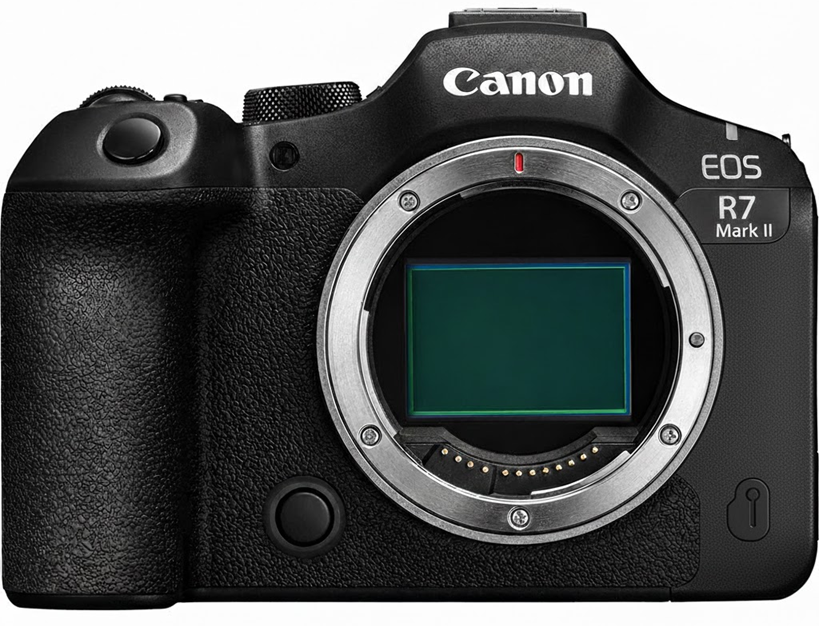
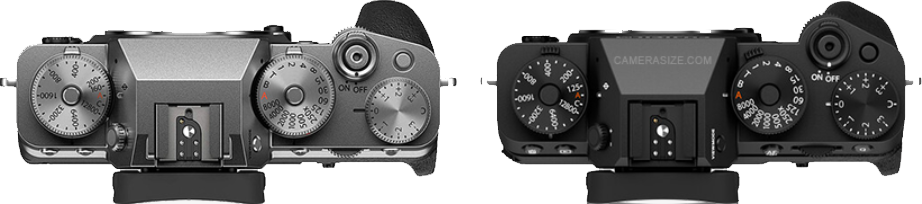
For the X-T6, we have no idea, but it would most likely not change much from the X-T4 and the X-T5. Regardless, the Fujifilm will certainly be the better-looking camera. No offense, R7 Mark II.
Fujifilm is playing catch-up with Autofocus, and while they may make huge strides in that department against existing Fujifilm cameras, I doubt they will overtake Canon. I remain pretty confident that Canon has such a lead in this regard, and that with a new sensor and updated DIGIC X that Canon’s overall auto focus and subject recognition will be class leading in the APS-C realm.
What about a Fujifilm X-H3?
If we are talking flagship APS-C cameras, we’d be remiss to forget this for Fujifilm, but there aren’t any recent rumors. If the X-H3 were coming out soon, we’d expect to hear something recent. If Fujifilm is releasing generation 6 of its sensor and processor, it stands to reason that the X-H3 will come sooner or later. The X-H2 was positioned above the R7, and I would expect the X-H3 to follow that mold with increased pricing and capability over the X-T6 and ultimately the R7 Mark II, assuming that’s even possible for Fujifilm to achieve ;)
Closing Thoughts
It’s very early in both camps to be comparing what these two companies are doing; this was more a fun article for me, because, well, I rarely get to write about upcoming cameras :) For both companies, I see a difference – for APS-C, anyway, this is the tale of two different companies.
Canon has unlimited ability to stuff things into the R7 because it’s not going to compete against a full-frame camera such as the R3 or the R1, or even the R5 Mark II. So Canon’s engineers have a great deal of flexibility.
Meanwhile, the engineers in Fujifilm have more of a challenge in positioning the X-T6 within the Fuji lineup, and they may get pushback on making it “too good” and not having enough breathing room for the X-H2 or the forthcoming X-H3.
People always complain about Canon doing market positioning and the near legendary performance of the Canon Cripple Hammer™, but we have to always realize that cameras aren’t created in a bubble. As Canon is putting the finishing touches on the R7 Mark II, that team knows that Canon still will need to sell a future R7 Mark III.
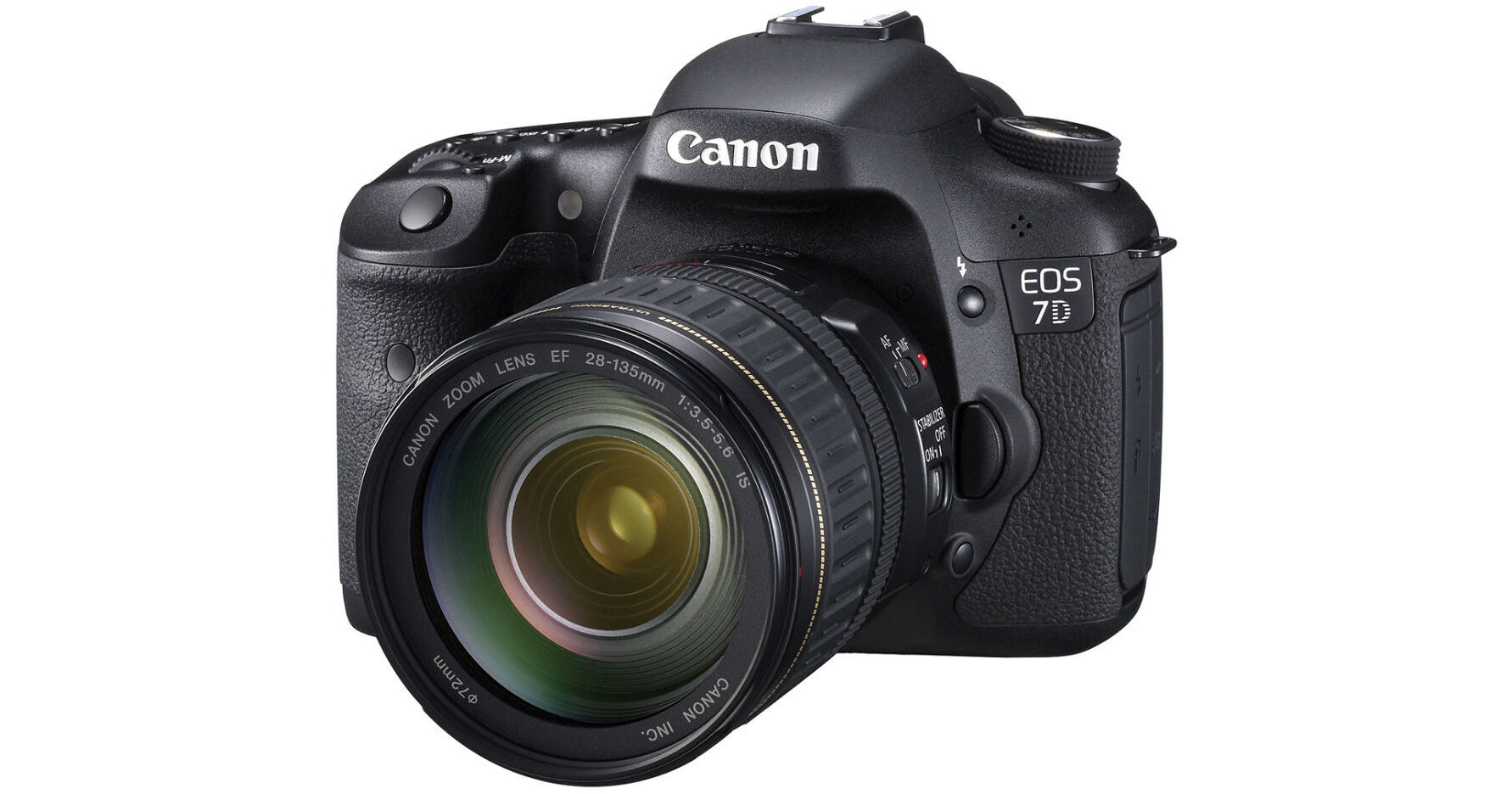
Many of Canon’s APS-C “issues” seem to be self-inflicted. Canon has always seemed to be disininterested in the entire “APS-C package” for even the EF System (who here remembers the EOS 7D packaged with the EF 28-135mm full frame lens as a kit – was there any more worthless of a kit lens in a Canon kit? ever?).
I’d love for Canon to prove me wrong, but even with the RF-S system, Canon is content to have Sigma and others fill the gap on what is missing while they work on the full-frame ecosystem. Which isn’t a bad strategy, but it seems like it’s their ONLY strategy. Canon hasn’t even averaged a lens a year for the RF-S system if we discount the dual fisheye lenses that I’m not sure anyone purchased.
So how these two cameras compare may ultimately come down to the Fuji Cripple Hammer™ versus the Canon APS-C Loathing Hammer™.
If you don’t think that APS-C Loathing hammer exists, I turn your attention to the darling of the APS-C lineup for Canon, the EOS R100.
One thing is certain: when these two cameras hit the market, we’ll certainly be comparing them for real.






I honestly doubt that Canon doesn’t know what Fujifilm, Nikon, and Sony are doing in terms of camera releases.
So why would the R7 Mark II need a stacked sensor at all? Since it’s APS-C, Canon might be able to achieve very fast readout anyway. I know readout speed depends on pixel count, but I’d expect sensor size to matter as well.
So there is compromises to what Canon is doing, namely, there is a significant hit to electronic shutter noise and dynamic range.
while the A7 V still has that compromise as well, it has it for different reasons (DGO).
I’m still not sure whether the compromises show up mainly in dynamic range when using electronic shutter. There seems to be roughly a 0.5 EV gap between the partially stacked Sony sensor (A7 V) and the FSI Canon sensor (R6 Mark III). If I remember correctly, Sony sensors have usually been slightly better in DR, even back when both were using FSI.
It would honestly look far worse. There are a ton of vendors that don't make for the RF mount, but make for the X mount.
Can anyone explain why the R100 can't use the RF extenders?
Back-side illumination has been the only architectural improvement to imager sensitivity since gapless microlenses.
Not sure how many people buying an R7ii care about the lack of RF-S lenses either? I suspect most potential buyers would be using it with long telephoto lenses so it makes no difference that these are designed for full frame and most of them already own full frame bodies with which they can use wide angle and normal FF lenses.
Improvements to the AF, which is already good, would be a plus for birders and others seeking to photograph the proverbial needle in a haystack.
Readout speed - yes, a must for E-shutter, though I use E-first curtain and get plenty of images typically, for my purposes.
On the part of lenses, I have no idea why Canon didn't, at a minimum, take the best of the EF-M range and adapt them to the RF mount. That is, do what they did with the 18-150 lens. A 15-45 with Canon's 1.6X is a very suitable normal range telephoto. The 32/1.4 is great, the 22/2 pancake lens. Should be pretty easy as the back focus distance is almost the same between M and RF. Seems like Canon has ceded the RF-S lens manufacturing to third parties.
rather than, what does canon have to do get EF-S and EF-M users onto RFS or even better get them onto RF,
I could argue R7 was a pretty mild update over M6/D90. how many people stood pat especially the M6 users who cant get an adapter and have to replace the kit.