


When you purchase through links on our site, we may earn an affiliate commission. Here's how it works. |
The Japan Patent Office (2026-033938) has recently published a Canon patent application that shows off some very interesting optical designs. I had previously discussed these as quarter-wave optical designs, just because I have no idea what else to call them.
How these lenses work is that there are transmissive surfaces that bounce the light back and forth between the elements.
Are characterized in that the plurality of lens groups include a first transmissive-reflective surface and a second transmissive-reflective surface located closer to the image than the first transmissive-reflective surface.
But like the prior patent examples to show this technology, the back focus distance between the lens and the sensor for most of the embodiments is extremely tight – for all purposes – the rear element is resting on the sensor, as it's only being .4mm away from the sensor. There's absolutely no chance that most of these embodiments would be for interchangeable lenses for the RF mount.
The prior examples from earlier patents were for prime lenses, and now, we have this patent application showing off some zoom lenses. Now, before we assume these are going to be in the next compact camera, it should be noted that none of these lenses are exactly small, but they would seem to allow a significant amount of room to collapse.
Speed, Speed and more Speed
What these lenses bring to the table is how incredibly fast they are, which is why I think we can all get behind Canon doing at least one camera with these lenses, right?
Besides full-frame designs, there are some other ones with some odd image circle sizes; there are a few other sensor sizes listed. This is by far one of the longest lens patent applications in terms of the number of embodiments, so while we won't mention every embodiment here in detail, I'm going to table them all.
| Name | Image Height | Sensor Size | |
|---|---|---|---|
| 1 | 4.2-6.5mm f/1.2 | 3.55 | Super 8 or 1/2.5″ |
| 2 | 28-45mm f/1.2 | 21.30 | Full Frame |
| 3 | 28-45mm f/1.4 | 20.12-21.64 | Full Frame |
| 4 | 15-35mm f/1.4 | 11.54-13.49 | APS-C |
| 5 | 35-70mm f/1.4 | 19.42-21.64 | Full Frame |
| 6 | 28-55mm f/1.4 | 19.84-21.64 | Full Frame |
| 7 | 14-30mm f/1.2 | 14.20 | Super-35 |
| 8 | 20-40mm f/1.4 | 21.30 | Full Frame |
| 9 | 35-70mm f/1.4 | 19.42-21.64 | Full Frame |
| 10 | 35-50mm f/1.4 | 20.27-21.64 | Full Frame |
| 11 | 20-40mm f/1.4 | 21.64 | Full Frame |
| 12 | 24-40mm f/1.4 | 21.64 | Full Frame |
| 13 | 24-60mm f/1.4 | 18.51-21.64 | Full Frame |
| 14 | 35-70mm f/1.4 | 19.42-21.64 | Full Frame |
| 15 | 35-60mm f/1.1 | 19.42-21.64 | Full Frame |
| 16 | 16-24mm f/1.4 | 19.47-21.64 | Full Frame |
There's one embodiment in particular that I'm going to focus on because it could actually be made for the RF mount. Buried deep in the embodiments was one that had a back focus distance of 15mm, which is very relaxed in terms of the RF mount. This means that the rear element sits slightly inset into the mount by around 5mm.
Canon RF 24-45mm f/1.4L
So, for that, the one I'm going to share in detail is the Canon RF 24-45(ish)mm F/1.4. Would we ever get such a lens? I'm not sure, but it would certainly be a Halo lens if Canon did it.
Unlike all the other designs, this design has a 15mm back focus distance, and also sports a full image circle of 21.64. It would basically be 3 ultra-fast primes of 24, 35, and 45mm in one zoom lens.
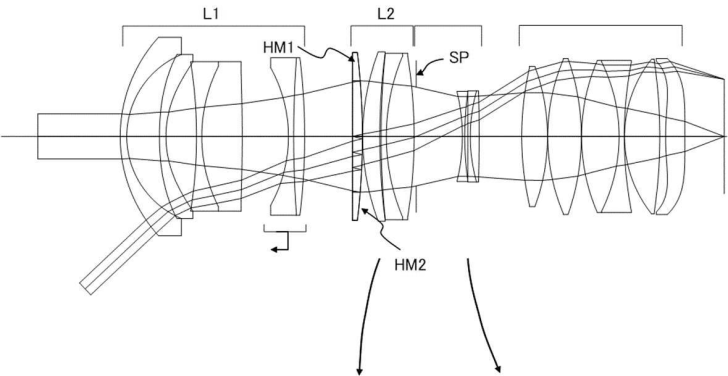
Unlike the other embodiments that were rather simplistic collapsible designs, this one has well, has a much more complicated optical design.
This is not, however, a small lens. With a lens length of around 220mm, it's around the same length as some zooms, and nearly twice the length of the 85mm f/1.2L. That alone may keep it firmly on the drawing board and never in our hands.
| Wide-angle | Mid-range | Telephoto | |
|---|---|---|---|
| Focal length | 24.00 | 32.00 | 41.80 |
| F-number | 1.41 | 1.41 | 1.41 |
| Half angle of view | 42.03 | 34.06 | 27.37 |
| Image height | 21.64 | 21.64 | 21.64 |
| Lens length | 237.50 | 237.50 | 237.50 |
| Back Focus Distance | 15.00 | 15.00 | 15.00 |
If Canon keeps up with these designs, we could be well on our way to the fabled 10-1000mm f/1.0.
Just a Reminder!
With all patents and patent applications, I have to stress constantly – this is simply a look into Canon’s research; the only thing we can quantify accurately is that Canon is researching this. A patent application doesn’t mean they are going to release this in the next month, or even year, or even at all.




Could this be the ‘transmissive-reflective’ bounce?
Even if it were no f/1,4, but an f/2,8.
Yes, you got it. the light bounces in between the two elements and magic happens.
Because this lens exists only as a patent! 😭
This 'reflecting forth and back' sounds a little bit like interference, but there the distance between the two reflecting surfaces is VERY small.
Concerning all the patent applications: Is it possible that Canon want's to distract a little bit from the potential new lenses, so that they created some 'nonsense' patents to 'hide' the potential new lenses in this larger amount of patents?
Most patents are not necessarily intended to become products directly, and in many cases some claim(s) in a patent have broad applicability, e.g., a new lens coating included in a patent may be used on many lenses.
Look at the Oly/OM 150-400mm, for example. It’s for m4/3 (2x crop) but it’s about the same size as the Canon 100-500 (and if OM made a FF camera, the lens would work on it).
As for wide lenses not making money, I really don’t get why some people seem to think they know better than Canon what lenses people will buy. I mean, Canon has led the ILC market for over two decades and dominates it today…but you know more about what lenses they need to make? LOL. You get to decide what lenses you want to buy, but Canon doesn’t care what you personally want.
I can intuitively visualize in a telephoto lens with a narrower angle-of-view the edge transmission path taking up more of the width of the central elements.
Honestly, I don't think a lens like the a 24-45mm (or 50mm?) f1.4 is likely to happen. I´d love to see it, but I don´t believe in it. Plus, what would a lens like that cost? Taking into account, the prices of three vcm primes (24/ 35/50) or maybe four once Canon fills that glaring hole (28mm), I´d guess the price would be north of 4k € at least.