

When you purchase through links on our site, we may earn an affiliate commission. Here's how it works. |
Dpreview today has put out their studio scene with the EOS R6 Mark III, which gives us our first side-by-side look at how the EOS R6 Mark III compares to its relatives and also its competitors.
One thing about sensor design is that there is no such thing as a free lunch. Something has to give if you want to increase the sensor readout speed, and usually, the cost is slightly lower image quality. Now when it comes to read out speed, even though the numbers look good when compared to their competitors, we should note that at times Canon can now be firmly in the “we're cheating a bit” or in this case, 2 bits, as Canon usually offers on it's none stacked sensors, 12 bit readout with electronic shutter for both stills and video.
Canon uses a ramp comparator. The last time I've seen their sensor patents discuss their AD on sensor chip, and this means the more precise you want the measurement, the more time it takes to make that measurement, which is why Canon limits the amount of bits in the faster readouts.
Do keep in mind that when comparing the EOS R6 Mark III to the EOS R6, the EOS R6 Mark II, or the Nikon Z6 III, numbers do have a quality of their own. At the same time, dpreview shows a downsampling of the image to equalize the resolutions. You can take more pixels in the R6 Mark III and use far more advanced tools to reduce its noise, and you have 40% more pixels to work with to do so.
Dynamic Range / Exposure Latitude
According to dpreview's exposure latitude test charts, which are meant to see how much you can push an image up in terms of exposure to see where it starts to fall apart with noise. We will look at the EOS R6 Mark III as compared to the EOS R6, EOS R6 Mark II, and the Z6 III, which I think is a good choice because it has similar prioritization to the R6 Mark III.
When looking at a heavy push, but not the most extreme for dpreview's test scenario, it appears that the difference in DR is less than 1 EV, with the EOS R6 Mark II having the better latitude. The EOS R6 Mark III looks very similar to the response you'd get out of the Z6 III with its partially stacked sensor. The EOS R6 Mark III also appears to sit right in between the EOS R6 and the EOS R6 Mark II. There's really not much to differentiate the four cameras.
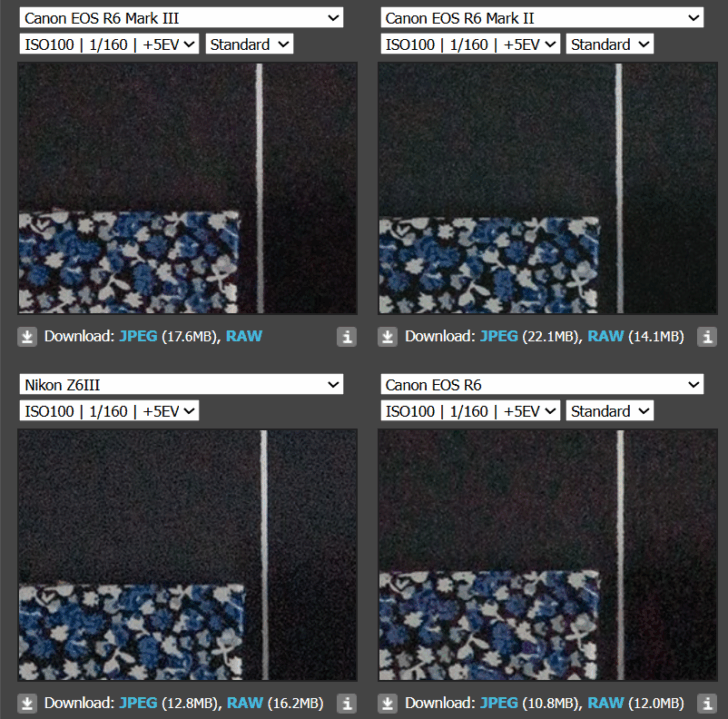
If we look at a more dramatic push, oddly enough we see that the Z6 III and the original R6 fall off the cliff in terms of noise in the shadows, while the EOS R6 Mark III is just slightly more noise than the EOS R6 Mark II. There's a difference, but it's pretty slight.

Now, where the Nikon Z6 III cleans the EOS R6 Mark III's clock is when you switch the EOS R6 Mark III to electronic shutter and compare the results. Here we can see the effect of the R6 lineup using 12-bit, with the Z6 III a good 1 EV better in the shadows on a hard push of +6EV.
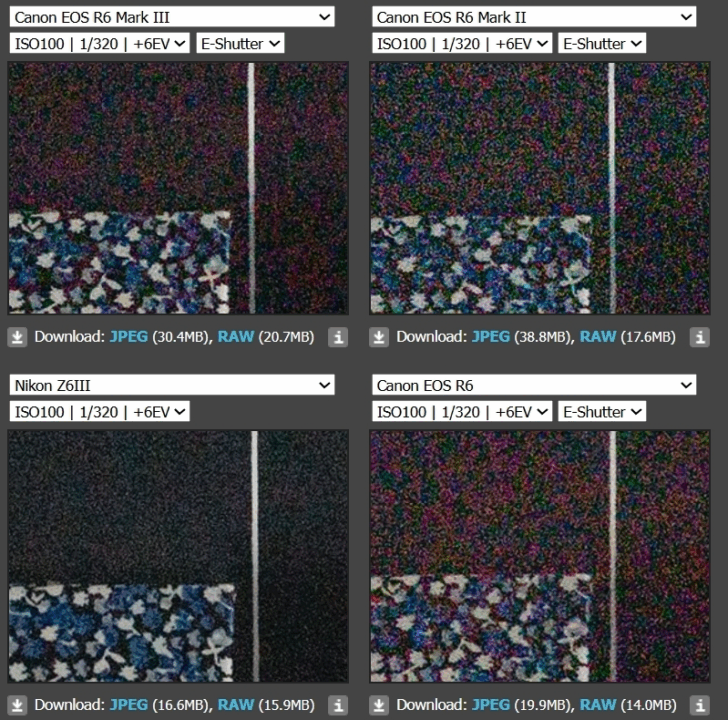
How much does the electronic shutter hamper the overall camera's dynamic range and latitude? It's evident at the extremes as if we compare this at a +6 stop push in the shadows.
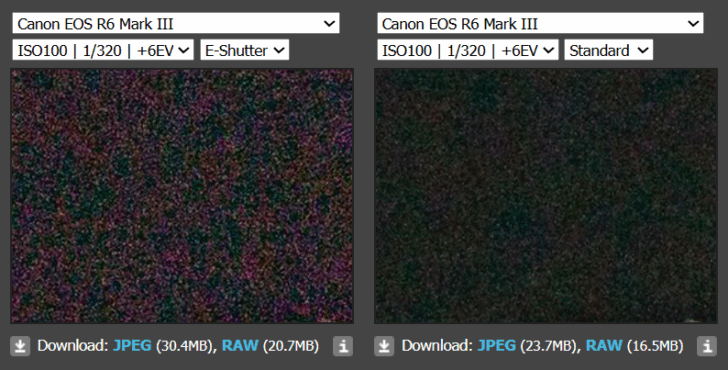
If we compare +5 EV electronic to +6 mechanical, we still see a difference favoring the mechanical shutter.
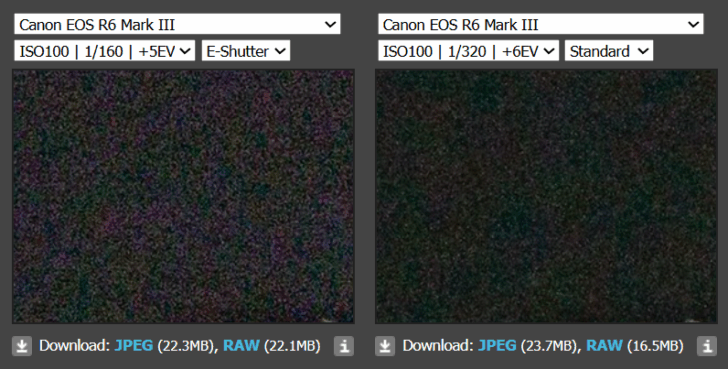
It isn't until we compare +4 to +6 that we see the electronic shutter with better noise response in the shadows. I would judge this as being somewhere around 1.6 to 1.8 EV difference between the mechanical and electronic shutter latitude. This stands to reason since you are losing 2 bits of data, which would be the equivalent pre-tone mapping of around 2EV of data.
To judge the EOS R6 Mark III's electronic shutter difference, I think the delta that was shown with the EOS R6 Mark II would be fairly accurate. There's going to be some difference because of architecture or pixel density, but it should give us a good estimate of its performance. Here's what the EOS R6 Mark II looks like, thanks to PhotonToPhotos.
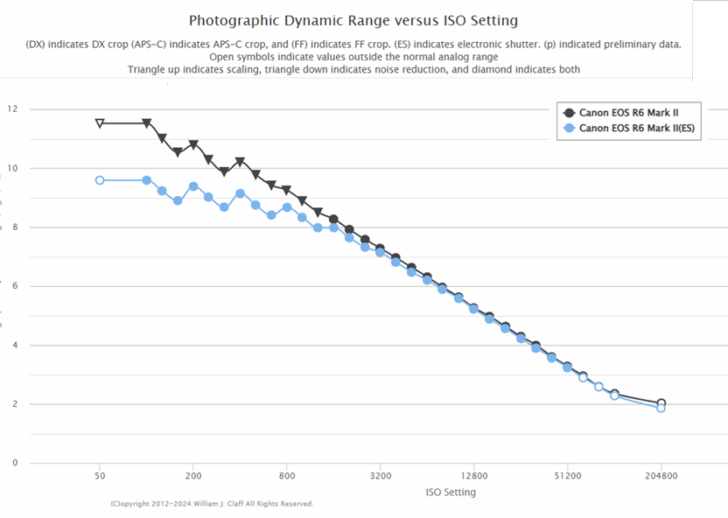
So in short. The Internet forums will now be filled with “I cannot shoot without an electronic shutter, and I need maximum dynamic range. My photography extreme skills require this. This camera is dead to me” because that's the way the internet rolls. I kid, I know there are certain use cases where an electronic shutter and high dynamic range are indeed useful, so don't go that crazy on me in the forums ;)
High ISO Noise
High ISO noise is much trickier to see the difference unless you start to hit the end of the ISO ranges of these cameras; they are all just that good. There's maybe a bit more noise at ISO 12,8000 than the others, but it's close enough that it would be difficult to see the difference in practical terms because you have more pixels able to reduce noise better.
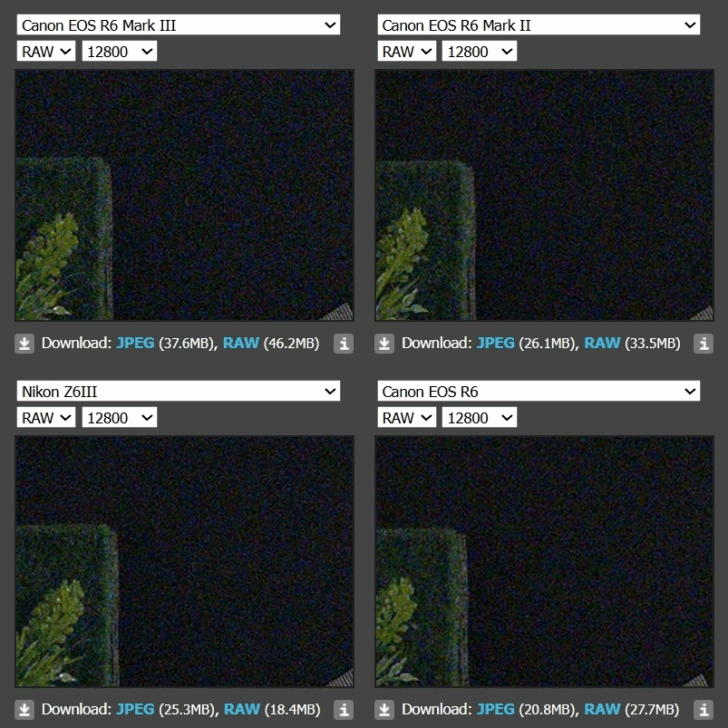
At around ISO 51,200, the other cameras do pull away from the EOS R6 Mark III, but it's less than one full stop difference in high ISO noise.

There's really not much to separate the cameras here.
Closing Thoughts
The EOS R6 Mark III delivers excellent results, but the decrease in rolling shutter by increasing the readout speed does come with a slight amount of cost.
Canon increased the pixel count significantly from the other cameras that we are comparing against. When you consider this, they increased the resolution and still made a sensor that was quicker to read out than the EOS R6 and EOS R6 Mark II. All things being equal, the sensor has to read 4640 lines instead of 4000, and it's still quicker. Canon even managed to get a readout speed faster than the Nikon Z6 III's partially stacked sensor. It's even worse if you consider that Canon is DPAF, so in theory, if you are comparing it against the Z6 III, Canon is reading 4640 lines of 13920 columns, instead of the Z6 III's 4000 lines and 6000 columns.
ISO ranges, such as what we've talked about, are also dependent on the sensor temperature at the time of shooting and the overall camera temperature. This is directly influenced by how long you've been using it, since the sensor runs all the time in a mirrorless camera. So if Canon has improved the cooling of the camera between successive models, it could be that after prolonged use, the EOS R6 Mark III may actually deliver superior results to its EOS R6 and EOS R6 Mark II predecessors.
However, in practical terms, unless you continually photograph in the upper boundaries of the ISO range or sensor dynamic range, the differences are not vast, and in practical terms and you most likely will not notice it.
MSRP: $2799 • €2899 • £2799
32.5MP Full-Frame CMOS Sensor
7K 60p 12-Bit Internal RAW Light Video
Open Gate 7K 30p, High-Speed 4K 120p
Dual Pixel CMOS AF II & Movie Servo AF
Up to 40 fps & Pre-Continuous Shoot Mode





What do you think about the performance with mech shutter compared to electronic? (I don't need 40 fps most of the time)
but if you are thinking mech vs electronic? It's going to be around 1EV and probably close to 1.5EV difference depending on how extreme you are pushing. do you need the 11.2EV or whatever it turns out or are you perfectly happy with 10?
Everyone there is different. I mean, I had someone argue with me that they needed more than 11EV in a damned studio shooting still life.
I'm going to add in a comparison between the shutters.
yes. actually i just added it in there. It's closer to 1.5-1.8 EV. The difference of 2 bits is 2EV difference assuming 100% efficiency and 0 noise. So in this case, around 1.8 I think. very similar to the R6 Mark II with and without ES.
Having the R6m2 and being pretty pleased with it it was mainly about the higher MP count vs. high ISO performance.
And better AF as well.
I shoot a lot of wildlife action, dragonflies in flight, etc. so high ISO (>3200-6400) and good s/n there is what I'm looking for.
Does anyone know the R6iii's sensor readout speed yet? Ah...I see them measured on the main DPreview R6iii review page specs:
R6iii ~13.5ms vs R6ii ~14.7
About 1ms faster than the R6ii
it's faster with 17% more lines to read. Canon did a bang up job.. AND it is still FSI. bonkers.
Overall, the increase in pixel density and faster readout (slightly) are a good tradeoff.
I wrote a comment here about 4 years ago about how sensor readout speeds will be the big new feature over the next decade. Everyone laughed at me and mocked me....but here we are. The megapixel war is well and truely over....the sensor read out speed war is in full flight. The difference in real world shooting between 24mp through to 45mp on Canon is suprisingly slight. But, being able to shoot at 30/40 fps in 14 bit Electronic shutter mode without readout artifacts can make or break a picture.
With the R7 and R5, the max of 20 fps ES compared to 15/12fps FCS isn't enough to justify the risks of high ES frame rates. The drop in DR and the artifacts aren't worth the bother...especially with the R7's REALLY slow read out speed. The R6ii 's EC can function at 40fps and that's a whole different ball game. The diffrence between 12fps and 40fps is massive.
I'm wondering if in the future (R6iv?) we'll see a ES mode with 14 bit, but isn't stacked but limited to say 20 or 30 fps.
The R5ii's stacked sensor is amazing with it's read out speed in the same region as the R6ii/iii's 1st Curtain shutter. It's just seems to loose some of it's resolution advantage and some DR over the original R5. Once all the tests are availablem it's possible we could be seeing that the new 32mp R6iii sensor actually matching the current R5ii's resolution. The R5ii's sensor is resolving notibly less detail that the original R5.
That stated, I think that the first comparison must always be pixel to pixel -- not downsized. If I buy a matrix of pixels then I want to use all of those pixels -- downsizing is a silly comparison. If I downsize of my R6 20mp images to 10mp they're amazing even at 52k ISO -- but why would I do that? I wouldn't. Crop, yes, but downsize for quality? Nope. I use all of those pixels to the best that I can and each pixel must stand on its own.
Unless your display device magically got bigger, than you will do that at least some of the time.
Sure, downsizing happens all the time in the real world. But I’d be surprised if it’s more often for quality purposes — I suspect other concerns are more typically being addressed, such as saving on storage for the purpose of speed (network, printer processing relative to maximum effective resolution) or cost (less disk on a server).
For example, the maximum pixel peeping resolution in pixel terms for a Canon Pixma Pro 200 is 600ppi. Sending 1,200ppi won’t make the output sharper / cleaner — it just takes more time.
All things being equal. A smaller PNG is cheaper to store in the cloud than a larger PNG.
But , can it improve perceived quality in terms of noise due to the average that occurs on downsizing? Yeah. Is it wrong for this purpose? No. Is it useful for comparing sensors? Only if the target output is the same and in reach of both. Otherwise, it just hides pragmatic performance.
I think it's the reverse, actually, unless you are printing 100" wide prints and want people to camp out 6" away from the print and compare side to side, it's a little irrelevant. There's a diminishing return to more mega pickles.
You aren't paying x dollars per megapixel, you're paying for the camera on the whole.
In this case, objectively, just downsizing is the worst-case scenario, as I mentioned in the article.