

When you purchase through links on our site, we may earn an affiliate commission. Here's how it works. |
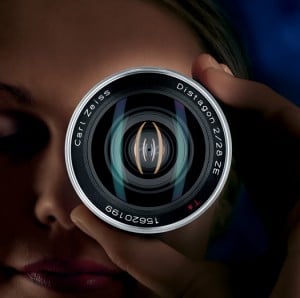
OBERKOCHEN/Germany, 12.10.2009. : The breaking dawn is a special time for photo- graphers. When the early-morning sun reluctantly chases away the still-glistening dew on the trees, this delicate transition between night and day creates moments of calm and anticipation. But without a tripod at hand, these shots will only succeed with a lens that can handle intense light.
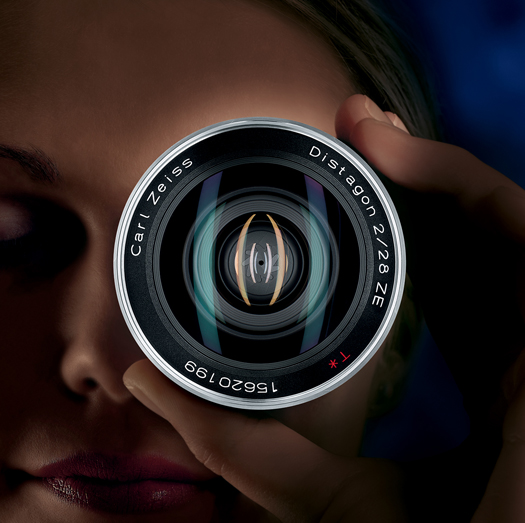
Carl Zeiss today introduces the wide-angle lens Distagon T* 2/28 ZE with EF bayonet, suitable for all analog and digital EOS camera models. With an initial aperture opening of 1:2, it is among the most light-intense of its kind in its focal length. From landscape photography at dawn to interior shots with weak lighting and close-up portraits, the Distagon T* 2/28 ZE offers photographers plenty of room for creativity when a tripod is not used. Following the recent introduction of its two ultra-wide-angle lenses, the Distagon T* 3,5/18 ZE and the T* 2,8/21, the new Distagon T* 2/28 ZE is Carl Zeiss’ first moderate wide-angle lens with EF bayonet.
Despite its high light intensity and complex retro-focus construction, the Distagon T* 2/28 ZE has a compact build. These characteristics make the lens a highly versatile and performance-driven tool for all types of photographers. Even with its wide angle, the lens enables photographers to play fully with an image’s depth of focus. With a wide aperture opening, for example, one can effectively separate the motif from its background. With a small aperture opening, photographers can use the sharpness of the lens system for the entire image range. The floating elements design guarantees high imaging performance each time, from close-ups to infinity, enabling the photo- grapher to make razor-sharp close-up images of even the tiniest objects. Thanks to the Carl Zeiss T* anti-reflective coating and meticulously crafted lenses, the new Distagon T* 2/28 ZE deals effortlessly with reflections and stray light. Brilliant pictures work every time, even under tough lighting conditions such as a breaking dawn.
The Distagon T* 2/28 ZE will be available starting autumn for a suggested retail price of EUR 965.55 (excluding VAT)*.
Technical specifications:
| Focal length: | 28 mm |
| Aperture range: | f/2 – f/22 |
| No. of elements/groups: | 10/8 |
| Focusing range: | 0.24 m – infinity |
| Angular field** (diag./horiz./vert.): | 74/64/45° |
| Coverage at close range: | 18 x 12 cm (close-up) |
| Image ratio at close range: | 1:4.7 (close-up) |
| Filter thread: | M 58 x 0.75 |
| Dimensions (with caps): | ø 72.4 mm, length 96 mm |
| Weight: | 580 g |
| Mounts: | ZF (F bayonet) ZK (K bayonet) ZE (EF bayonet) |
| Accessories: | Lens hood included |



Great! And I’ll add this lens to the other Zeiss ZE lenses that I desperately want, but I’ll probably never see because they’ll never actually see the light of day. Ughhhh!
The Zeiss description of the lens clearly states that it will see “the light of day” ;)
only f/2?
Do you know if this lens have autofocus on Canon cameras?
None of the others do, I don’t know why they would bother now…
I wonder how this lens compares for edge-to-edge sharpness and CA to Canon’s EF 28mm f/1.8 USM, which is a real horror for edge softness and color fringing even on APS-C. (I used to own one, so I speak from experience.)
this is exactly why i asked if this Carl Zeiss 28 f2 autofocuses because i am looking for an alternative to Canon 28 1.8. The Canon 24 1.4 is too expensive for me.
Does any of you know a real alternative to Canon 28 1.8?
Check out the Sigma 30mm f/1.4
I’m extremely happy with mine.
It depends on your exact criteria. For my purposes, the Canon EF 35mm f/2 is mostly a good alternative to the 28mm f/1.8, and it’s less expensive, too (partly because it lacks USM). If you really need 28mm or wider, and you need it to be faster than f/2.8, then no, I don’t know of a good alternative that’s cheaper than the 24mm f/1.4.
Some people like the Sigma 30mm f/1.4, but I keep hearing from different people that it has problems with back-focusing. I don’t know if that’s so severe that Canon’s auto-focus micro-calibration feature wouldn’t be able to deal with it.
I would not buy the Sigma. Currently I own a 50D and in an year or so I’ll upgrade to full frame. So, I would have to sell the sigma.
Another drawback would be the focusing speed… does the Sigma 30 f1.4 keep up with Canon 28 1.8 in terms of focusing speed?
I would not buy the Canon 28 1.8 because of the issues such as sharpness, flaring and chromatic aberration. Is the Sigma 30 f1.4 better at those points?
I do weddings so I need fast focusing lenses. Currently I own a Canon 17-55 2.8 IS and a 85 1.8. I tried the Canon 50 1.4 and I was not happy with it’s focusing speed – actually it does not have a true HSM
Yeah, I totally forgot about the EF-S drawback when I recommended the Sigma.
AF is fast and quiet, never experienced any backfocusing troubles.
Why would anybody use this lens instead of the Canon EF 24mm f/1.4 L USM II?
because it is much cheaper
“because it is much cheaper”
Also slower and lacks AF. When you decide to buy this lens you are basically buying a name, not a product.
Hmmm, according to todays exchange rate, 965.55 Euros is 1,426.64 Dollars. That’s not a whole lot less than the Canon 24mm f/1.4 L II. Definitely not enough to be considered “a whole lot cheaper” I can’t find a US$ price for the new Zeiss, but I’d imagine it’ll be in line with the Canon 24mm f/1.4 L II.
The Canon comes with AF and an extra stop.
Then again, maybe the Zeiss will be a better lens? Reviews of the Zeiss 85mm f/1.4 place it behind the Canon 85mm f/1.2 L II. Should we expect more from this lens?
For those who are looking for a “cheaper” option, Sigma 30mm f/1.4 is probably the best bet, especially since Sigma seems to have improved some of the issues that were present in the earlier production versions of this lens.
I doubt that the marginally lower price of the new Zeiss is sufficient to make it a better choice than the 24L II or the 35L unless one needs exactly 28mm focal length…
Though this Carl Zeiss lens is MF,I dont’t know why it is expensive.
Because it’s called “Carl Zeiss”, you are paying extra for the name just like with most other “luxury” items. Brand is the king.
Hahhh! Okay, you got me there. However, it also says that it “…will be available starting autumn…” …okay, but it doesn’t make any reference to autumn of which YEAR! Hahhh! See, that’s where they get us. ;~)
The Canon’s extra stop adds distortion & weight and costs edge performance.
And AF is a drawback because the focusing ring is never as nice to use as with a true manual focusing lens.
Because people with proper eyesight prefer MF to nonsensical technology like the hit-and-miss open loop AF as implemented by Canon.
Yeah I hear ya. This one might be a good rent before you buy lens.
Many people have alos become fans of Paul Smith Shoes since they came into the market. I also one of them , I very like Paul Smith Wallets and <a Paul Smith Belts,It designs very good.